
Robot Vacuums Reviews & Buying Guide
Robot vacuums can help keep floors cleaner with less daily effort, especially in homes with pets, carpet, hardwood floors, apartments, large rooms, multiple floors, busy families, and smart home routines. This hub organizes every robot vacuum guide in one place so you can compare the best robot vacuums for pet hair, carpet, hardwood floors, apartments, large homes, budgets, self-emptying docks, multi-floor mapping, regular vacuums, buying advice, and maintenance tips.
What Are Robot Vacuums?
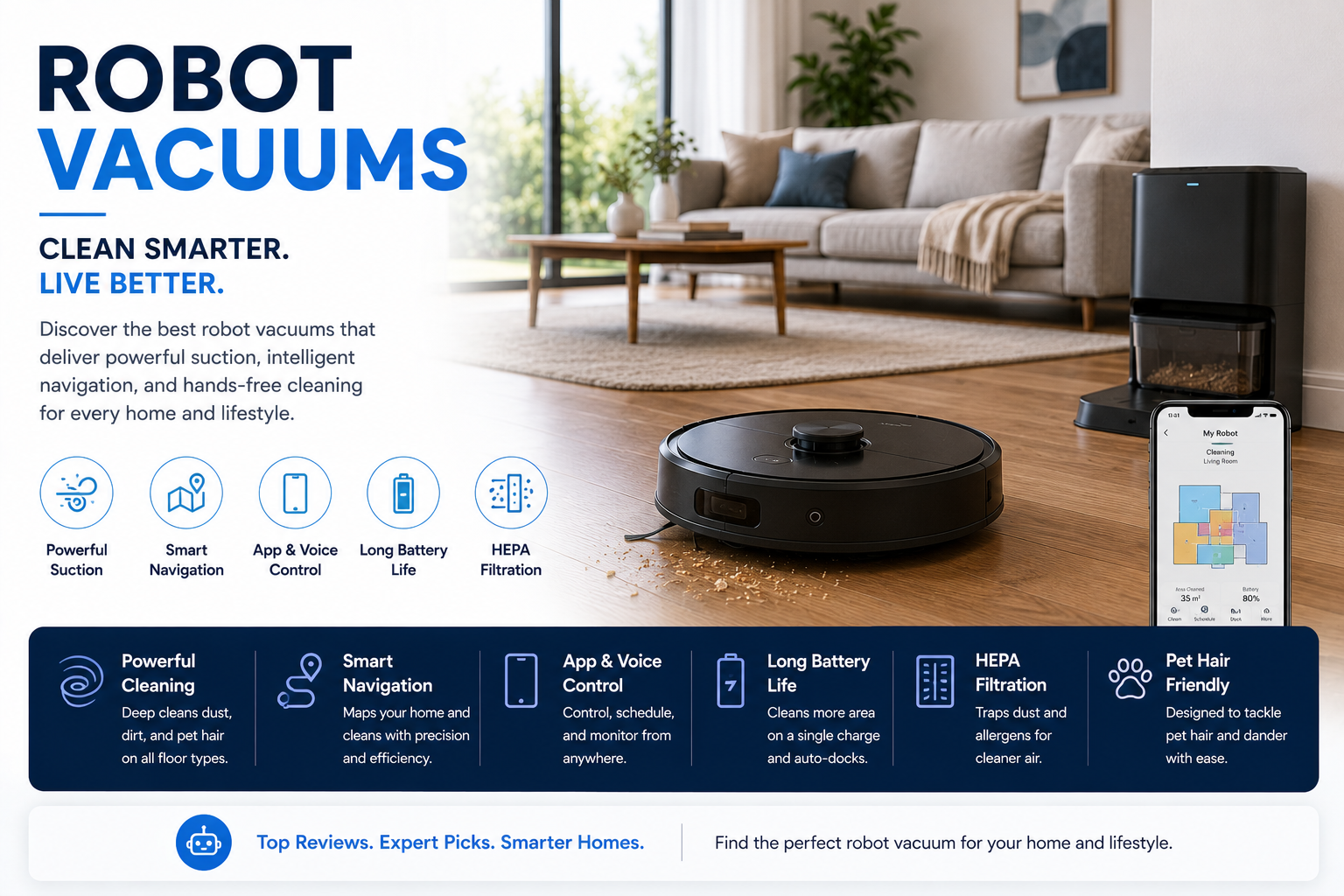
Robot vacuums are automatic floor-cleaning robots designed to vacuum dust, crumbs, pet hair, dirt, debris, and everyday messes with less manual cleaning. Modern robot vacuums may include smart mapping, app control, obstacle avoidance, carpet detection, hardwood floor cleaning, self-emptying docks, multi-floor maps, scheduling, voice assistant control, edge cleaning, and automatic charging.
The robot vacuum category is no longer one simple product type. Some models are built for pet hair and strong suction. Others focus on carpet deep cleaning, hardwood floor protection, apartment-friendly size, large-home mapping, self-emptying convenience, budget value, or multi-floor navigation. Some robot vacuums also include mopping, but this hub focuses mainly on vacuum-first models and floor debris pickup.
The best robot vacuum depends on your home. A pet owner needs strong suction and anti-tangle brushes. A carpet-heavy home needs better agitation and carpet boost. A hardwood floor home needs gentle movement and good edge cleaning. A large home needs mapping and battery life. An apartment may need quiet operation and compact docking. A busy family may benefit most from self-emptying convenience.
Important: Robot vacuums reduce routine cleaning, but they do not fully replace deep cleaning, stairs, upholstery cleaning, baseboard dusting, manual vacuuming, or occasional maintenance.
Best Robot Vacuum Guides
Best Robot Vacuums for Pet Hair
For homes with dogs, cats, shedding, fur, dander, litter tracking, and hair around furniture, start with pet-focused robot vacuums.
Best Robot Vacuums for Carpet
Carpet homes need stronger suction, brush agitation, carpet boost, good navigation, and enough power to lift embedded debris.
Best Self-Emptying Robot Vacuums
Self-emptying robot vacuums are best for busy homes that want less bin emptying and more hands-off cleaning.
Best Robot Vacuums for Apartments
Apartment robot vacuums should be compact, quiet, easy to store, simple to schedule, and good around tight spaces.
Best Budget Robot Vacuums
Budget robot vacuums can still handle everyday crumbs, dust, hard floors, low-pile carpet, and small homes when chosen carefully.
Robot Vacuum Buying Guide
Use the buying guide to compare suction, mapping, brushes, battery life, docks, obstacle avoidance, app features, and floor types.
Robot Vacuum Types Compared
| Robot Vacuum Type | Best For | Main Benefit | Possible Limitation |
|---|---|---|---|
| Pet Hair Robot Vacuum | Dogs, cats, shedding, litter, dander | Stronger pickup and better hair handling | Brushes and filters need more maintenance |
| Carpet Robot Vacuum | Low and medium-pile carpet | Better suction, brush agitation, and carpet boost | May use more battery on carpet |
| Hardwood Floor Robot Vacuum | Wood, laminate, tile, vinyl, hard floors | Gentle cleaning and strong dust pickup | May need careful wheel and brush maintenance |
| Self-Emptying Robot Vacuum | Busy homes, pets, large homes, allergy-sensitive users | Less manual bin emptying | Docks are larger and bags may cost extra |
| Apartment Robot Vacuum | Small spaces, renters, condos, tight layouts | Compact, convenient, and easier to store | May have smaller dustbin or battery |
| Large Home Robot Vacuum | Big floor plans and multiple rooms | Better mapping, battery life, and room control | Usually costs more |
| Budget Robot Vacuum | Starter buyers and simple floor plans | Lower cost and basic cleaning support | May lack advanced mapping or obstacle avoidance |
| Multi-Floor Robot Vacuum | Homes with upstairs and downstairs cleaning | Stores multiple maps and room layouts | Robot still must be moved between floors manually |
Robot Vacuum Supporting Articles
How to Choose the Right Robot Vacuum
Start With Your Floor Type
Floor type is the first decision. Carpet needs stronger suction and brush agitation. Hardwood floors need gentle movement, strong dust pickup, and good edge cleaning. Mixed floors need automatic floor detection and enough power to transition between surfaces.
Think About Pets
Pet homes need more than basic suction. Look for anti-tangle brush rolls, strong airflow, good filters, larger bins, self-emptying docks, edge cleaning, and easy brush maintenance. Pet hair can quickly overwhelm cheaper models if the robot is not designed for it.
Decide If Self-Emptying Is Worth It
Self-emptying robot vacuums are more expensive, but they reduce daily maintenance. They are especially useful for pet owners, large homes, allergy-sensitive users, and busy families who do not want to empty the dustbin after every run.
Check Mapping and Navigation
Smart mapping helps the robot clean rooms more efficiently, avoid repeating areas, remember layouts, support no-go zones, and clean specific rooms. Basic random-navigation models can still work in small spaces, but mapping is much better for larger homes.
Compare Battery Life
Small apartments may not need long battery life. Large homes need longer runtime, recharge-and-resume, room-by-room cleaning, and efficient navigation. Carpet cleaning can drain batteries faster than hard floors.
Look at Obstacle Avoidance
Homes with toys, cords, shoes, pet bowls, socks, furniture legs, and clutter benefit from better obstacle avoidance. This helps prevent stuck robots and interrupted cleaning sessions.
Review App and Voice Control
A good app lets you schedule cleaning, choose rooms, set no-go zones, adjust suction, check maps, receive alerts, and manage maintenance. Smart speaker compatibility can also make daily use easier.
Understand Maintenance
Every robot vacuum needs maintenance. Brushes collect hair, filters clog, sensors get dusty, wheels pick up debris, and dustbins need emptying. The best robot vacuum is one you can maintain easily.
Best Robot Vacuum by Use Case
For Pet Hair
Choose a robot vacuum with strong suction, anti-tangle brushes, good filtration, strong edge cleaning, and preferably a self-emptying dock if you have heavy shedding.
For Carpet
Choose a model with carpet boost, strong brush agitation, good suction, and enough battery power to handle thicker flooring.
For Hardwood Floors
Choose a robot vacuum with gentle wheels, soft brush design, strong dust pickup, edge cleaning, and good navigation to avoid bumping furniture too hard.
For Apartments
Choose a compact, quiet robot vacuum with simple scheduling, good navigation in tight spaces, and a dock that does not take up too much room.
For Large Homes
Choose a robot vacuum with smart mapping, long battery life, recharge-and-resume, room selection, no-go zones, and preferably self-emptying.
For Multiple Floors
Choose a robot vacuum with multi-floor mapping. Remember that most robot vacuums still cannot climb stairs, so you will need to carry the robot between levels.
For Budget Buyers
Choose a basic robot vacuum if you have simple floors, small rooms, low-pile carpet, and realistic expectations. Budget models are best for maintenance cleaning, not deep cleaning.
Robot Vacuum vs Regular Vacuum
A robot vacuum is better for daily maintenance cleaning. It can run on a schedule, clean while you are away, pick up crumbs, reduce pet hair buildup, and keep floors looking cleaner between deeper cleanings.
A regular vacuum is better for deep cleaning, stairs, upholstery, tight corners, thick carpets, cars, furniture, and heavy messes. Traditional vacuums usually have stronger suction and more control.
For most homes, the best setup is both. Use a robot vacuum for daily maintenance and a regular vacuum for deeper weekly or occasional cleaning.
Common Robot Vacuum Buying Mistakes
- Buying only by suction number: Navigation, brush design, filtration, and maintenance matter too.
- Ignoring floor type: Carpet, hardwood, tile, and rugs need different strengths.
- Buying too cheap for pet hair: Heavy shedding can overwhelm basic models.
- Skipping self-emptying when needed: Pet owners and large homes may benefit from it more than expected.
- Ignoring maintenance: Brushes, filters, sensors, wheels, and bins still need regular care.
- Expecting it to replace deep cleaning: Robot vacuums are great for maintenance, not every cleaning job.
- Forgetting obstacle avoidance: Cluttered homes need better navigation and object detection.
- Ignoring app quality: The app controls schedules, maps, rooms, zones, suction, and maintenance alerts.
- Not checking dock size: Self-emptying docks can be large and need space.
- Expecting stairs to be cleaned: Robot vacuums cannot vacuum stairs like a handheld or upright vacuum.
Robot Vacuum Maintenance Basics
Robot vacuums work best when they are maintained regularly. Empty the dustbin or replace dock bags as needed, clean the filter, remove hair from brushes, wipe sensors, check wheels, clean charging contacts, and keep the dock area clear.
Pet homes usually need more frequent maintenance because hair and dander build up faster. Homes with carpet may also need more brush cleaning than hard-floor homes.
Good maintenance helps improve suction, navigation, battery life, docking reliability, edge cleaning, and overall cleaning performance.
Are Robot Vacuums Worth It?
Robot vacuums are worth it for many homes because they reduce daily floor cleaning, help control pet hair, pick up crumbs, support smart schedules, and keep floors cleaner between manual vacuuming sessions.
They may not be worth it if your home has many stairs, heavy clutter, thick carpet, lots of cords, or if you expect a robot to fully replace deep cleaning.
The best value comes from using a robot vacuum for maintenance cleaning and a regular vacuum for deeper cleaning. When expectations are realistic, robot vacuums can be one of the most useful home robots.
Future of Robot Vacuums
Robot vacuums are likely to keep improving with better AI obstacle avoidance, stronger suction, quieter motors, better battery life, smarter mapping, better pet waste avoidance, automatic maintenance docks, improved filtration, and smarter integration with robot mops and smart home systems.
Future robot vacuums may become more self-managing, with docks that empty debris, wash components, dry parts, refill water for mop combos, update maps, detect room conditions, and schedule cleaning based on real household activity.
As home robotics grows, robot vacuums will remain one of the most practical entry points into automated home cleaning.
Related Cleaning Robot Guides
Robot Vacuums FAQ
What is the best robot vacuum?
The best robot vacuum depends on your home. Pet owners need strong hair pickup. Carpet homes need suction and brush agitation. Large homes need smart mapping and battery life. Budget buyers need reliable basic cleaning.
Are robot vacuums worth it?
Yes, robot vacuums can be worth it for daily maintenance cleaning, pet hair control, crumbs, dust, and keeping floors cleaner between manual vacuuming.
Can a robot vacuum replace a regular vacuum?
Usually no. Robot vacuums are great for maintenance, but regular vacuums are still better for deep cleaning, stairs, upholstery, and heavy messes.
Are robot vacuums good for pet hair?
Yes, the right models can be excellent for pet hair. Look for strong suction, anti-tangle brushes, good filtration, and self-emptying if shedding is heavy.
Are robot vacuums good for carpet?
Some are good for carpet, especially models with carpet boost, strong suction, and brush agitation. Thick carpets may still need regular vacuuming.
Are robot vacuums good for hardwood floors?
Yes, many robot vacuums work very well on hardwood floors, tile, laminate, vinyl, and other hard surfaces.
Are self-emptying robot vacuums worth it?
They can be worth it for pet owners, large homes, busy families, and people who want less daily dustbin emptying.
Do robot vacuums work in apartments?
Yes, compact robot vacuums can work very well in apartments, condos, and small homes.
Do robot vacuums work in large homes?
Yes, but large homes should prioritize smart mapping, long battery life, recharge-and-resume, room selection, and self-emptying docks.
Can robot vacuums clean multiple floors?
Some can save multiple maps, but most still need to be carried between floors manually.
Do robot vacuums avoid stairs?
Most robot vacuums include cliff sensors to avoid stairs, but sensors should be kept clean and tested carefully.
Do robot vacuums need Wi-Fi?
Basic cleaning may work without Wi-Fi on some models, but app control, mapping, schedules, updates, and voice assistant features usually need Wi-Fi.
How often should I run a robot vacuum?
Many homes run robot vacuums daily or several times per week. Pet homes may benefit from daily cleaning.
How often should I clean robot vacuum brushes?
Check brushes weekly, or more often if you have pets or long hair in the home.
How often should I replace robot vacuum filters?
Filter timing depends on the model and use. Check the manufacturer’s recommendation and replace when airflow or cleaning performance drops.
Do robot vacuums get stuck?
They can get stuck on cords, socks, toys, rugs, pet bowls, thresholds, or clutter. Better obstacle avoidance helps.
Are budget robot vacuums good?
Budget robot vacuums can be good for simple homes, hard floors, apartments, and light cleaning, but they may lack advanced mapping and obstacle avoidance.
What features matter most?
Floor type support, suction, brush design, mapping, battery life, self-emptying, obstacle avoidance, app quality, filtration, and maintenance access matter most.
What is the biggest robot vacuum buying mistake?
Buying a model that does not match your floor type, pet situation, home size, or maintenance expectations.
Should I buy a robot vacuum or robot mop?
Buy a robot vacuum if debris, dust, crumbs, and pet hair are the main problem. Buy a robot mop if hard-floor mopping is the priority. Some homes benefit from both.
Explore Robot Vacuums
Robot vacuums can help with pet hair, carpet cleaning, hardwood floors, apartments, large homes, budget cleaning, self-emptying convenience, multi-floor mapping, daily maintenance, and smart home routines. Compare robot vacuums by floor type, home size, pets, budget, mapping, dock features, app control, and maintenance needs before choosing the best option for your home.
Shop Robot Vacuums