
Best Self-Emptying Robot Vacuums
Compare the best self-emptying robot vacuums and learn whether automatic dustbin systems are worth the investment for busy households. This guide compares the main product types, performance factors, limitations, maintenance needs, and buying considerations.
As an Amazon Associate, HomeBotGuide may earn from qualifying purchases at no extra cost to you.
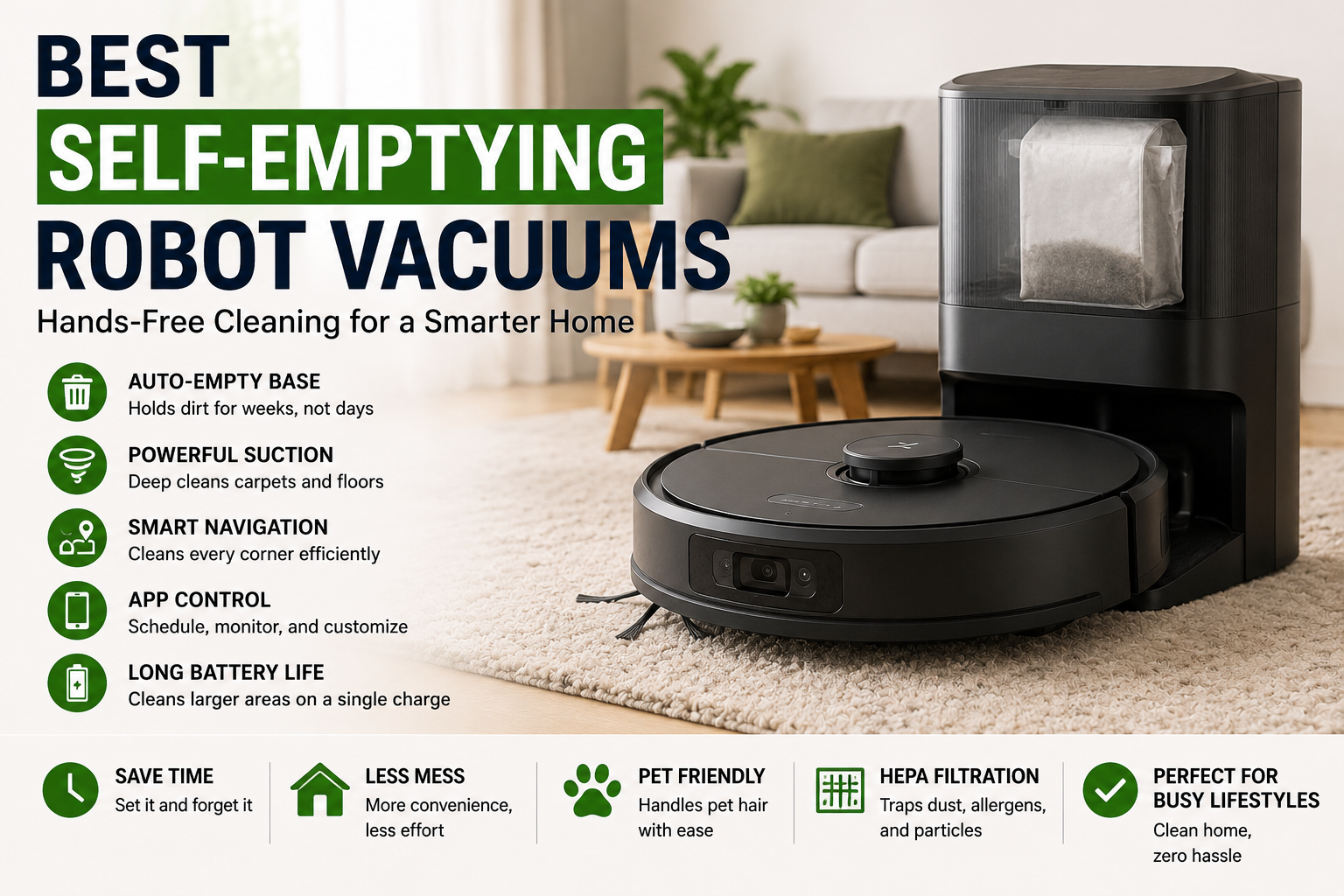
The best self-emptying robot vacuum combines reliable mapping, strong pickup, a sealed dock, affordable replacement bags or a washable bin, and a clear airflow path. The dock saves the most time in pet homes, large homes, and households where the onboard bin fills before the cleaning cycle ends.
Best Self-Emptying Robot Vacuums at a Glance
Strong sealing, low dust exposure, and easy maintenance.
Combines hair control with automatic emptying.
Avoids disposable bags but needs more frequent washing.
Empties debris and manages mop washing and drying.
Best Self-Emptying Robot Vacuums Comparison Table
| Type | Best For | Core Features | Important Limitation |
|---|---|---|---|
| Bagged Dock Robot | Allergy and pet homes | Sealed bag and automatic emptying | Recurring bag cost |
| Bagless Dock Robot | Lower consumable cost | Reusable dust container | More dust exposure during emptying |
| Compact Dock Robot | Apartments | Smaller footprint | Reduced bag or bin capacity |
| High-Capacity Dock | Large homes | Long intervals between disposal | Large footprint |
| Vacuum-and-Mop Dock | Hard floors and pets | Emptying, washing, refilling, drying | Complex maintenance |
| Budget Self-Emptying Robot | Basic automation | Lower entry price | Simpler navigation and sealing |
What to Look for Before Buying
Start with the floor surfaces, room layout, debris type, maintenance tolerance, and available dock space. The best robot is the one that can complete the actual cleaning route consistently.
- Match the brush and suction system to the flooring.
- Check navigation and obstacle handling in the real layout.
- Review bin, dock, filter, and consumable requirements.
- Confirm replacement parts and battery support.
Main Types to Consider
Sealed bag and automatic emptying
Reusable dust container
Smaller footprint
Long intervals between disposal
How Self-Emptying Systems Work
After cleaning, the dock uses high airflow to pull debris from the robot's bin into a larger bag or container.
- Confirm compatibility with the actual floor plan and surfaces.
- Compare maintenance needs and consumable costs.
- Test navigation, scheduling, and dock access.
- Keep a manual vacuum available for deep cleaning.
Bagged vs Bagless Docks
Bagged systems contain dust better, while bagless systems reduce consumable cost but require more direct contact with debris.
- Confirm compatibility with the actual floor plan and surfaces.
- Compare maintenance needs and consumable costs.
- Test navigation, scheduling, and dock access.
- Keep a manual vacuum available for deep cleaning.
Dock Suction and Airflow
A strong motor is not enough if the robot's bin door, dock inlet, or bag path is poorly designed. Hair clogs are common failure points.
- Confirm compatibility with the actual floor plan and surfaces.
- Compare maintenance needs and consumable costs.
- Test navigation, scheduling, and dock access.
- Keep a manual vacuum available for deep cleaning.
Who Benefits Most
Pet owners, allergy-sensitive households, large homes, and people with limited dexterity often gain the most.
- Confirm compatibility with the actual floor plan and surfaces.
- Compare maintenance needs and consumable costs.
- Test navigation, scheduling, and dock access.
- Keep a manual vacuum available for deep cleaning.
Dock Placement
The dock needs clear approach space, reliable power, and a location where noise and dust release are manageable.
- Confirm compatibility with the actual floor plan and surfaces.
- Compare maintenance needs and consumable costs.
- Test navigation, scheduling, and dock access.
- Keep a manual vacuum available for deep cleaning.
Ongoing Cost
Include dock bags, filters, replacement seals, and occasional deep cleaning of the base.
- Confirm compatibility with the actual floor plan and surfaces.
- Compare maintenance needs and consumable costs.
- Test navigation, scheduling, and dock access.
- Keep a manual vacuum available for deep cleaning.
Noise and Emptying Frequency
Dock emptying is much louder than normal robot operation, though it usually lasts only a few seconds.
- Confirm compatibility with the actual floor plan and surfaces.
- Compare maintenance needs and consumable costs.
- Test navigation, scheduling, and dock access.
- Keep a manual vacuum available for deep cleaning.
Maintenance Routine
Inspect the dock inlet, bag chamber, robot bin flap, filter, and seals regularly to prevent hidden airflow loss.
- Confirm compatibility with the actual floor plan and surfaces.
- Compare maintenance needs and consumable costs.
- Test navigation, scheduling, and dock access.
- Keep a manual vacuum available for deep cleaning.
Robot Vacuums Still Need Oversight
Automated vacuuming reduces routine work but does not eliminate floor preparation, brush cleaning, filter replacement, dock maintenance, or periodic deep cleaning.
How We Evaluated the Options
We prioritized pickup, brush design, navigation, battery, bin capacity, dock reliability, maintenance, obstacle handling, consumable cost, replacement parts, warranty, and total ownership value.
Final Verdict
The best self-emptying robot vacuum combines reliable mapping, strong pickup, a sealed dock, affordable replacement bags or a washable bin, and a clear airflow path. The dock saves the most time in pet homes, large homes, and households where the onboard bin fills before the cleaning cycle ends.
Best Self-Emptying Robot Vacuums FAQ
Are self-emptying robot vacuums worth it?
They are especially valuable in pet homes, large homes, and households that run the robot frequently.
How often do dock bags need replacement?
It depends on debris volume, but many last several weeks.
Are bagless docks better?
They reduce bag cost but require more direct dust handling.
Do self-emptying docks clog?
They can, especially with long hair, dense pet fur, or oversized debris.
Are they good for allergies?
Bagged sealed systems can reduce dust exposure compared with manual bin emptying.
How loud are they?
The emptying cycle is usually loud but brief.
Do they work with vacuum-and-mop robots?
Yes, and some docks also wash and dry mop pads.
Can I place the dock on carpet?
Some can, but a hard, level surface usually improves stability and sealing.
What maintenance does the dock need?
Clean the inlet, filters, seals, bag chamber, and sensors.
What is the biggest downside?
Higher purchase price, dock size, and ongoing consumable costs.