
Best Robot Vacuums for Carpet
Discover the best robot vacuums for carpet. Learn which features, suction levels, and navigation systems work best for cleaning rugs and carpets effectively. This guide compares the main product types, performance factors, limitations, maintenance needs, and buying considerations.
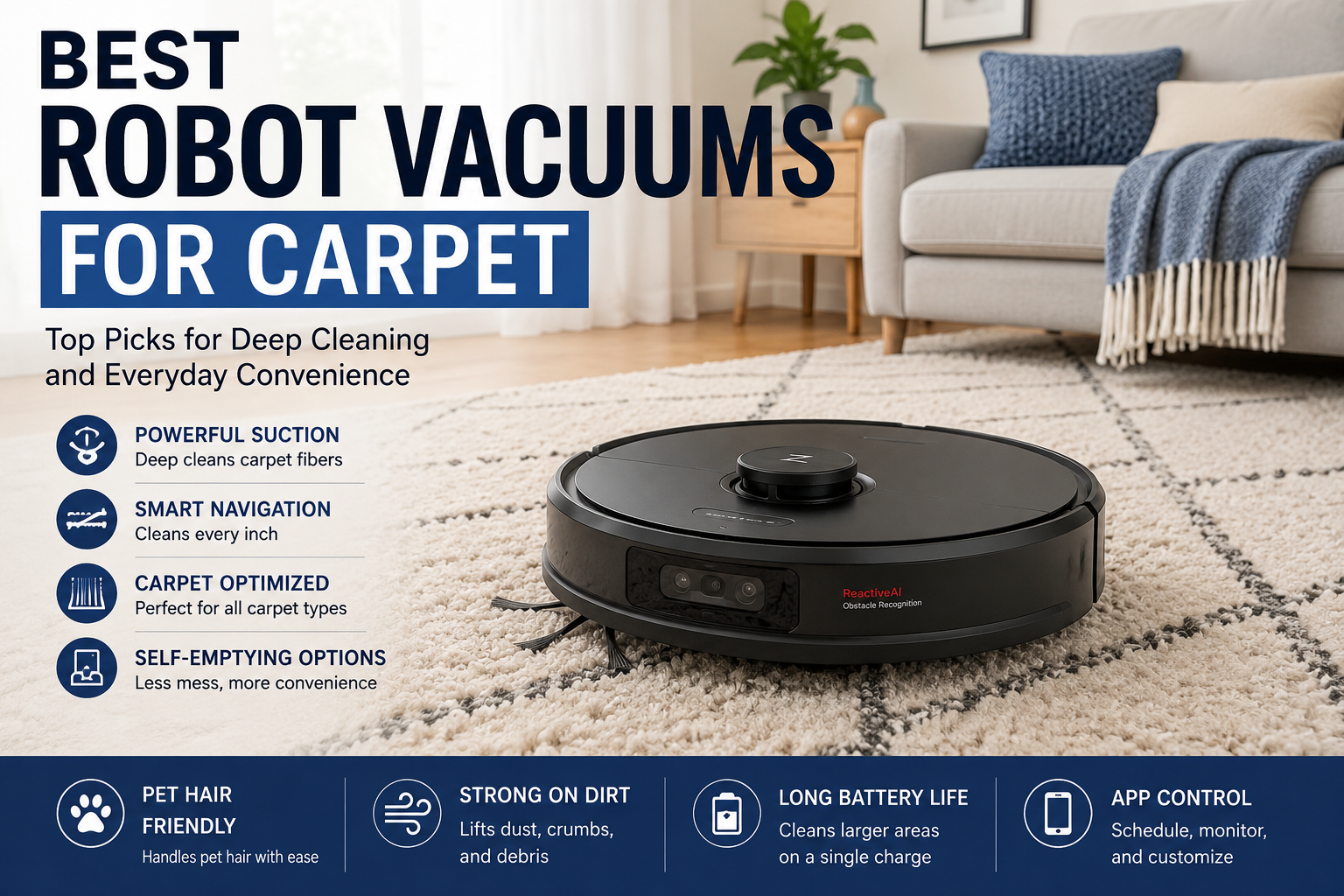
As an Amazon Associate, HomeBotGuide may earn from qualifying purchases at no extra cost to you.
The best robot vacuum for carpet combines strong airflow, effective roller agitation, automatic carpet boost, anti-tangle brush design, and accurate navigation. Low-pile carpet is easier for most robots, while medium- and high-pile carpet require better traction, stronger suction, and a brush system that can reach embedded debris.
Best Robot Vacuums for Carpet at a Glance
Strong agitation and reduced hair wrap for mixed carpet.
Handles fur while limiting brush maintenance.
Cleans multiple rooms and reduces bin handling.
Raises suction automatically when carpet is detected.
Best Robot Vacuums for Carpet Comparison Table
| Type | Best For | Core Features | Important Limitation |
|---|---|---|---|
| Dual Rubber-Roller Robot | Pet hair and mixed carpet | Strong agitation and reduced tangles | Can be louder than single-roller designs |
| Bristle-Roller Robot | Deep carpet pickup | Aggressive fiber agitation | More hair wrap |
| Self-Emptying Robot | Large carpeted homes | Automatic bin emptying and mapping | Higher ongoing cost |
| Budget Carpet Robot | Low-pile carpet | Basic suction and scheduled cleaning | Limited deep-cleaning ability |
| Mop-Lifting Combo | Mixed carpet and hard floors | Carpet detection and mop lift | Thick rugs may still need no-go zones |
| Premium AI Robot | Cluttered rooms | Object avoidance and adaptive cleaning | Higher purchase price |
What to Look for Before Buying
Start with the floor surfaces, room layout, debris type, maintenance tolerance, and available dock space. The best robot is the one that can complete the actual cleaning route consistently.
- Match the brush and suction system to the flooring.
- Check navigation and obstacle handling in the real layout.
- Review bin, dock, filter, and consumable requirements.
- Confirm replacement parts and battery support.
Main Types to Consider
Strong agitation and reduced tangles
Aggressive fiber agitation
Automatic bin emptying and mapping
Basic suction and scheduled cleaning
Why Carpet Requires More Than High Suction
Carpet traps debris below the surface, so airflow alone is not enough. The robot also needs roller agitation, good wheel traction, and enough clearance to move without bogging down.
- Confirm compatibility with the actual floor plan and surfaces.
- Compare maintenance needs and consumable costs.
- Test navigation, scheduling, and dock access.
- Keep a manual vacuum available for deep cleaning.
Low-Pile vs Medium- and High-Pile Carpet
Most robots handle low-pile carpet well. Thicker carpet can reduce movement, increase battery use, and make edge cleaning less effective.
- Confirm compatibility with the actual floor plan and surfaces.
- Compare maintenance needs and consumable costs.
- Test navigation, scheduling, and dock access.
- Keep a manual vacuum available for deep cleaning.
Brush Rollers and Hair Wrap
Rubber rollers reduce maintenance, while bristle rollers may dig more aggressively into carpet fibers. Removable end caps and easy axle access matter in pet homes.
- Confirm compatibility with the actual floor plan and surfaces.
- Compare maintenance needs and consumable costs.
- Test navigation, scheduling, and dock access.
- Keep a manual vacuum available for deep cleaning.
Automatic Carpet Boost
Carpet detection lets the robot increase suction only when needed, which helps preserve battery on hard floors.
- Confirm compatibility with the actual floor plan and surfaces.
- Compare maintenance needs and consumable costs.
- Test navigation, scheduling, and dock access.
- Keep a manual vacuum available for deep cleaning.
Navigation and Coverage
Systematic mapping prevents wasted passes and improves large-room coverage. Resume-after-charge is especially useful in carpet-heavy homes.
- Confirm compatibility with the actual floor plan and surfaces.
- Compare maintenance needs and consumable costs.
- Test navigation, scheduling, and dock access.
- Keep a manual vacuum available for deep cleaning.
Self-Emptying Docks
Carpet generates fine dust and hair that can fill small onboard bins quickly. Self-emptying docks add convenience but require bags, filters, and airflow maintenance.
- Confirm compatibility with the actual floor plan and surfaces.
- Compare maintenance needs and consumable costs.
- Test navigation, scheduling, and dock access.
- Keep a manual vacuum available for deep cleaning.
Robot Vacuum vs Upright Vacuum
A robot is ideal for frequent maintenance, while an upright remains better for deep carpet, stairs, edges, and rapid heavy cleanup.
- Confirm compatibility with the actual floor plan and surfaces.
- Compare maintenance needs and consumable costs.
- Test navigation, scheduling, and dock access.
- Keep a manual vacuum available for deep cleaning.
Carpet Maintenance Routine
Inspect rollers, wheels, filter, and bin frequently because carpet fibers and hair can reduce performance faster than on hard floors.
- Confirm compatibility with the actual floor plan and surfaces.
- Compare maintenance needs and consumable costs.
- Test navigation, scheduling, and dock access.
- Keep a manual vacuum available for deep cleaning.
Robot Vacuums Still Need Oversight
Automated vacuuming reduces routine work but does not eliminate floor preparation, brush cleaning, filter replacement, dock maintenance, or periodic deep cleaning.
How We Evaluated the Options
We prioritized pickup, brush design, navigation, battery, bin capacity, dock reliability, maintenance, obstacle handling, consumable cost, replacement parts, warranty, and total ownership value.
Final Verdict
The best robot vacuum for carpet combines strong airflow, effective roller agitation, automatic carpet boost, anti-tangle brush design, and accurate navigation. Low-pile carpet is easier for most robots, while medium- and high-pile carpet require better traction, stronger suction, and a brush system that can reach embedded debris.
Best Robot Vacuums for Carpet FAQ
Do robot vacuums work well on carpet?
Yes, especially on low- and medium-pile carpet when the robot has strong agitation and suction.
What suction level is best for carpet?
Suction ratings vary by brand, so real-world pickup and brush design matter more than one number.
Are rubber rollers better for pet hair?
They usually reduce tangles and are easier to clean than dense bristle rollers.
Can robot vacuums clean high-pile carpet?
Some can, but traction, clearance, and battery use become more challenging.
Is carpet boost worth having?
Yes, because it increases cleaning power only when the robot detects carpet.
Do self-emptying docks help with carpet?
They are useful because carpeted rooms often generate more dust and hair.
Can robot vacuums replace upright vacuums?
No. They reduce routine buildup but do not replace periodic deep cleaning.
Will a robot damage carpet fibers?
A compatible, maintained robot should not damage normal carpet, but delicate rugs may need no-go zones.
How often should I run one on carpet?
Several times per week or daily in pet homes.
What is the biggest limitation?
Deeply embedded debris and thick rugs still require stronger manual cleaning.