
Home Security Robots Reviews & Buying Guide
Home security robots help homeowners, renters, pet owners, travelers, families, and smart home users monitor their homes with mobile cameras, AI alerts, indoor patrols, outdoor security, night vision, two-way audio, remote control, motion detection, garage monitoring, large-property coverage, and smart home security support. This hub organizes every home security robot guide so you can compare indoor security robots, outdoor security robots, AI security robots, security robot vs camera setups, large-property robots, maintenance tips, and buying advice in one place.
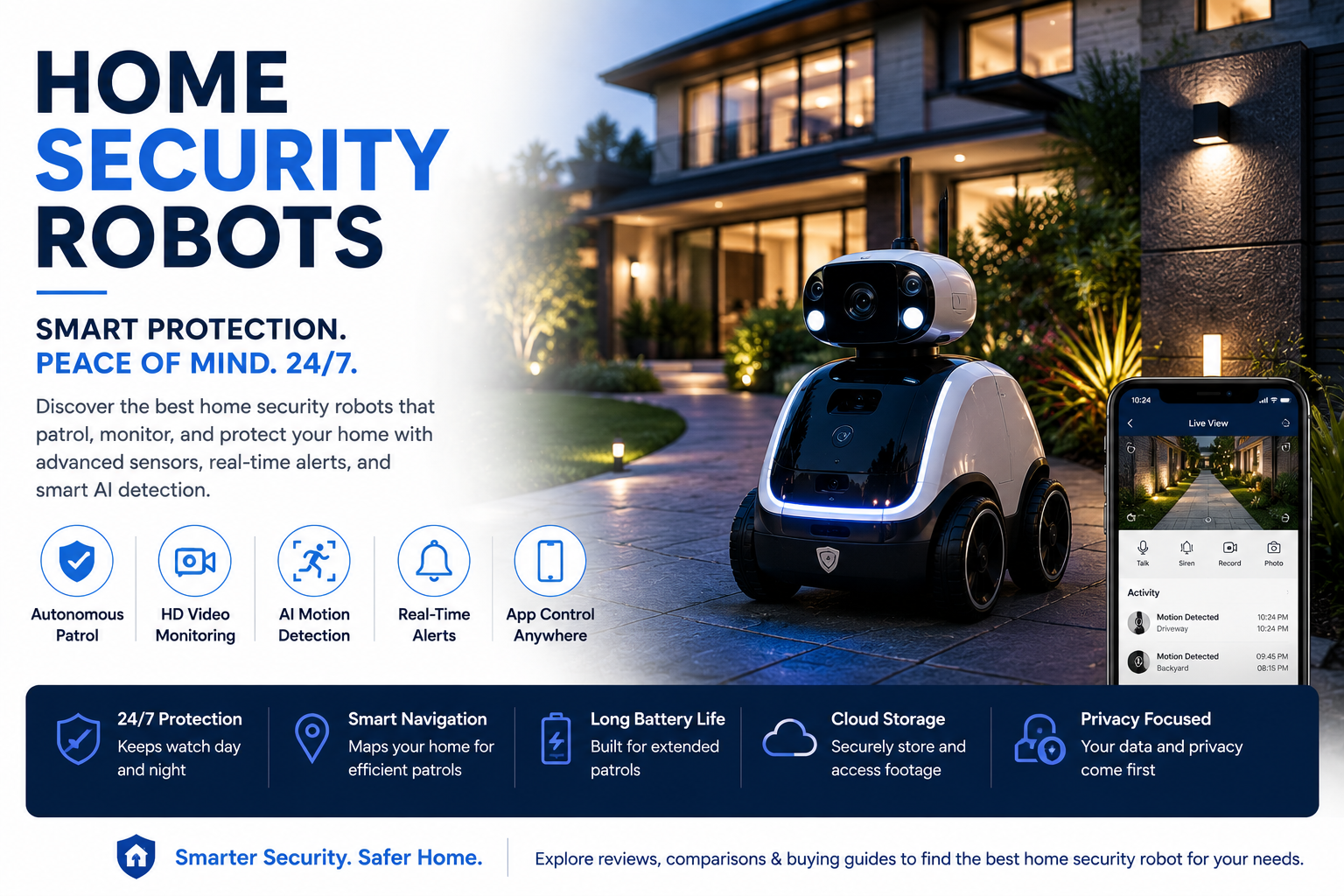
What Are Home Security Robots?
Home security robots are smart monitoring devices that use cameras, sensors, AI detection, app alerts, motion tracking, night vision, two-way audio, and sometimes mobile patrol features to help monitor a home. Unlike a traditional fixed security camera, some home security robots can move between rooms, patrol indoor spaces, check pets, inspect garages, support elderly caregiver check-ins, and give homeowners more flexible visibility from a phone.
The home security robot category includes indoor security robots, outdoor security robots, AI security robots, home monitoring robots, mobile camera robots, pet monitoring robots, garage monitoring robots, large-property security robots, patrol robots, and smart home security devices that work alongside cameras, lights, alarms, locks, sensors, and home assistant systems.
The best home security robot depends on your actual security need. A small apartment may only need a compact indoor robot or smart camera. A large home may benefit from a mobile indoor robot and fixed outdoor cameras. A large property may need outdoor security robots, driveway cameras, smart lighting, gates, sensors, and strong Wi-Fi coverage. A pet owner may prioritize two-way audio and pet detection, while a traveler may prioritize remote control and reliable alerts.
Important: Home security robots can improve monitoring and awareness, but they do not replace locks, alarms, outdoor lighting, emergency services, professional security planning, or common-sense home safety habits.
Best Home Security Robot Guides
Best Home Security Robots
Start with the main guide comparing security robots for home monitoring, indoor patrols, outdoor alerts, pets, smart homes, and remote check-ins.
Best Indoor Security Robots
Indoor models are best for rooms, hallways, apartments, pets, elderly check-ins, travel monitoring, and flexible room-to-room visibility.
Best Outdoor Security Robots
Outdoor models focus on yards, patios, garages, driveways, gates, perimeter awareness, night vision, and weather-resistant monitoring.
Best AI Security Robots
AI security robots use smart alerts, person detection, pet detection, motion zones, mobile patrol features, and intelligent monitoring.
Security Robot vs Camera
Compare mobile robots with fixed cameras to decide whether movement, patrol routes, and remote driving are worth the extra cost.
Security Robot Maintenance
Learn how to keep cameras, sensors, batteries, wheels, alerts, storage, Wi-Fi, privacy settings, and software working properly.
Home Security Robot Types Compared
| Security Robot Type | Best For | Main Benefit | Possible Limitation |
|---|---|---|---|
| Indoor Security Robot | Rooms, hallways, apartments, pets, elderly check-ins | Flexible indoor monitoring and room-to-room visibility | Not built for outdoor weather or rough terrain |
| Outdoor Security Robot | Yards, patios, driveways, garages, gates, property edges | Weather-resistant exterior monitoring and patrol support | Higher cost, tougher setup, and stronger Wi-Fi needs |
| AI Security Robot | Smart alerts, person detection, pet detection, unusual motion | More useful notifications and better event filtering | AI detection can still create false alerts |
| Home Monitoring Robot | Pets, elderly caregiver check-ins, travel, large homes | Remote visibility from a phone | Privacy and consent matter inside the home |
| Large-Property Security Robot | Estates, long driveways, detached garages, workshops, warehouses | Can add mobile coverage where fixed cameras may not be enough | Often needs strong networking and multiple security layers |
| Fixed Security Camera Alternative | Doors, driveways, garages, gates, hallways, patios | Lower cost and constant fixed coverage | No mobile patrol or room-to-room movement |
Home Security Robot Supporting Articles
How to Choose the Right Home Security Robot
Start With the Security Problem
Do you need to watch a fixed entry point, check pets, monitor an elderly parent, patrol rooms, watch a garage, inspect a driveway, or cover a large property? The right security robot depends on the job. If you only need one fixed camera angle, a smart camera may be better. If you need mobile monitoring, a robot may make more sense.
Choose Indoor or Outdoor First
Indoor security robots are built for smooth floors, rooms, hallways, apartments, pet areas, and caregiver check-ins. Outdoor security robots need weather resistance, durable movement, stronger night vision, better battery life, and stronger connectivity. Do not use an indoor robot outside unless it is clearly outdoor-rated.
Compare Camera Quality
Clear video matters more than flashy robot design. Look for strong daytime video, night vision, useful viewing angles, stable live streaming, and enough detail to understand what is happening. Poor camera quality can make a security robot less useful than a basic fixed camera.
Review AI Alerts
AI alerts can help separate people, pets, vehicles, motion, and unusual activity. Good AI detection can reduce false alerts and make notifications more meaningful. But AI is not perfect, so alerts should support a larger security setup instead of being your only protection.
Check Wi-Fi Coverage
Mobile security robots need reliable connection where they move. Large homes, garages, yards, patios, detached buildings, and outdoor areas may have weak Wi-Fi. Before buying, consider whether you need mesh Wi-Fi, outdoor access points, or fixed wired cameras in weak-signal zones.
Understand Storage and Subscriptions
Some security robots require cloud subscriptions for video history, AI detection, saved clips, or advanced alerts. Others may support local storage. Compare the total long-term cost, not just the purchase price.
Prioritize Privacy
Security robots often include cameras, microphones, apps, cloud accounts, and remote access. Indoor robots especially need privacy controls, camera shutters, microphone settings, user permissions, strong passwords, and two-factor authentication where available.
Best Home Security Robot by Use Case
For Apartments
A compact indoor security robot or smart camera may be enough. Prioritize quiet movement, privacy settings, simple app control, strong Wi-Fi, and no unnecessary outdoor features.
For Indoor Home Monitoring
Choose an indoor security robot with clear video, two-way audio, night vision, obstacle avoidance, automatic docking, and reliable app alerts.
For Outdoor Security
Choose an outdoor-rated robot or camera system with weather resistance, durable movement, strong night vision, long battery life, and reliable connectivity.
For Large Properties
Large properties usually need a layered setup: fixed cameras, lights, sensors, alarms, strong Wi-Fi, and possibly a mobile robot where patrol movement adds real value.
For Pet Monitoring
Look for quiet operation, pet detection, two-way audio, remote driving, and camera angles that work well at pet height.
For Elderly Care Check-Ins
Use privacy-first monitoring with consent, simple caregiver access, stable video, clear two-way audio, and reliable notifications.
For Frequent Travelers
Prioritize remote access, live video, event history, automatic docking, strong alerts, storage reliability, and the ability to check multiple areas while away.
Home Security Robot vs Security Camera
A security camera is usually better for fixed coverage. Doors, driveways, garages, gates, and hallways often benefit from a camera that always watches the same area. Cameras are usually cheaper, simpler, and more reliable for constant monitoring.
A home security robot is better when movement adds value. A robot can move from room to room, check pets, inspect areas from different angles, support remote driving, or patrol indoor spaces where fixed cameras are not installed.
For most homes, the strongest setup is layered. Use fixed cameras for entry points, smart sensors for alerts, smart lights for visibility, locks and alarms for protection, and a security robot for flexible mobile monitoring.
Common Home Security Robot Buying Mistakes
- Buying a robot when a camera is enough: If you only need one fixed view, a smart camera may be better value.
- Using indoor robots outdoors: Outdoor use requires weather-rated hardware and durable movement.
- Ignoring Wi-Fi: Weak signals can ruin live view, alerts, and remote control.
- Forgetting privacy: Indoor cameras and microphones require careful settings.
- Ignoring subscriptions: Cloud storage and AI alerts may cost extra.
- Expecting perfect AI detection: AI alerts can still miss events or create false alarms.
- Skipping maintenance: Dirty cameras, blocked sensors, and outdated firmware reduce reliability.
- Ignoring battery life: A robot that cannot stay charged is not useful for security.
- Overlooking terrain: Outdoor robots may struggle with grass, gravel, steps, slopes, and uneven surfaces.
- Thinking robots replace security systems: Robots support monitoring but do not replace locks, alarms, lights, or emergency planning.
Privacy and Security Checklist
- Use strong passwords: Protect robot accounts and app access.
- Enable two-factor authentication: Add extra account protection when available.
- Review camera settings: Know when the robot records, streams, or saves video.
- Check microphone settings: Understand audio recording and two-way talk controls.
- Use privacy mode: Turn off cameras or microphones when monitoring is not needed.
- Limit shared users: Only trusted people should access footage or robot controls.
- Review cloud storage: Understand what is stored, where, and for how long.
- Update firmware: Keep the robot updated for security and performance improvements.
- Respect household privacy: Make sure family members know how the robot is used.
- Respect outdoor boundaries: Avoid unnecessary recording of neighboring property.
Are Home Security Robots Worth It?
Home security robots can be worth it when mobile monitoring solves a real problem. They are useful for checking pets, monitoring rooms, inspecting garages, supporting elderly caregiver check-ins, checking vacation homes, and adding flexible visibility where fixed cameras are not installed.
They may not be worth it when a simple smart camera, doorbell camera, motion sensor, smart lock, or alarm system would solve the security problem for less money.
The best value comes from matching the device to the job. Use security robots for movement and flexible check-ins. Use cameras for fixed coverage. Use locks, alarms, lights, and sensors for layered security.
Future of Home Security Robots
Home security robots are likely to improve as AI detection, camera quality, battery life, mapping, navigation, night vision, smart home compatibility, and privacy controls improve. Future security robots may patrol more intelligently, understand unusual activity more accurately, and coordinate with cameras, lights, locks, alarms, gates, and home assistant robots.
The future of home security will likely be layered and automated. Fixed cameras may cover entry points, sensors may detect movement, smart lights may respond automatically, AI security robots may patrol, and home assistants may organize alerts and routines.
As home robotics grows, security robots may overlap with home monitoring robots, elderly care robots, pet care robots, smart garage robots, telepresence robots, personal assistant robots, and AI home robots.
Related Home Robot Guides
Home Security Robots FAQ
What is a home security robot?
A home security robot is a smart monitoring device that uses cameras, sensors, app alerts, AI detection, and sometimes movement to help monitor a home.
Are home security robots worth it?
They can be worth it if you need mobile monitoring, room-to-room checks, pet monitoring, elderly check-ins, or flexible home visibility.
Are security robots better than security cameras?
Security robots are better for mobile checks. Security cameras are better for fixed coverage of doors, driveways, gates, garages, and hallways.
Can home security robots patrol a house?
Some can patrol rooms, follow routes, move remotely, or return to a charging dock depending on the model.
Can home security robots be used outdoors?
Only outdoor-rated models should be used outside. Indoor robots are usually not built for weather or rough terrain.
What is the best indoor security robot?
The best indoor security robot depends on camera quality, app control, night vision, two-way audio, privacy settings, battery life, and navigation.
What is the best outdoor security robot?
The best outdoor security robot should have weather resistance, durable movement, strong night vision, good battery life, and reliable alerts.
Do home security robots use AI?
Many modern models use AI for person detection, pet detection, object detection, motion filtering, or unusual activity alerts.
Do home security robots need Wi-Fi?
Most need Wi-Fi for live video, app alerts, remote control, cloud storage, and software updates.
Do home security robots have monthly fees?
Some require subscriptions for cloud recording, AI alerts, saved clips, event history, or advanced monitoring features.
Are home security robots private?
Privacy depends on camera controls, microphone settings, app permissions, cloud storage, passwords, and shared user access.
Can security robots monitor pets?
Yes, many indoor security robots can help check on pets, feeding areas, crates, doors, and movement while you are away.
Can security robots help with elderly care?
They can support caregiver check-ins, but privacy, consent, simple setup, and reliable alerts matter.
Can one security robot cover a whole house?
Sometimes, but many homes still benefit from fixed cameras, sensors, lights, and other security layers.
Can security robots replace alarm systems?
No. They support monitoring but do not replace locks, alarms, emergency services, or professional security planning.
What features matter most?
Camera quality, AI alerts, night vision, mobile patrol, battery life, docking, Wi-Fi, privacy controls, app reliability, and storage options matter most.
Should I buy a security robot or a camera first?
Buy a camera first if you need fixed coverage. Buy a robot if you need mobile room-to-room visibility.
Are security robots good for large properties?
They can help, but large properties usually need a layered setup with cameras, lights, sensors, strong Wi-Fi, and alarms.
How do you maintain a security robot?
Clean the camera, wipe sensors, check wheels, update firmware, test alerts, review storage, check Wi-Fi, and review privacy settings.
What is the biggest buying mistake?
Buying a robot without checking whether a fixed camera would be better, or ignoring Wi-Fi, privacy, subscriptions, battery life, and indoor vs outdoor use.
Explore Home Security Robots
Home security robots can help with mobile monitoring, AI alerts, indoor patrols, outdoor awareness, pet checks, elderly caregiver check-ins, garage monitoring, vacation home checks, large-property security, and smart home protection. Compare home security robots, indoor security robots, outdoor security robots, AI security robots, security cameras, home monitoring robots, and maintenance guides before choosing the best setup for your home.
Shop Home Security Robots