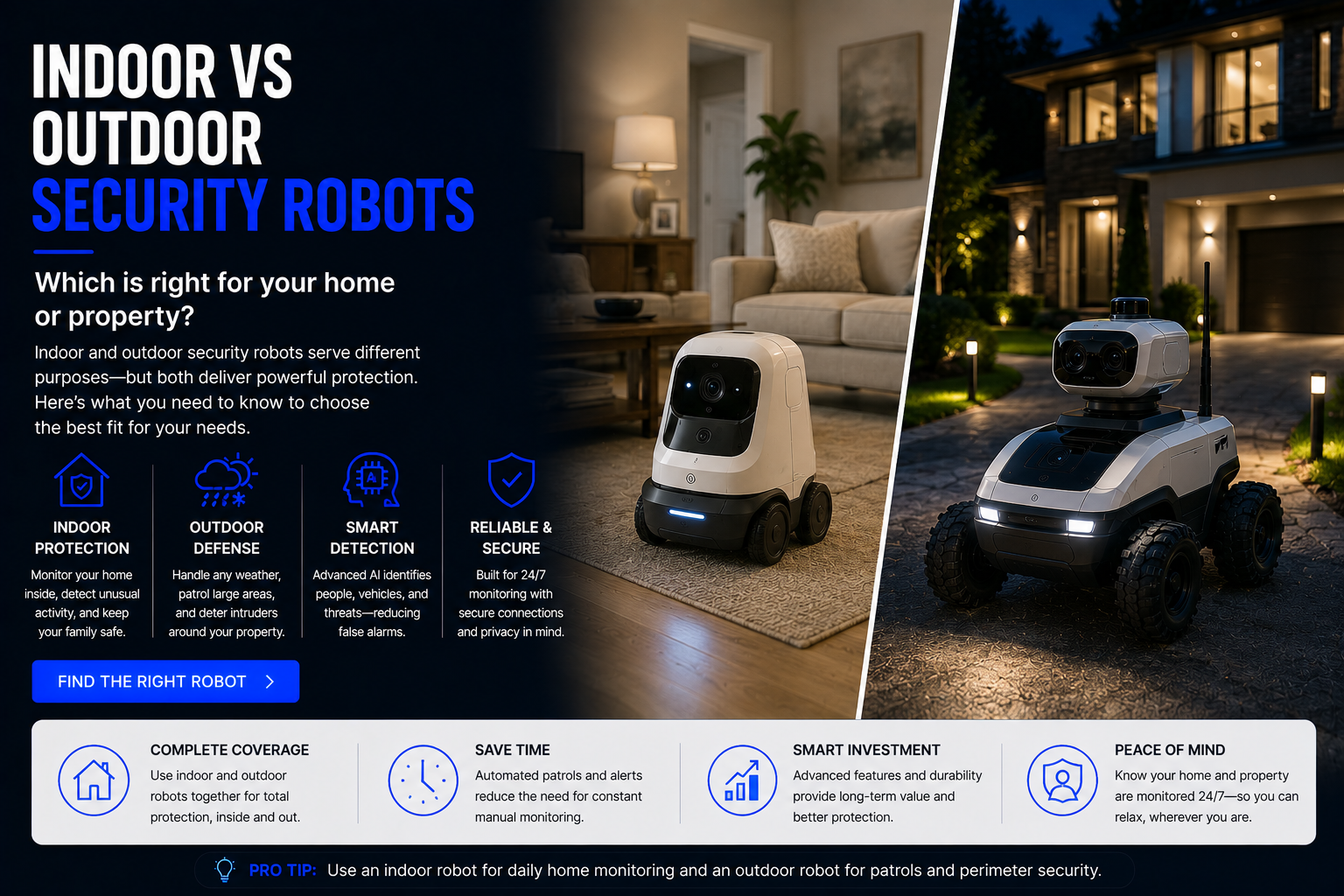
Indoor vs Outdoor Security Robots: Which Is Right for You?
Indoor security robots and outdoor security robots solve different home monitoring problems. Indoor robots are built for rooms, hallways, pets, apartments, elderly check-ins, and remote home monitoring, while outdoor security robots are designed for yards, driveways, garages, patios, gates, perimeter checks, night vision, weather exposure, and larger property security. This guide compares both options so you can choose the right security robot for your home.
Indoor vs Outdoor Security Robots: Quick Answer
Choose an indoor security robot if you mainly want room-to-room monitoring, pet check-ins, elderly caregiver check-ins, apartment security, hallway monitoring, two-way audio, indoor motion alerts, and a mobile camera you can control from your phone. Indoor security robots are usually easier to use, quieter, more affordable, and better for smooth floors and normal home layouts.
Choose an outdoor security robot if you need to monitor yards, driveways, gates, detached garages, patios, pool areas, side entrances, workshops, or larger properties. Outdoor security robots need weather resistance, stronger wheels or tracks, better night vision, longer battery life, stronger navigation, and more durable construction.
For many homes, the best security setup is not only one robot. Indoor robots, outdoor cameras, smart lights, alarms, motion sensors, locks, doorbell cameras, and home monitoring robots can work together to create better coverage than any single device.
Important: Indoor robots should not be used outdoors unless the manufacturer clearly says they are outdoor-rated. Outdoor security needs weather-resistant hardware, safe power, durable movement, and reliable connectivity.
Best rule: choose indoor for rooms, pets, elderly check-ins, and apartments. Choose outdoor for yards, driveways, garages, gates, patios, and weather-exposed areas.
Indoor vs Outdoor Security Robots Comparison
| Category | Indoor Security Robots | Outdoor Security Robots |
|---|---|---|
| Best Use | Rooms, hallways, pets, apartments, elderly check-ins | Yards, driveways, gates, garages, patios, perimeter areas |
| Surface Type | Smooth floors, rugs, tile, hardwood, low obstacles | Concrete, driveway surfaces, outdoor paths, rougher ground |
| Weather Resistance | Usually not weather-rated | Should be built for rain, dust, heat, cold, and outdoor use |
| Camera Needs | Clear indoor video and two-way audio | Stronger night vision and wider outdoor visibility |
| Movement | Quiet room-to-room movement | Durable wheels, tracks, or outdoor navigation |
| Battery Life | Moderate battery may be enough | Longer runtime matters more |
| Wi-Fi | Usually easier because router is nearby | May need mesh Wi-Fi or outdoor access points |
| Privacy | Very important because cameras are inside the home | Important for neighbors, property lines, and outdoor recording |
| Best Alternative | Indoor smart camera or home monitoring camera | Outdoor camera system, floodlight camera, or driveway sensor |
What Is an Indoor Security Robot?
An indoor security robot is a mobile home monitoring device designed to move around inside a house, apartment, condo, or office. It may include a camera, microphone, speaker, motion detection, app control, remote driving, AI alerts, automatic docking, and two-way audio.
Indoor security robots are commonly used for pet monitoring, elderly check-ins, travel monitoring, room-to-room viewing, hallway checks, apartment security, and general smart home monitoring. They are usually designed for smooth floors and controlled indoor environments.
The biggest advantage of an indoor security robot is flexibility. Instead of installing a fixed camera in every room, you can move one mobile robot to check different areas when needed.
What Is an Outdoor Security Robot?
An outdoor security robot is a security robot designed to monitor outside areas such as driveways, patios, yards, gates, garages, pool areas, side entrances, storage buildings, and larger property zones.
Outdoor models need tougher hardware than indoor models. They may require weather resistance, stronger movement systems, better low-light cameras, longer battery life, outdoor charging protection, durable construction, and better handling of uneven surfaces.
Outdoor security robots are more demanding because outside environments include rain, dust, sunlight, temperature changes, uneven ground, animals, shadows, leaves, vehicles, and weaker Wi-Fi signals.
When Indoor Security Robots Are Better
Pet Monitoring
Indoor robots are useful for checking dogs, cats, feeding areas, crates, doors, and unusual pet activity while away.
Elderly Check-Ins
Families may use indoor monitoring robots for respectful caregiver check-ins, communication, and home awareness.
Apartment Security
Indoor robots work well in apartments because the space is smaller, Wi-Fi is stronger, and outdoor patrol is usually unnecessary.
Frequent Travelers
A mobile indoor robot can help travelers check rooms, doors, pets, and activity from a phone.
Room-to-Room Monitoring
Indoor robots can provide flexible visibility without installing cameras in every room.
Privacy-Controlled Monitoring
Indoor use requires strong privacy settings, camera control, microphone control, and trusted user access.
When Outdoor Security Robots Are Better
Driveways
Outdoor robots or outdoor camera systems can help monitor long driveways, parked vehicles, and property entrances.
Yards and Patios
Outdoor models can support backyard, patio, pool, garden, and side-yard monitoring when designed for outdoor use.
Detached Garages
Large homes with garages, workshops, sheds, or storage buildings may need outdoor or garage-ready monitoring.
Large Properties
Outdoor security robots can help where fixed cameras do not cover enough ground.
Perimeter Awareness
Outdoor robots may support gates, fences, side entrances, and property edge monitoring.
Night Monitoring
Outdoor use requires stronger night vision, motion alerts, and durable operation after dark.
Indoor Security Robot Buying Factors
Quiet Movement
Indoor robots should move quietly enough for normal home use. Loud motors can be annoying in living rooms, bedrooms, apartments, or elderly care situations.
Obstacle Avoidance
Indoor robots need to avoid furniture, rugs, toys, pet bowls, cables, shoes, and thresholds. Good navigation reduces getting stuck.
Two-Way Audio
Two-way audio is useful for speaking with family members, pets, caregivers, or visitors inside the home.
Privacy Mode
Because indoor robots use cameras inside personal spaces, privacy mode is extremely important. Look for camera shutters, microphone controls, user permissions, and secure app access.
Auto Docking
A good indoor robot should return to its charging dock reliably so it is ready when needed.
App Control
The app should make it easy to drive the robot, view video, receive alerts, change settings, and manage privacy.
Outdoor Security Robot Buying Factors
Weather Resistance
Outdoor robots need protection from moisture, dust, sunlight, temperature changes, and outdoor conditions. Check the manufacturer’s rating before using a robot outside.
Terrain Handling
Outdoor areas may include concrete, gravel, slopes, grass edges, patio pavers, garage thresholds, and uneven ground. Not every robot can handle these surfaces.
Night Vision
Outdoor security depends heavily on low-light performance. Night vision, infrared, spotlight features, and camera clarity matter more outside.
Battery Life
Outdoor patrols often take longer and may be farther from a charging dock. Battery life and charging reliability are critical.
Connectivity
Wi-Fi often gets weaker outside. Outdoor robots may need stronger networking, mesh Wi-Fi, outdoor access points, or cellular support.
Durability
Outdoor security robots should be built tougher than indoor models. Wheels, motors, sensors, camera housing, and charging systems all need outdoor durability.
Indoor vs Outdoor Security Robot by Use Case
For Apartments
Indoor security robots usually make more sense. Apartments rarely need outdoor robots, and a compact indoor model or smart camera may provide enough coverage.
For Large Homes
Large homes may benefit from an indoor robot for room-to-room checks and outdoor cameras or outdoor robots for driveways, patios, and detached garages.
For Pet Owners
Indoor robots are usually better for pet check-ins because pets are often inside. Outdoor cameras may be useful for yards or dog runs.
For Elderly Care
Indoor monitoring robots may help with caregiver check-ins, but privacy and consent matter. Outdoor robots are usually less relevant unless property monitoring is also needed.
For Vacation Homes
Both can help. Indoor robots can check rooms and pets, while outdoor cameras or robots can monitor driveways, gates, and entrances.
For Garages and Workshops
If the garage is attached and smooth, an indoor-style robot may work. Detached garages or outdoor paths may require outdoor-rated devices or fixed cameras.
For Yards and Driveways
Outdoor-rated robots or fixed outdoor cameras are the better choice. Indoor robots should not be used in outdoor conditions.
Indoor vs Outdoor Security Robots: Cost and Value
Indoor security robots are usually cheaper and easier to set up. They work in controlled environments, need less rugged construction, and often have better access to Wi-Fi and power.
Outdoor security robots are usually more expensive because they need weather resistance, stronger navigation, better night vision, durable wheels, longer battery life, and more rugged hardware.
The best value depends on the security problem. If you need to monitor pets, rooms, or elderly family members, indoor is better. If you need property edge, driveway, yard, or garage awareness, outdoor is better. If you need both, use a layered setup.
Security Robot vs Fixed Camera for Indoor and Outdoor Use
For indoor use, a robot can be better than a camera when you want flexible room-to-room monitoring. A fixed camera may be better when you only need one view, such as a front door, hallway, nursery, or pet room.
For outdoor use, fixed cameras are often the better first choice because they can continuously monitor driveways, doors, gates, and yards. Outdoor robots become more useful when mobile patrol adds real value.
For most homes, a hybrid security setup is strongest: fixed cameras for important entry points, smart sensors for alerts, indoor robots for flexible checks, and outdoor-rated devices for weather-exposed areas.
Privacy and Safety Checklist
- Use indoor privacy modes: Indoor cameras should have strong privacy controls.
- Protect accounts: Use strong passwords and two-factor authentication when available.
- Review cloud storage: Understand where video is saved and who can access it.
- Limit users: Only trusted people should control the robot or view footage.
- Respect household privacy: Tell family members how the robot is used.
- Respect outdoor boundaries: Avoid unnecessary recording of neighboring property.
- Use outdoor-rated hardware: Do not expose indoor robots to rain, heat, dust, or rough terrain.
- Check Wi-Fi coverage: Weak signals can make alerts and live video unreliable.
- Test alerts: Make sure notifications reach your phone quickly.
- Have backup security: Robots should support locks, lights, alarms, and emergency planning.
Common Mistakes When Choosing Indoor or Outdoor Security Robots
- Using indoor robots outside: Indoor robots are usually not built for weather or outdoor terrain.
- Buying outdoor features you do not need: Apartments and small homes may only need indoor monitoring.
- Ignoring Wi-Fi range: Outdoor areas and garages often have weak signals.
- Forgetting privacy: Indoor robots record inside personal spaces and need careful settings.
- Expecting one robot to cover everything: Most homes need multiple security layers.
- Ignoring night vision: Outdoor security is weak without usable low-light video.
- Skipping subscription costs: Cloud storage and AI alerts may cost extra.
- Choosing robot over camera without reason: If movement does not add value, a camera may be better.
- Ignoring terrain: Outdoor robots may struggle with grass, gravel, slopes, and steps.
- Not testing before relying on it: Test movement, alerts, video, docking, and privacy settings.
Final Verdict: Indoor or Outdoor Security Robot?
Choose an indoor security robot if your main needs are room checks, pet monitoring, elderly check-ins, apartment security, travel monitoring, indoor motion alerts, and flexible home visibility.
Choose an outdoor security robot if your main needs are yard monitoring, driveway patrol, garage checks, gate awareness, patio security, perimeter coverage, or large-property surveillance.
Choose both or combine robots with cameras if you have a larger property, multiple entry points, indoor and outdoor concerns, or a smart home security setup that needs layered coverage.
Future of Indoor and Outdoor Security Robots
Indoor security robots will likely become smarter, quieter, more private, and more useful for home monitoring, pet care, elderly care, and smart home routines.
Outdoor security robots will likely improve with better weather resistance, stronger batteries, smarter patrol routes, AI person and vehicle detection, better night vision, and stronger integration with cameras, gates, lights, locks, and alarms.
The future of home security will likely use a layered system: indoor robots, outdoor robots, fixed cameras, smart sensors, AI alerts, smart lighting, smart locks, and home assistant robots working together.
Related Home Security Robot Guides
Related Home Robot Guides
Indoor vs Outdoor Security Robots FAQ
What is the difference between indoor and outdoor security robots?
Indoor security robots are designed for rooms and smooth floors. Outdoor security robots are built for weather, terrain, yards, driveways, and exterior monitoring.
Can I use an indoor security robot outside?
No, not unless the manufacturer clearly says it is outdoor-rated. Indoor robots are usually not built for rain, dust, heat, cold, or rough terrain.
Are outdoor security robots better than indoor security robots?
Not always. Outdoor robots are better for outside monitoring, while indoor robots are better for pets, rooms, apartments, and elderly check-ins.
Which is better for apartments?
Indoor security robots are usually better for apartments because outdoor patrol is rarely needed.
Which is better for large homes?
Large homes may benefit from both indoor robots for room checks and outdoor cameras or robots for yards, driveways, and garages.
Which is better for pet monitoring?
Indoor security robots are usually better because pets are commonly inside and need room-to-room check-ins.
Which is better for elderly monitoring?
Indoor monitoring robots are usually better, but privacy, consent, and caregiver setup matter.
Do outdoor security robots need Wi-Fi?
Most need Wi-Fi or another network connection for live video, alerts, remote control, and app features.
What if my outdoor Wi-Fi is weak?
You may need mesh Wi-Fi, outdoor access points, cellular options, or fixed wired cameras.
Do outdoor security robots work in rain?
Only weather-rated models should be used in rain. Check the manufacturer’s outdoor rating.
Do indoor security robots have night vision?
Many do, but night vision quality varies by model.
Do outdoor security robots have better night vision?
They should, because outdoor monitoring depends heavily on low-light visibility.
Are indoor security robots private?
Privacy depends on camera controls, microphone settings, app access, cloud storage, and user permissions.
Are outdoor security robots private?
Outdoor privacy matters too. Avoid unnecessary recording of neighboring property and review storage settings.
Are security robots better than cameras?
Robots are better for mobile monitoring. Cameras are better for fixed coverage of doors, driveways, and entry points.
Can one robot cover inside and outside?
Some advanced models may handle both, but most homes should choose devices specifically designed for each environment.
Do outdoor security robots cost more?
Usually yes, because they need weather resistance, stronger movement, better battery life, and tougher construction.
What features matter most indoors?
Quiet movement, camera quality, two-way audio, privacy controls, app control, auto docking, and obstacle avoidance matter most.
What features matter most outdoors?
Weather resistance, night vision, terrain handling, battery life, AI alerts, Wi-Fi coverage, and durability matter most.
What is the best setup for most homes?
Use fixed cameras for key entry points, an indoor robot for flexible room checks, and outdoor-rated cameras or robots for exterior zones.
Shop Indoor and Outdoor Security Robots
Indoor and outdoor security robots can help with mobile monitoring, home check-ins, pet monitoring, elderly care support, room-to-room visibility, driveway awareness, garage monitoring, yard security, AI alerts, and smart home protection. Compare indoor security robots, outdoor security robots, AI security robots, smart cameras, home monitoring robots, and large-property security devices before choosing the right setup.
Shop Home Security Robots