AI Home Robots Guide

AI Home Robot Buying Guide: How to Choose the Right AI Robot

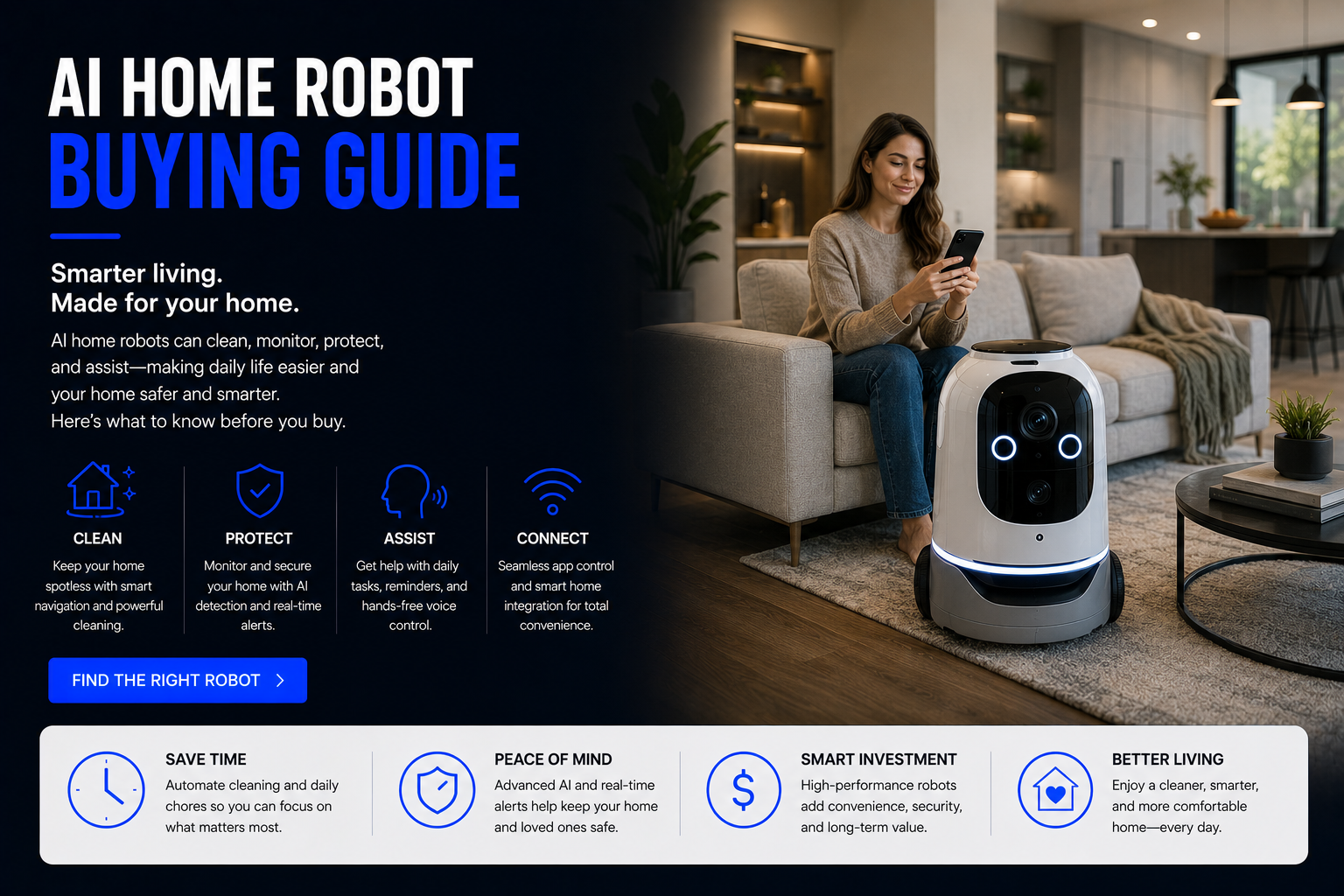
Choosing the right AI home robot depends on what you actually want it to do: answer questions, follow routines, monitor your home, help seniors, entertain kids, manage reminders, support pets, control smart devices, move around the house, clean, teach, communicate, or act like a personal home assistant. This buying guide explains how to compare AI home robots, humanoid home robots, companion robots, home assistant robots, personal assistant robots, smart home robots, monitoring robots, pet care robots, elderly care robots, and future home robots.

AI home robot buying guide how to choose the right AI robot

How Do You Choose the Right AI Home Robot?

To choose the right AI home robot, start with the real job you want the robot to handle. Some buyers want a smart home assistant with voice control and reminders. Others want a companion robot for seniors or families. Some want a mobile robot with a camera for home monitoring. Others want a humanoid home robot, a pet care robot, a kitchen robot, a child education robot, or a future-ready personal assistant robot.

The best AI robot is not always the most advanced or expensive robot. The best choice is the robot that fits your home, budget, privacy comfort, daily routines, technology level, app ecosystem, Wi-Fi setup, and expectations. A simple smart home robot may be better than a humanoid robot if you only need reminders and smart home control. A companion robot may be better if the goal is engagement and daily interaction. A home monitoring robot may be better if security and check-ins matter most.

AI home robots are still an evolving category. Many products are more like smart assistants, mobile cameras, companion devices, or specialized home robots than fully independent household helpers. That is why buyers should focus on useful features, not marketing hype.

Quick answer: choose an AI home robot based on its main purpose, mobility, voice assistant quality, app control, smart home compatibility, privacy settings, camera features, battery life, ease of use, support for routines, and whether it solves a real daily problem.

Important: AI home robots can support convenience, reminders, monitoring, learning, companionship, and smart home control, but they do not replace professional caregivers, emergency services, medical advice, home security systems, or human supervision.

AI Home Robot Buying Guide

Step 1

Decide What You Want the Robot to Do

Before comparing AI robots, decide what problem you want to solve. Do you need help with reminders, companionship, smart home control, home monitoring, pet check-ins, elderly support, child learning, entertainment, cleaning, or daily scheduling?

This matters because “AI home robot” is a broad category. A robot designed for companionship may not be the best for home security. A robot designed for monitoring may not be good for kids. A home assistant robot may not clean, cook, or physically manipulate objects.

Step 2

Choose Between Stationary, Mobile, and Humanoid Robots

Stationary AI robots sit on a table, counter, or shelf and act more like smart displays or smart speakers. Mobile AI robots can move around the home and may offer room-to-room monitoring, pet checks, or patrol features.

Humanoid home robots are the most futuristic option, but they are also the most expensive and least mature for normal homes. For most buyers, a specialized AI assistant, companion robot, or mobile monitoring robot will be more practical than a full humanoid robot.

Step 3

Check Voice Assistant and Conversation Quality

An AI home robot should be easy to talk to. Voice recognition, response quality, natural conversation, wake-word reliability, accent handling, microphone quality, speaker clarity, and follow-up ability all matter.

If the robot is frustrating to talk to, it will not feel helpful, even if it has impressive hardware.

Step 4

Review Smart Home Compatibility

Some AI robots work with lights, plugs, cameras, thermostats, locks, routines, speakers, calendars, or smart home platforms. Others are more closed and only work inside their own app.

If you already use smart home devices, choose a robot that fits your ecosystem instead of forcing you to rebuild everything.

Step 5

Understand Camera, Microphone, and Privacy Settings

Many AI home robots include cameras, microphones, sensors, face detection, app access, cloud accounts, video calling, or remote monitoring. These features can be useful, but privacy settings are critical inside a home.

Look for physical camera shutters, microphone mute controls, privacy mode, user permissions, secure login, data controls, and clear options for deleting stored information.

Step 6

Compare Mobility and Navigation

If the robot moves, check how well it navigates real homes. Look for obstacle avoidance, mapping, docking, room-to-room movement, carpet handling, pet safety, stair detection, and whether it can avoid cords, toys, rugs, furniture, and clutter.

A mobile robot that gets stuck constantly will feel less useful than a simple stationary assistant.

Step 7

Check Battery Life and Charging

Battery life matters for mobile AI home robots. A robot that moves around the house, streams video, talks, patrols, or responds to commands needs reliable charging and automatic docking.

For stationary robots, battery life may matter less, but power reliability still matters if the device handles reminders, calls, or monitoring.

Step 8

Look for Useful Daily Routines

A good AI robot should help with routines: morning reminders, bedtime routines, medication prompts, hydration reminders, family schedules, school reminders, smart home scenes, pet feeding reminders, security checks, and caregiver check-ins.

The best robot is one that becomes part of daily life instead of being a novelty that sits unused after a week.

Step 9

Check App Quality and Setup

The app controls setup, accounts, routines, alerts, video, privacy, settings, and updates. A confusing app can make a good robot frustrating.

Look for simple setup, reliable notifications, clear privacy controls, easy user management, and regular software updates.

Step 10

Compare Price, Subscriptions, and Long-Term Value

Some AI robots require subscriptions for cloud services, advanced AI features, video storage, monitoring, or premium assistant functions. Compare the total cost, not only the purchase price.

The best value comes from a robot that solves a real problem often enough to justify its cost.

AI Home Robot Types Compared

Robot Type Best For Main Benefit Possible Limitation
AI Home Assistant Robot Reminders, smart home control, schedules, questions Daily voice support and routine management May not physically help around the home
Companion Robot Seniors, families, loneliness support, engagement More personality and interaction than a speaker Not a replacement for human connection
Home Monitoring Robot Security, pets, elderly check-ins, travel Mobile camera and remote visibility Privacy and Wi-Fi coverage matter
Humanoid Home Robot Future-focused buyers and advanced robotics interest Most futuristic physical form Expensive, early-stage, and not practical for most homes yet
Personal Assistant Robot Daily planning, reminders, routines, communication Helps organize household tasks Features vary widely by model
Child Education Robot Learning, coding, STEM, language practice, routines Interactive education and engagement Needs parental guidance and age-appropriate use
Elderly Care Robot Aging in place, medication reminders, caregiver check-ins Supports safety, routines, and communication Does not replace caregivers or medical guidance
Pet Care Robot Pet monitoring, feeding reminders, check-ins, entertainment Helps pet owners monitor and interact remotely Not a substitute for real care and supervision

Most Important AI Home Robot Features

Voice Intelligence

The robot should understand commands, answer naturally, support routines, and respond reliably in real home conditions.

Useful Purpose

The best robot solves a daily problem: reminders, monitoring, companionship, learning, smart home control, or family routines.

Privacy Controls

Cameras, microphones, sensors, apps, and cloud features need clear privacy controls and secure account settings.

Mobility

If the robot moves, it should navigate safely, avoid obstacles, dock reliably, and work in your home layout.

Smart Home Support

Compatibility with lights, cameras, plugs, locks, routines, calendars, and assistants can make the robot more useful.

Long-Term Updates

AI robots depend heavily on software. Regular updates, app support, and cloud reliability matter long-term.

Best AI Home Robot by Use Case

For Smart Home Control

Choose an AI home assistant robot or smart home robot with strong voice control, app integration, routines, and compatibility with your existing smart devices.

For Seniors

Choose an elderly care robot, companion robot, or healthcare robot with clear reminders, simple controls, caregiver communication, emergency awareness, privacy controls, and easy charging.

For Families

Choose a robot that supports reminders, schedules, entertainment, learning, smart home routines, and easy multi-user controls.

For Kids and Learning

Choose a child education robot with age-appropriate activities, coding lessons, language support, parental controls, and safe content settings.

For Pets

Choose a pet care robot or monitoring robot with live video, two-way audio, pet-safe movement, treat or feeding support if needed, and reliable app alerts.

For Security and Monitoring

Choose a home monitoring robot or AI security robot with clear video, night vision, app alerts, privacy settings, Wi-Fi reliability, and remote control.

For Future Robotics Enthusiasts

Choose a humanoid home robot or advanced AI robot if your goal is exploring future robotics, but be realistic about cost, limitations, and early-stage features.

AI Home Robot vs Smart Speaker

A smart speaker is usually cheaper and better for basic voice commands, music, timers, weather, reminders, and smart home control. For many homes, a smart speaker is the best starting point.

An AI home robot is better when you want more personality, visual presence, mobility, camera features, companionship, room-to-room monitoring, family engagement, or a more futuristic home assistant experience.

The best choice depends on the job. If you only need simple voice help, start with a smart speaker. If you want a robot that feels more interactive and present, consider an AI home robot.

AI Home Robot vs Humanoid Robot

AI home robots do not always need to be humanoid. Many useful home robots are small, stationary, wheeled, screen-based, or specialized for one task. Humanoid robots are exciting, but they are not always the most practical choice.

A humanoid home robot may eventually help with physical tasks, navigation, object handling, caregiving, and home assistance. But for most current buyers, a companion robot, home monitoring robot, or personal assistant robot may provide more practical value.

Do not buy a humanoid robot only because it looks futuristic. Buy it only if its actual features, support, cost, and limitations make sense for your home.

Privacy and Safety Checklist

  • Review camera settings: Know when the robot records, streams, or stores video.
  • Check microphone controls: Look for mute options and clear audio settings.
  • Use strong passwords: Protect robot accounts and app access.
  • Enable two-factor authentication: Add extra protection when available.
  • Review cloud storage: Understand what data is saved and where it goes.
  • Limit shared users: Only trusted people should control the robot or see data.
  • Use privacy mode: Turn off cameras or microphones when not needed.
  • Check child settings: Use parental controls for education or family robots.
  • Respect household privacy: Make sure family members understand how the robot is used.
  • Update software: AI robots need security and feature updates.

Common AI Home Robot Buying Mistakes

  • Buying for hype instead of purpose: Choose based on the real problem the robot solves.
  • Expecting a robot to do everything: Most AI home robots are specialized, not all-purpose helpers.
  • Ignoring privacy: Cameras, microphones, and cloud accounts need careful review.
  • Ignoring subscriptions: Some AI features may require monthly fees.
  • Choosing humanoid too early: Humanoid robots may be exciting but not practical for most homes yet.
  • Forgetting smart home compatibility: Make sure it works with your devices and routines.
  • Ignoring Wi-Fi coverage: Mobile robots and cloud AI need reliable connectivity.
  • Skipping app reviews: The app experience can make or break the robot.
  • Buying too complicated for seniors or kids: Ease of use matters more than advanced features.
  • Assuming AI means perfect: AI can misunderstand, miss alerts, or give imperfect responses.

Are AI Home Robots Worth It?

AI home robots can be worth it when they solve a real daily problem. They can help with reminders, smart home control, companionship, security check-ins, pet monitoring, senior support, learning, and household routines.

They may not be worth it if you only need simple voice commands, timers, music, or smart home control. In that case, a smart speaker or smart display may be a better value.

The best value comes from matching the robot to the task. Buy an AI home robot for the job it is good at today, not only for what future robots might eventually do.

Future of AI Home Robots

AI home robots are likely to become more useful as voice AI, computer vision, sensors, navigation, batteries, smart home integrations, and robotics hardware improve. Future home robots may understand routines better, move more safely, recognize family needs, monitor homes, support seniors, teach children, care for pets, and coordinate more household tasks.

The future of home robotics will likely include a mix of AI home assistants, humanoid robots, companion robots, monitoring robots, healthcare robots, pet care robots, kitchen robots, child education robots, home maintenance robots, and smart home systems working together.

For buyers today, the best strategy is to choose useful, realistic AI robots that solve current problems while leaving room for future smart home expansion.

Related AI Home Robot Guides

Related Home Robot Guides

AI Home Robot Buying Guide FAQ

What is an AI home robot?
An AI home robot is a smart robot or assistant device that uses artificial intelligence to support tasks like reminders, communication, monitoring, companionship, learning, smart home control, or daily routines.

How do I choose an AI home robot?
Start with the main job you need: smart home control, companionship, security, elderly care, pet monitoring, child learning, reminders, or future robotics exploration.

Are AI home robots worth it?
They can be worth it when they solve a real daily problem. They may not be worth it if a smart speaker or simple device can do the same job for less.

What features matter most?
Voice quality, useful routines, privacy controls, smart home compatibility, app reliability, battery life, mobility, camera quality, and software updates matter most.

Are AI home robots better than smart speakers?
AI home robots are better for interaction, mobility, cameras, companionship, and visual presence. Smart speakers are better for low-cost voice assistance.

Do AI home robots need Wi-Fi?
Most AI home robots need Wi-Fi for apps, cloud AI, updates, alerts, smart home control, and remote access.

Do AI home robots have monthly fees?
Some may require subscriptions for cloud AI, video storage, monitoring, advanced features, or premium services.

Are AI home robots private?
Privacy depends on camera controls, microphone settings, cloud storage, app permissions, passwords, and user access.

Can AI home robots control smart home devices?
Some can control lights, plugs, cameras, locks, thermostats, routines, and smart home scenes depending on compatibility.

Can AI home robots help seniors?
Yes, some can support reminders, companionship, caregiver check-ins, daily routines, and communication, but they do not replace caregivers.

Can AI home robots help kids learn?
Some child education robots support STEM learning, coding, language practice, routines, and interactive lessons with parental guidance.

Can AI home robots monitor pets?
Some robots can provide live video, two-way audio, pet check-ins, treat features, or remote movement for pet monitoring.

Can AI home robots replace home security systems?
No. They can support monitoring, but they do not replace locks, alarms, emergency services, or full security planning.

Are humanoid home robots ready for most homes?
Most humanoid home robots are still expensive, early-stage, and less practical than specialized robots for typical buyers.

Should I buy a humanoid robot or regular AI robot?
Buy a regular AI robot if you want practical features today. Consider humanoid robots only if you understand the cost and limitations.

Can AI home robots move around the house?
Some can. Mobile robots may offer room-to-room movement, docking, patrols, or remote driving, depending on the model.

What is the biggest buying mistake?
Buying based on hype instead of choosing a robot that solves a real, frequent problem in your home.

Are AI home robots safe?
They can be safe when used correctly, but privacy, mobility, child settings, caregiver use, and security settings should be reviewed.

Can AI home robots replace humans?
No. They can support routines, reminders, entertainment, and monitoring, but they do not replace human care, judgment, or connection.

What should I buy first?
Start with the simplest device that solves your real need. Upgrade to a more advanced AI home robot only if mobility, personality, cameras, or deeper interaction add value.

Shop AI Home Robots

The right AI home robot should solve a real daily problem in your home. Compare AI home robots, home assistant robots, companion robots, humanoid home robots, personal assistant robots, pet care robots, elderly care robots, child education robots, home monitoring robots, and smart home robots before choosing the best option.

Shop AI Home Robots