
Robotic Pool Cleaner vs Suction Cleaner: Key Differences Explained
Robotic pool cleaners and suction pool cleaners both help remove debris from swimming pools, but they work in very different ways. This guide compares robotic pool cleaners, suction-side pool cleaners, automatic pool vacuums, pool robots, inground pool cleaners, above-ground pool cleaners, wall-climbing pool robots, pool pump suction cleaners, maintenance needs, cleaning power, energy use, cost, debris handling, and long-term value so you can choose the right pool cleaner for your home.
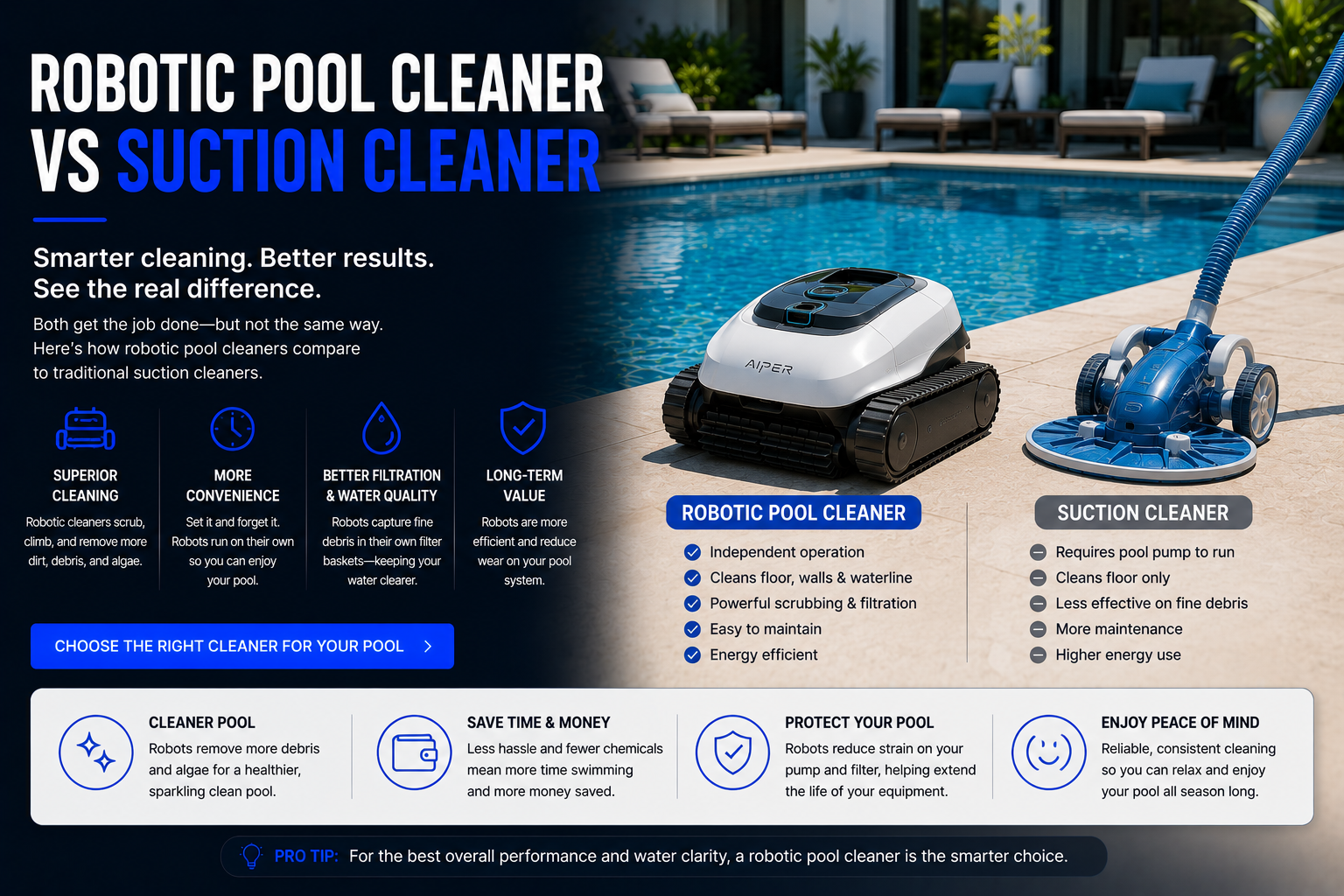
Robotic Pool Cleaner vs Suction Cleaner: Quick Answer
A robotic pool cleaner is usually better if you want stronger independent cleaning, better debris filtration, less strain on your pool pump, more complete floor coverage, wall climbing, waterline scrubbing, and easier automated pool maintenance. A suction cleaner is usually better if you want a lower upfront price, a simpler pool vacuum system, and you do not mind relying on your pool pump and filtration system.
For most pool owners who want convenience and cleaning performance, a robotic pool cleaner is the better long-term choice. For budget-focused pool owners with simple pools and lighter debris, a suction-side pool cleaner can still be useful.
Best rule: choose a robotic pool cleaner for stronger independent cleaning and convenience; choose a suction cleaner for lower upfront cost and simple pool floor vacuuming.
Robotic Pool Cleaner vs Suction Cleaner Comparison
| Category | Robotic Pool Cleaner | Suction Pool Cleaner |
|---|---|---|
| Power Source | Uses its own motor, power supply, or battery | Uses suction from the pool pump |
| Filtration | Collects debris in its own filter basket or cartridge | Sends debris through pool pump and filter system |
| Cleaning Performance | Usually stronger and more independent | Depends heavily on pump suction and pool system |
| Wall Cleaning | Available on many models | Varies and is often limited |
| Waterline Cleaning | Available on some premium models | Usually limited |
| Energy Use | Runs separately from the pool pump | Requires the pool pump to run |
| Upfront Cost | Usually higher | Usually lower |
| Maintenance | Clean basket, filters, brushes, tracks, cord or battery | Clean hoses, skimmer basket, pump basket, filter system |
| Best For | Convenience, stronger cleaning, fine debris, walls, larger pools | Budget buyers, simple pools, light debris, basic vacuuming |
What Is a Robotic Pool Cleaner?
A robotic pool cleaner is an independent pool cleaning robot that moves around the pool using its own motor, brushes, wheels, tracks, sensors, filters, and cleaning system. It does not depend on your pool pump suction to move or collect debris.
Robotic pool cleaners usually collect leaves, dirt, sand, bugs, pollen, algae dust, and fine debris inside their own filter basket or cartridge. Many models clean the pool floor, and more advanced models can climb walls, scrub the waterline, use smart navigation, or run cordless with a rechargeable battery.
The robotic pool cleaner category includes budget robotic pool cleaners, cordless robotic pool cleaners, corded pool robots, above-ground pool robots, inground robotic pool cleaners, wall-climbing pool cleaners, waterline cleaners, and premium smart pool cleaning robots.
What Is a Suction Pool Cleaner?
A suction pool cleaner is an automatic pool vacuum that connects to your pool’s suction line or skimmer and uses the pool pump to move around and collect debris. Instead of storing debris inside the cleaner, it usually sends dirt and debris through the pool’s filtration system.
Suction-side pool cleaners are popular because they are usually cheaper than robotic pool cleaners and simpler than many pressure-side or robotic systems. They can be useful for basic floor cleaning, especially in pools with lighter debris and strong pool pump suction.
The main limitation is that suction cleaners depend heavily on your pool pump, hoses, filter condition, suction balance, and plumbing setup. If your pool system is weak or clogged, the cleaner may not perform well.
When a Robotic Pool Cleaner Is Better
You Want Independent Cleaning
Robotic pool cleaners use their own motor and filter system, so they do not depend on your pool pump to move or collect debris.
You Want Better Fine Debris Pickup
Many pool robots have filters designed to collect sand, silt, pollen, algae dust, and small debris more effectively.
You Want Wall Cleaning
Many robotic pool cleaners can climb walls and clean more pool surfaces than basic suction cleaners.
You Want Less Pump Strain
Because robotic cleaners filter debris internally, they do not send as much debris through your pool pump and filter system.
You Want Smart Features
Some robotic pool cleaners include app controls, smart navigation, cleaning modes, waterline cleaning, and scheduled cycles.
You Want Convenience
A pool robot can be dropped into the water, run independently, and removed when finished, reducing manual vacuuming.
When a Suction Cleaner Is Better
You Want Lower Upfront Cost
Suction pool cleaners usually cost less upfront than robotic pool cleaners, making them attractive for budget pool owners.
Your Pool Is Simple
A suction cleaner can work well in simple pools with fewer obstacles, light debris, and strong pump suction.
You Already Have Strong Filtration
If your pool pump and filter system are strong and well maintained, a suction cleaner may perform better.
You Mainly Need Floor Vacuuming
If you do not need walls, waterline scrubbing, or smart navigation, a suction cleaner may be enough.
You Prefer Simple Equipment
Suction cleaners can be simpler mechanically, with no battery, power supply, or onboard motor system.
You Have Light Debris
Pools with mostly small debris and moderate dirt may not need the stronger performance of a robotic cleaner.
Cleaning Performance Differences
Robotic pool cleaners usually provide stronger and more consistent cleaning because they have their own motor, filtration, and movement system. Many models actively scrub with brushes and collect debris inside onboard filters.
Suction cleaners depend on pool pump suction. If the pump is strong, the filter is clean, and the hose setup is correct, they can clean pool floors effectively. But if suction drops, the cleaner may move slowly, miss areas, or fail to collect debris well.
For heavy debris, fine sand, wall cleaning, waterline scrubbing, and more complete automation, robotic pool cleaners usually have the advantage. For basic dirt and floor vacuuming on a budget, suction cleaners can still be practical.
Pool Pump and Filter Impact
One of the biggest differences is how each cleaner affects your pool system. A suction cleaner uses your pool pump and filter to move and collect debris. That means debris travels through hoses, skimmer lines, pump baskets, and filters.
A robotic pool cleaner has its own internal filter basket or cartridge. This can reduce the amount of debris sent through the pool filtration system and may reduce how often your pump basket or filter needs attention after cleaning.
If your pool filter clogs easily or your pump suction is inconsistent, a robotic cleaner may be easier to own. If your pool system is strong and you do not mind filter maintenance, a suction cleaner can be a lower-cost solution.
Cost and Long-Term Value
Suction cleaners usually win on upfront price. They are often cheaper than robotic pool cleaners and can be a good starting point for pool owners who want automatic vacuuming without a large investment.
Robotic pool cleaners usually cost more upfront, but they can offer better cleaning performance, less dependence on the pool pump, improved filtration, wall cleaning, waterline features, smart controls, and easier routine pool maintenance.
The better value depends on your pool and expectations. A suction cleaner may be enough for a simple pool. A robotic pool cleaner may be worth the higher price if you want better automation, cleaner surfaces, and less manual effort.
Maintenance Differences
| Maintenance Area | Robotic Pool Cleaner | Suction Pool Cleaner |
|---|---|---|
| Debris Storage | Empty onboard basket or filter | Debris goes through pump/filter system |
| Filters | Rinse robot filters after use | Clean pool filter, pump basket, skimmer basket |
| Movement Parts | Clean brushes, tracks, wheels | Inspect hoses, diaphragm, gears, wheels |
| Power System | Care for cord, battery, or power supply | Depends on pool pump suction |
| Storage | Store robot dry and shaded | Store hoses and cleaner properly |
| Common Issues | Clogged filters, worn brushes, cord or battery issues | Low suction, hose leaks, clogged pump or filter |
Which Cleaner Is Better by Pool Type?
Above-Ground Pools
Budget robotic pool cleaners and suction cleaners can both work for above-ground pools. Robotic cleaners are often easier if you want independent cleaning and less pump dependence.
Small Inground Pools
Either type can work. Choose robotic if you want stronger cleaning and easier maintenance. Choose suction if cost matters more and your pool system has strong suction.
Large Inground Pools
Robotic pool cleaners are usually better for large inground pools because they provide independent power, stronger coverage, and better filtering options.
Pools with Heavy Leaves
Robotic cleaners with large baskets may be better for leaves. Suction cleaners can send debris into the pool system and may clog baskets or filters more often.
Pools with Fine Sand or Silt
Robotic cleaners with fine filters are often better for sand, silt, pollen, and algae dust. Suction cleaners depend heavily on the pool filter.
Pools That Need Wall Cleaning
Robotic pool cleaners are generally the better choice if wall climbing or waterline cleaning matters.
Common Mistakes When Choosing Between Robotic and Suction Cleaners
- Buying only by price: The cheapest cleaner may not fit your pool type or debris level.
- Ignoring pump strength: Suction cleaners need strong and consistent pool suction.
- Expecting wall cleaning from a suction cleaner: Many suction cleaners are limited compared with robotic wall-climbing models.
- Forgetting filter load: Suction cleaners send debris through your pool filtration system.
- Ignoring fine debris: Sand, silt, and pollen may require better robotic filters.
- Not checking pool surface: Vinyl, fiberglass, concrete, tile, and plaster surfaces may need compatible cleaner designs.
- Overbuying features: A simple pool may not need a premium smart robotic cleaner.
Final Verdict: Robotic Pool Cleaner or Suction Cleaner?
Choose a robotic pool cleaner if you want better automation, independent cleaning, stronger debris pickup, less pool pump dependence, wall cleaning, fine filtration, and easier routine maintenance.
Choose a suction pool cleaner if you want a lower upfront price, have a simple pool, already have strong pump suction, and mainly need basic floor vacuuming.
For most pool owners who want the easiest and most complete cleaning experience, a robotic pool cleaner is usually the better choice. For pool owners focused mostly on budget and basic cleaning, a suction cleaner can still make sense.
Future of Pool Cleaning Robots and Automatic Pool Cleaners
Robotic pool cleaners are becoming smarter as battery technology, sensors, filtration, app controls, and navigation improve. Future pool robots may include better cordless runtime, stronger wall climbing, smarter debris detection, improved fine filtration, waterline recognition, and more automatic cleaning recommendations.
Suction cleaners will likely remain useful for budget pool cleaning, but the long-term trend in home maintenance robots is toward more independent automation. Robotic pool cleaners may eventually connect with smart pool systems, water quality sensors, home maintenance robots, AI home robots, and broader smart home routines.
Related Robotic Pool Cleaner Guides
Related Home Robot Guides
Robotic Pool Cleaner vs Suction Cleaner FAQ
Is a robotic pool cleaner better than a suction cleaner?
For most pool owners, yes. Robotic pool cleaners usually provide stronger independent cleaning, better filtration, and less dependence on the pool pump.
Is a suction pool cleaner worth it?
A suction pool cleaner can be worth it if you want a lower-cost automatic pool vacuum and your pool pump provides strong suction.
Do robotic pool cleaners use the pool pump?
Most robotic pool cleaners use their own motor and filter system, so they do not rely on the pool pump for suction.
Do suction cleaners use the pool filter?
Yes, suction cleaners usually send debris through the pool pump and filtration system.
Which cleaner is better for leaves?
A robotic pool cleaner with a large debris basket is often better for leaves because it collects debris inside the cleaner instead of sending it through the pool system.
Which cleaner is better for sand?
A robotic pool cleaner with fine filters is often better for sand, silt, pollen, and small particles.
Which cleaner is cheaper?
Suction cleaners usually cost less upfront than robotic pool cleaners.
Which cleaner is easier to use?
Robotic pool cleaners are usually easier for routine cleaning because they work independently and do not need pool suction adjustments.
Can suction cleaners climb walls?
Some suction cleaners can climb walls, but robotic pool cleaners are usually better for wall cleaning and waterline scrubbing.
Do robotic pool cleaners clean the waterline?
Some premium robotic pool cleaners clean the waterline, but not every model includes this feature.
Are robotic pool cleaners good for above-ground pools?
Yes, many robotic pool cleaners are designed for above-ground pools and can make routine cleaning easier.
Are suction cleaners good for inground pools?
They can work in inground pools if the pool system has strong suction and the cleaner is matched to the pool layout.
Which cleaner needs more maintenance?
Both need maintenance. Robotic cleaners need filter, brush, cord, battery, and track care. Suction cleaners need hose, skimmer, pump basket, and pool filter care.
Can a robotic pool cleaner replace manual vacuuming?
It can reduce manual vacuuming significantly, but you may still need manual tools for steps, corners, algae cleanup, and special messes.
Which should I buy?
Buy a robotic cleaner for better convenience and cleaning performance. Buy a suction cleaner if your budget is lower and your pool needs simple floor vacuuming.
Shop Robotic Pool Cleaners
Robotic pool cleaners and suction cleaners can both help maintain a pool, but they fit different needs. Compare robotic pool cleaners, suction-side pool vacuums, cordless pool robots, corded robotic cleaners, wall-climbing pool cleaners, budget pool robots, and automatic pool cleaning systems before choosing the best option for your pool.
Shop Robotic Pool Cleaners