Robotic Pool Cleaners Guide

Corded vs Cordless Robotic Pool Cleaners: Which Should You Buy?

Corded and cordless robotic pool cleaners both automate pool cleaning, but they fit different pool owners. This guide compares corded robotic pool cleaners, cordless robotic pool cleaners, battery-powered pool robots, plug-in pool cleaners, above-ground pool robots, inground pool cleaners, wall-climbing cleaners, runtime, power, convenience, maintenance, battery life, cable tangles, pool size, and long-term value so you can choose the right pool robot.

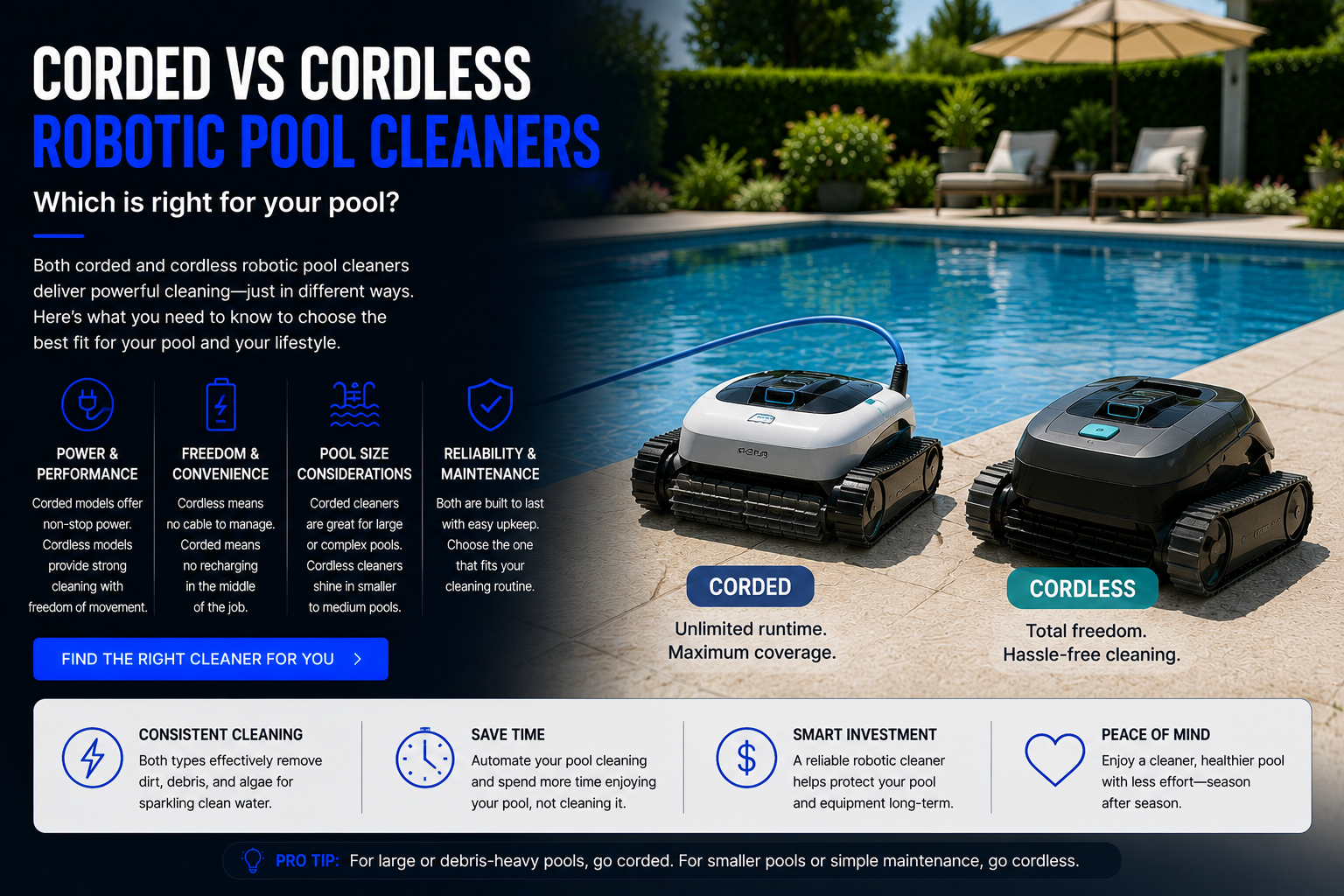
Corded vs cordless robotic pool cleaners comparison

Corded vs Cordless Robotic Pool Cleaners: Quick Answer

A cordless robotic pool cleaner is better if you want easy drop-in cleaning, no cable tangles, simple storage, and a cleaner experience for small pools, above-ground pools, and simple pool layouts. A corded robotic pool cleaner is better if you want consistent power, longer cleaning cycles, stronger performance for larger pools, wall climbing, waterline cleaning, and fewer battery runtime limits.

For small above-ground pools and simple inground pools, cordless pool robots are often the most convenient. For large inground pools, heavy debris, wall cleaning, waterline scrubbing, and longer cleaning sessions, corded robotic pool cleaners are often the safer choice.

Best rule: choose cordless for convenience and smaller pools; choose corded for power, longer runtime, larger pools, and stronger full-pool cleaning.

Corded vs Cordless Robotic Pool Cleaner Comparison

Category Corded Robotic Pool Cleaner Cordless Robotic Pool Cleaner
Power Source Plug-in power supply Rechargeable battery
Best For Larger pools, longer cycles, wall cleaning Small pools, above-ground pools, quick cleaning
Runtime Usually longer and more consistent Limited by battery capacity
Convenience Requires cable handling No cable or floating cord
Cable Tangles Possible depending on design No cord tangles
Wall Climbing Often better in premium models Available on some models, but varies
Waterline Cleaning More common in higher-end corded models Less common in budget cordless models
Storage Cleaner plus cord and power supply Cleaner plus charger
Long-Term Concern Cord wear or cable damage Battery aging and charging habits

What Is a Corded Robotic Pool Cleaner?

A corded robotic pool cleaner is a pool robot that connects to an external power supply through a floating cable. The cleaner moves around the pool using internal motors, brushes, filters, wheels, tracks, and navigation patterns while receiving steady power through the cord.

Corded pool robots are common for inground pools, larger pools, wall-climbing robotic pool cleaners, waterline cleaning models, and pool owners who want longer cleaning sessions without battery runtime limits.

The main downside is cable management. The cord can tangle, twist, or require careful storage. However, corded robotic pool cleaners often provide stronger cleaning coverage for larger or more demanding pool layouts.

What Is a Cordless Robotic Pool Cleaner?

A cordless robotic pool cleaner is a battery-powered pool robot that cleans without a floating power cable. You charge the robot, place it in the pool, let it complete the cleaning cycle, and remove it when finished.

Cordless pool robots are popular because they are simple to use, easier to store, and eliminate cord tangles. They are especially attractive for above-ground pools, small inground pools, simple pool shapes, and homeowners who want quick pool cleaning without cable setup.

The main limitation is battery life. A cordless robotic pool cleaner must have enough runtime to cover your pool before the battery runs out. Battery aging, charging time, pool size, wall climbing, debris load, and filter clogs can all affect performance.

When a Cordless Robotic Pool Cleaner Is Better

You Hate Cable Tangles

Cordless pool robots remove the biggest corded complaint: floating cable tangles, twisting, and storage.

You Have a Small Pool

Small pools are a great match for cordless robotic pool cleaners because the battery does not need to cover as much area.

You Own an Above-Ground Pool

Many above-ground pools are simple enough for lightweight cordless pool cleaners to handle effectively.

You Want Fast Setup

Cordless cleaners are easy to charge, drop in, run, remove, rinse, and store without dealing with a power supply cable.

You Prefer Lightweight Cleaning

Many cordless models are designed for simple handling, easy retrieval, and lower daily hassle.

Your Pool Has Light Debris

Pools with moderate dirt, bugs, leaves, or floor debris can often be handled well by a cordless cleaner.

When a Corded Robotic Pool Cleaner Is Better

You Have a Large Pool

Large pools often need longer cleaning cycles and consistent power that corded robotic pool cleaners can provide.

You Need Wall Cleaning

Corded pool robots are often stronger choices for wall climbing and full-pool cleaning in inground pools.

You Want Waterline Scrubbing

Waterline cleaning is more common in higher-end corded robotic pool cleaners.

Your Pool Gets Heavy Debris

Leaves, acorns, sand, and frequent debris may require longer cycles and larger filtration capacity.

You Do Not Want Battery Limits

Corded models avoid battery runtime and charging cycle concerns during cleaning.

You Want Maximum Coverage

For complex inground pools, corded robotic cleaners often provide more dependable coverage.

Pool Size: Which Type Works Better?

Pool size is one of the biggest deciding factors. A small pool may not need the extra runtime of a corded cleaner, making cordless a strong choice. A large pool may need longer cleaning time, stronger navigation, more debris capacity, and consistent power, making corded models more practical.

For above-ground pools and compact inground pools, cordless robotic pool cleaners can be very convenient. For larger inground pools, deep ends, long rectangles, freeform shapes, and pools surrounded by trees, a corded robotic pool cleaner may provide better coverage and fewer interruptions.

Cleaning Power and Performance

Corded robotic pool cleaners often have an advantage in cleaning power because they do not depend on a limited battery during the cleaning cycle. This can help with longer sessions, wall climbing, waterline scrubbing, and larger pools.

Cordless robotic pool cleaners are improving quickly, and many are strong enough for routine floor cleaning, small pools, and moderate debris. However, performance varies widely by model. Some cordless cleaners are floor-only, while others can climb walls or handle more complete cleaning.

Do not assume corded always means better or cordless always means weaker. Match the cleaner to your pool type, pool size, debris, and surface.

Battery Life vs Cable Length

Cordless robotic pool cleaners depend on battery runtime. If the battery does not last long enough, the robot may stop before finishing the pool. Charging time also matters because you may need to wait before running another cycle.

Corded robotic pool cleaners depend on cable length. The cable must be long enough to reach the full pool without restricting movement. If the cable is too short or tangles often, coverage can suffer.

Battery life matters most for cordless models. Cable length and swivel design matter most for corded models.

Maintenance Differences

Maintenance Area Corded Cleaner Cordless Cleaner
Filter Cleaning Required after use Required after use
Brush and Track Cleaning Required regularly Required regularly
Power System Inspect cord and power supply Care for battery and charger
Storage Store cable loosely Store battery properly
Long-Term Wear Cord, swivel, power supply Battery, charger, seals
After-Use Care Rinse robot and untwist cable Rinse robot and charge correctly

Cost and Long-Term Value

Cordless robotic pool cleaners can be affordable and convenient, especially for smaller pools. However, battery replacement and charging performance may affect long-term value.

Corded robotic pool cleaners may cost more depending on the model, but they can deliver longer cycles and stronger cleaning for larger pools. Long-term concerns include cable wear, power supply issues, and storage habits.

The better value depends on your pool. A cordless cleaner may be the best value for a small pool. A corded cleaner may be the better investment for a large inground pool that needs stronger cleaning and longer runtime.

Which Should You Buy by Pool Type?

Above-Ground Pools

Cordless robotic pool cleaners are often a great choice for above-ground pools because they are easy to use, avoid cords, and usually have enough runtime for smaller pool sizes.

Small Inground Pools

Either type can work. Choose cordless if convenience matters most. Choose corded if you want longer cycles, better wall cleaning, or more consistent power.

Large Inground Pools

Corded robotic pool cleaners are usually the safer choice for large inground pools because they offer longer runtime and stronger full-pool coverage.

Pools with Heavy Leaves

Corded models may be better if heavy debris requires longer cleaning cycles and larger baskets. Some cordless models can work if the basket is large enough and runtime is strong.

Pools with Mostly Sand or Fine Dirt

Both types can work if the filter is good. Focus on fine filtration more than corded vs cordless.

Simple Pool Layouts

Cordless models can be excellent for simple layouts where battery runtime is enough to finish the job.

Common Mistakes When Choosing Corded or Cordless

  • Buying cordless without checking runtime: Make sure the battery can finish your pool.
  • Buying corded without checking cable length: The cable must reach the whole pool.
  • Ignoring wall climbing: Not every cleaner can clean walls or waterlines.
  • Choosing only by price: Pool size and debris matter more than the cheapest option.
  • Forgetting battery aging: Cordless batteries lose capacity over time.
  • Forgetting cable care: Corded cleaners need proper cord storage and untangling.
  • Ignoring filter type: Leaves, sand, pollen, and fine debris need different filtration.

Final Verdict: Corded or Cordless?

Choose a cordless robotic pool cleaner if your priority is convenience, easy setup, no cable tangles, simple storage, and cleaning a small or medium pool with moderate debris.

Choose a corded robotic pool cleaner if your priority is longer runtime, stronger full-pool coverage, larger pool cleaning, wall climbing, waterline scrubbing, and avoiding battery limits.

For many pool owners, the answer is simple: cordless is easier, corded is stronger. The right choice depends on whether your pool needs convenience or performance more.

Future of Corded and Cordless Pool Robots

Cordless robotic pool cleaners are improving as battery technology, motors, filtration, and smart navigation improve. Future cordless pool robots may offer longer runtime, faster charging, better wall climbing, stronger suction, smarter path planning, and improved waterline cleaning.

Corded robotic pool cleaners will likely remain important for large pools and heavy-duty cleaning because consistent power still matters. Premium corded models may continue to lead in wall climbing, waterline scrubbing, and long-cycle performance.

As pool robotics develops, both corded and cordless cleaners may connect more closely with smart pool systems, water quality monitors, home maintenance robots, AI home robots, and smart home routines.

Related Robotic Pool Cleaner Guides

Related Home Robot Guides

Corded vs Cordless Robotic Pool Cleaners FAQ

Is a corded or cordless robotic pool cleaner better?
Cordless is better for convenience and smaller pools. Corded is better for larger pools, longer cleaning cycles, wall climbing, and consistent power.

Are cordless robotic pool cleaners worth it?
Yes, cordless robotic pool cleaners can be worth it for small pools, above-ground pools, simple layouts, and users who want no cable tangles.

Are corded robotic pool cleaners more powerful?
Many corded robotic pool cleaners provide more consistent power and longer runtime, which can help with larger pools and full-pool cleaning.

Do cordless pool robots clean walls?
Some cordless pool robots clean walls, but many budget cordless models are floor-only. Always check the specifications.

Do corded pool robots clean the waterline?
Many higher-end corded robotic pool cleaners can scrub the waterline, but not every model includes this feature.

How long do cordless robotic pool cleaners run?
Runtime depends on battery size, cleaning mode, pool size, debris, wall climbing, and filter condition.

Do corded robotic pool cleaners get tangled?
They can, especially if the cable is not managed well. Some models include swivel cables to reduce tangling.

Which is better for above-ground pools?
Cordless robotic pool cleaners are often better for above-ground pools because they are easy to use and do not require cable handling.

Which is better for large inground pools?
Corded robotic pool cleaners are usually better for large inground pools because they offer longer cleaning time and stronger coverage.

Do cordless pool cleaners need battery replacement?
Eventually, batteries may lose capacity. Battery lifespan depends on usage, charging habits, storage, and model quality.

Are corded pool cleaners cheaper long term?
Sometimes, because they avoid battery replacement. However, cords, power supplies, brushes, tracks, and filters can still wear over time.

Can a cordless cleaner handle leaves?
Some can handle leaves, but heavy leaf debris needs a strong intake and large debris basket.

Should I buy cordless if I have a deep pool?
Only if the cordless model is rated for your pool size and depth. Many deep or large pools are better served by corded models.

What is the biggest downside of cordless robotic pool cleaners?
The biggest downside is battery runtime and long-term battery aging.

What is the biggest downside of corded robotic pool cleaners?
The biggest downside is cable handling, tangling, and storage.

Shop Robotic Pool Cleaners

Corded and cordless robotic pool cleaners both make pool maintenance easier, but the best choice depends on your pool size, debris level, wall-cleaning needs, battery preference, cable tolerance, and budget. Compare cordless pool robots, corded robotic pool cleaners, above-ground pool cleaners, inground pool cleaners, wall-climbing robots, and smart pool cleaning systems before choosing.

Shop Robotic Pool Cleaners