
Best Self-Emptying Robot Vacuums
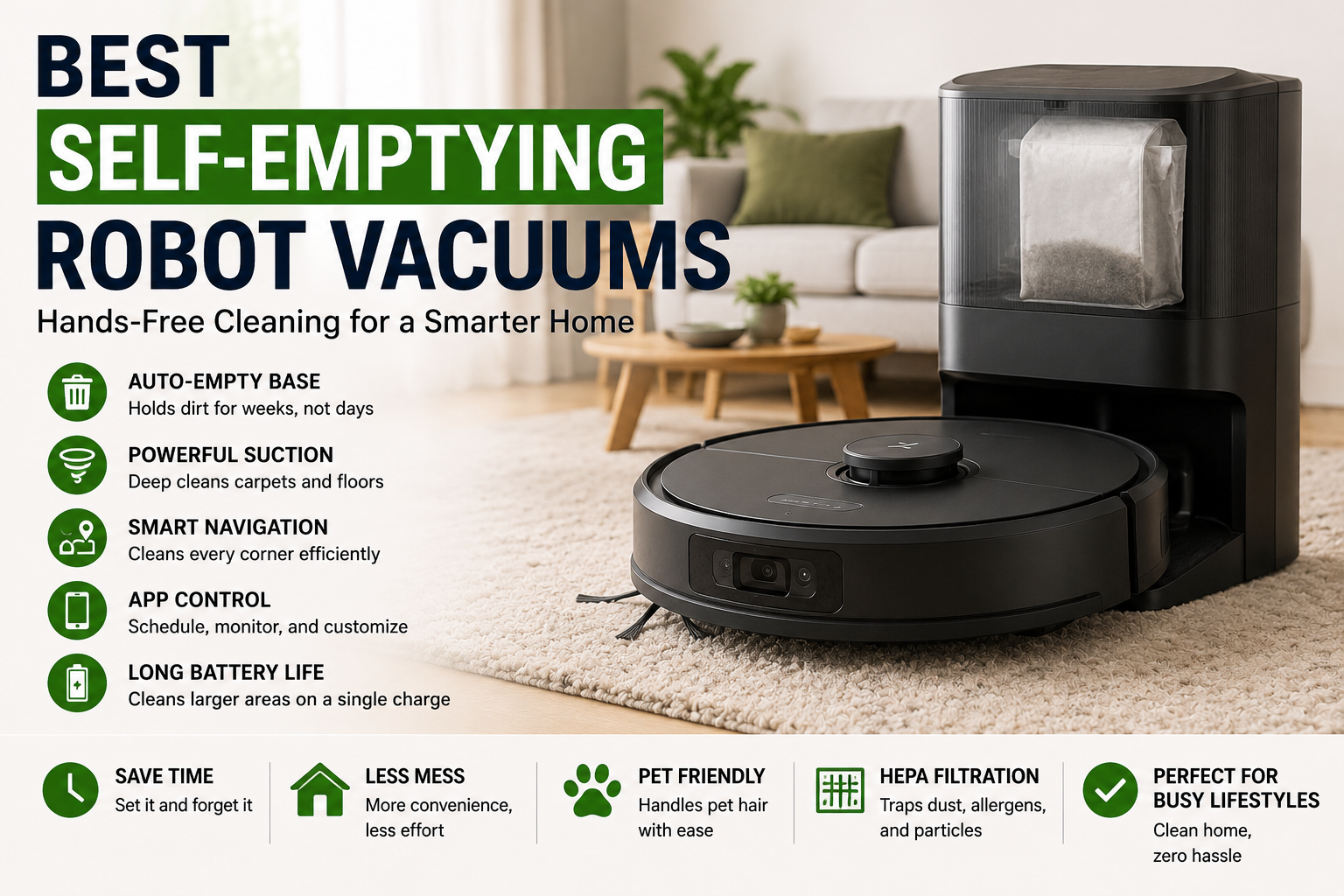
Self-emptying robot vacuums are designed for people who want cleaner floors with less daily maintenance. Instead of emptying the robot after every cleaning run, the vacuum returns to a dock that automatically pulls dirt, dust, pet hair, and debris into a larger bag or bin. In this guide, we explain what to look for in the best self-emptying robot vacuums, including suction power, dock design, smart mapping, carpet performance, pet hair pickup, filter quality, bag costs, and long-term convenience.
Why Self-Emptying Robot Vacuums Are So Popular
A standard robot vacuum can save time, but you still need to empty the dustbin often. In homes with pets, carpet, kids, or daily cleaning schedules, that small dustbin can fill quickly. A self-emptying robot vacuum solves one of the biggest annoyances by moving debris from the robot into a larger base station automatically.
This makes self-emptying models especially useful for pet owners, allergy-sensitive households, busy families, large homes, and anyone who wants a more hands-free cleaning routine.
What to Look for in a Self-Emptying Robot Vacuum
- Reliable auto-empty dock – the base should empty the robot consistently without clogs
- Strong suction power – important for carpet, rugs, pet hair, crumbs, and daily debris
- Smart mapping – helps the robot clean specific rooms and avoid missed areas
- Good filtration – helpful for dust, pollen, pet dander, and allergy concerns
- Bag or bagless design – affects long-term cost and maintenance
- Anti-tangle brushes – important for pet hair and long hair
Self-Emptying Robot Vacuum Features Compared
| Feature | Why It Matters |
|---|---|
| Auto-Empty Dock | Reduces how often you manually empty the robot’s small dustbin. |
| Large Dust Bag or Bin | Can hold weeks of dirt, dust, hair, and debris depending on use. |
| Smart Mapping | Allows room-by-room cleaning, schedules, no-go zones, and better coverage. |
| Carpet Boost | Helps increase suction automatically on carpet and rugs. |
| Anti-Tangle Brush | Reduces hair wrapping around the main brush and side brushes. |
Best Overall Type for Most Homes
For most households, the best self-emptying robot vacuum is one with strong suction, smart mapping, reliable obstacle avoidance, good filtration, and a dock that empties cleanly without constant clogs. If you have pets, carpet, or large rooms, these features become even more important.
A cheaper self-emptying model may still work well in smaller apartments or mostly hard-floor homes. But for carpet, pet hair, large homes, or multiple rooms, it usually makes sense to choose a more capable mapping system and a stronger cleaning base.
SEE SELF-EMPTYING ROBOT VACUUMSBest Self-Emptying Robot Vacuums for Pet Hair
Pet hair is one of the biggest reasons people upgrade to a self-emptying robot vacuum. Dog hair, cat hair, dander, and tracked-in dirt can fill a small dustbin fast. A self-emptying dock makes daily cleaning easier because the robot can run more often without needing attention after every session.
For pet owners, prioritize anti-tangle brushes, strong suction, high-quality filtration, and a dock that handles hair well. You may also want to compare our guide to the best robot vacuums for pet hair.
Best Self-Emptying Robot Vacuums for Carpet
Carpet creates more dust, lint, and hair buildup than hard floors. That makes self-emptying robot vacuums especially useful in carpeted rooms because the robot can collect more debris over repeated cleaning runs.
For carpet, look for suction power, carpet boost, brush roll performance, smart navigation, and a dock with enough capacity. For deeper details, compare our guide to the best robot vacuums for carpet.
Best Self-Emptying Robot Vacuums for Hardwood Floors
Hardwood floors usually do not need as much suction as carpet, but dust, crumbs, pet hair, and fine debris are more visible on hard surfaces. A self-emptying robot vacuum can help keep wood floors clean with less daily effort.
If your home has wood floors, prioritize soft movement, good edge cleaning, rubber wheels, smart mapping, and controlled cleaning routes. You can also review our guide to the best robot vacuums for hardwood floors.
Best Self-Emptying Robot Vacuums for Apartments
Apartments usually need compact robots, quiet operation, and efficient navigation. A self-emptying dock can still be useful in a small space, especially if you have pets, allergies, or limited time.
Before buying, check dock size, noise level during emptying, dust bag capacity, and whether the robot can clean tight areas under furniture. A future guide on best robot vacuums for apartments can help compare compact models.
Best Self-Emptying Robot Vacuums for Large Homes
Large homes need longer battery life, better mapping, room selection, zone cleaning, and a dock that can handle repeated cleaning cycles. A self-emptying robot vacuum can be especially valuable because larger homes produce more debris and require more frequent cleaning runs.
If your home has multiple rooms, carpeted areas, pets, or high-traffic zones, choose a robot with strong mapping, recharge-and-resume cleaning, and reliable app control. A future guide on robot vacuums for large homes will be useful for comparing whole-home coverage.
Bagged vs Bagless Self-Emptying Docks
Some self-emptying docks use disposable bags, while others use bagless bins. Bagged docks can be cleaner to empty and may be better for dust control, but you will need to buy replacement bags. Bagless docks avoid bag costs, but they can release more dust when emptied.
For allergy-sensitive homes, a sealed bagged system may be more convenient. For budget-focused buyers, bagless systems may be attractive if they are easy to clean.
Are Self-Emptying Robot Vacuums Worth It?
Self-emptying robot vacuums are often worth it for people who value convenience, have pets, live in larger homes, or run their robot daily. They reduce one of the most common robot vacuum chores: emptying the dustbin.
They may not be worth it if your home is small, you do not have pets, or you do not mind emptying the robot manually. For a deeper comparison, our article Are Self-Emptying Robot Vacuums Worth It? explains the pros, cons, and real value.
Popular Self-Emptying Robot Vacuum Brands
Popular brands in the self-emptying robot vacuum category include Roomba, Roborock, Shark, Eufy, Dreame, Ecovacs, and Narwal. Each brand has different strengths depending on cleaning power, mapping, mop features, app control, dock design, and price.
Roomba is one of the most recognized names in robot vacuums. Roborock and Dreame are often compared for advanced smart mapping and vacuum-mop systems. Shark has many self-emptying models. Eufy is popular with value-focused buyers. Ecovacs and Narwal are strong names in smart cleaning robots and robot vacuum and mop combos.
Future comparison guides such as Roomba vs Roborock, Shark vs Roomba, best budget robot vacuums, and robot vacuum buying guide for beginners can help buyers compare more specific options.
Common Mistakes When Buying a Self-Emptying Robot Vacuum
- Buying based only on the dock and ignoring cleaning performance
- Forgetting to check replacement bag costs
- Choosing a robot without smart mapping for a larger home
- Ignoring noise level when the dock empties the robot
- Assuming self-emptying means zero maintenance
- Forgetting to clean brushes, filters, sensors, and wheels regularly
Maintenance Still Matters
A self-emptying robot vacuum reduces dustbin maintenance, but it does not remove all maintenance. You still need to clean brushes, wipe sensors, check wheels, replace filters, and occasionally inspect the dock.
For long-term performance, a robot vacuum maintenance guide is important. A well-maintained robot usually cleans better, lasts longer, and avoids more clogs or navigation problems.
Future Buying Guides to Compare
This article is part of the HomeBotGuide robot vacuum cluster. If you are researching self-emptying models, you may also want to compare best robot vacuums for carpet, best robot vacuums for apartments, best robot vacuums for large homes, best budget robot vacuums, best robot vacuums for multiple floors, robot vacuum vs regular vacuum, and robot vacuum maintenance guide.
As home robots improve, self-emptying docks may also connect with auto-washing mop stations, AI cleaning robots, smart home robots, robot vacuum and mop combos, and future home cleaning systems.
Related HomeBotGuide Articles
- Best Robot Vacuums for Pet Hair
- Best Robot Vacuums for Carpet
- Best Robot Vacuums for Hardwood Floors
- Best Robot Vacuum and Mop Combos
- Are Home Robots Worth It?
FAQ – Self-Emptying Robot Vacuums
Are self-emptying robot vacuums worth it?
Yes, they can be worth it for busy homes, pet owners, larger spaces, and anyone who wants less daily maintenance. They are less necessary for very small homes or light cleaning needs.
How often do you empty a self-emptying robot vacuum?
It depends on the dock size, home size, pets, and cleaning frequency. Many docks can hold debris for several weeks, but homes with pets may need more frequent bag or bin changes.
Do self-emptying robot vacuums need bags?
Some self-emptying docks use disposable bags, while others are bagless. Bagged systems may be cleaner to empty, but bagless systems avoid replacement bag costs.
Are self-emptying robot vacuums good for pet hair?
Yes, they are often very useful for pet hair because the robot can clean more often without needing the dustbin emptied after every run.
Are self-emptying robot vacuums loud?
The auto-empty process can be loud for a short time because the dock uses strong suction to remove debris from the robot. Normal cleaning noise depends on the model.
Can a self-emptying robot vacuum replace a regular vacuum?
Not completely for every home. It can handle daily maintenance, but a regular vacuum may still be useful for deep cleaning, stairs, furniture, and thick carpet.
Which brands make self-emptying robot vacuums?
Popular brands include Roomba, Roborock, Shark, Eufy, Dreame, Ecovacs, and Narwal.
We may earn a commission from qualifying purchases at no extra cost to you.