
Robot Lawn Mower Buying Guide for Beginners
Buying your first robot lawn mower can feel confusing because there are many different technologies, price ranges, yard requirements, and setup styles. Some robotic mowers use boundary wires, while newer wire-free robot lawn mowers use GPS, RTK, AI mapping, cameras, and virtual boundaries. This beginner-friendly guide explains how to choose the right robot lawn mower based on lawn size, slopes, obstacles, battery life, safety features, smart controls, and long-term value.
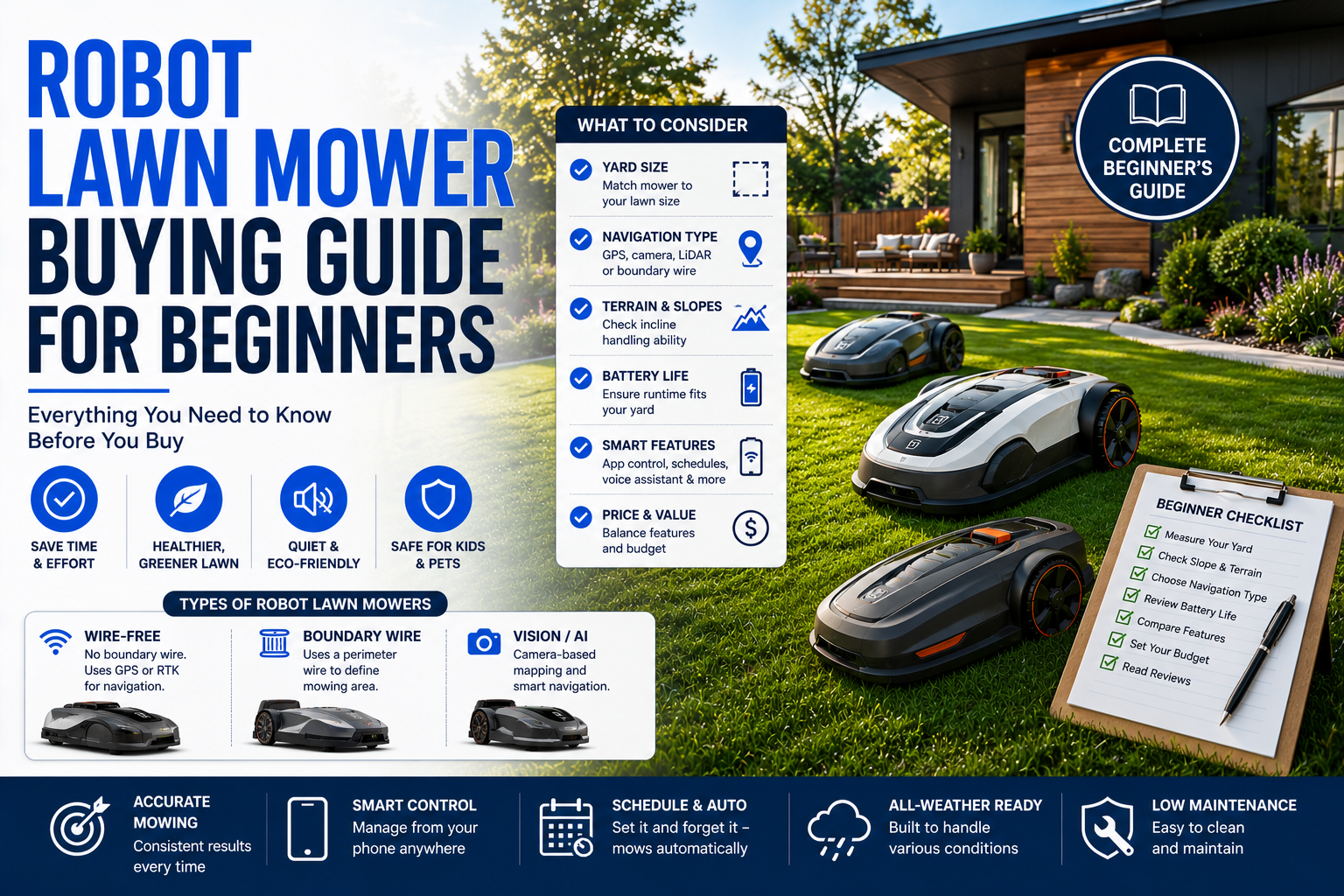
What Is a Robot Lawn Mower?
A robot lawn mower is an automated outdoor mower that cuts your grass on a schedule with minimal manual effort. Instead of mowing once per week like a traditional mower, most robotic mowers trim small amounts of grass frequently.
This frequent cutting helps maintain a consistent lawn height and can reduce the amount of visible grass clippings.
How Robot Lawn Mowers Work
Robot lawn mowers move around your yard, cut small amounts of grass, and return to their charging station automatically. Many models use sensors, boundary systems, smart navigation, and app controls to manage mowing schedules and lawn zones.
Depending on the model, setup may involve installing a boundary wire or creating digital boundaries through an app.
Robot Lawn Mower Features Explained
| Feature | What It Means |
|---|---|
| Lawn Coverage | The maximum yard size the mower is designed to maintain. |
| Slope Rating | How steep of an incline the mower can safely handle. |
| Boundary Wire | A physical wire used to define the mowing area. |
| Wire-Free Navigation | Uses GPS, RTK, cameras, AI, or virtual boundaries. |
| App Control | Lets you schedule, monitor, and adjust mowing from your phone. |
| Safety Sensors | Detects lifting, tilting, obstacles, and unsafe movement. |
Step 1: Know Your Lawn Size
The first step is measuring or estimating your lawn size. Robot lawn mowers are rated for specific coverage areas, and choosing a mower that is too small can lead to poor performance.
Small yards usually require less battery life and simpler navigation. Larger yards need stronger batteries, larger coverage capacity, and smarter route planning.
Compare our guides to the best robot lawn mowers for small yards and best robot lawn mowers for large yards.
Step 2: Check Your Yard's Slopes
If your yard has hills or uneven areas, slope rating becomes one of the most important buying factors. Not all robot mowers are built for climbing.
Look for traction wheels, stable chassis design, tilt sensors, and a slope rating higher than your steepest area.
For hilly yards, read our guide to the best robot lawn mowers for slopes.
Step 3: Decide Between Boundary Wire and Wire-Free
Traditional robot lawn mowers use perimeter wires to define the mowing area. These systems can be reliable, but installation may take time.
Wire-free robot lawn mowers use GPS, RTK, AI cameras, smart mapping, or virtual boundaries. They are usually easier to adjust and better for homeowners who want modern smart lawn care.
Compare our guide to the best wire-free robot lawn mowers.
COMPARE ROBOT LAWN MOWERSStep 4: Consider Obstacles and Yard Layout
Your yard may include trees, flower beds, patios, fences, pathways, garden edges, dog toys, furniture, rocks, or uneven terrain. More complex yards require better navigation and obstacle avoidance.
For simple rectangular lawns, basic models may work well. For complex yards, premium models with smart mapping and obstacle detection may be worth the investment.
Step 5: Look at Battery Life and Charging
Battery life matters most when your yard is larger or divided into multiple mowing zones. A good robot lawn mower should automatically return to its charging station when the battery is low.
Some models resume mowing after charging, which is especially useful for larger yards.
Step 6: Review Safety Features
Robot lawn mowers use sharp blades, so safety features matter. Look for models with lift sensors, tilt sensors, automatic blade stop, obstacle detection, PIN protection, app alerts, and emergency stop controls.
Always keep toys, hoses, tools, and small objects off the lawn before mowing.
Robot Lawn Mower vs Traditional Mower
| Feature | Robot Lawn Mower | Traditional Mower |
|---|---|---|
| Labor | Very Low | High |
| Scheduling | Automatic | Manual |
| Noise | Low | Higher |
| Consistency | Excellent | Depends on User |
| Upfront Cost | Higher | Often Lower |
Are Robot Lawn Mowers Worth It?
Robot lawn mowers are worth it for many homeowners who want to save time, reduce physical effort, and keep their lawn consistently maintained.
They are especially useful for busy families, homeowners with large yards, people who dislike mowing, and smart home users who want outdoor automation.
For a full value breakdown, read Are Robot Lawn Mowers Worth It?.
Common Beginner Mistakes
- Choosing a mower without checking lawn size
- Ignoring slope rating
- Buying a basic model for a complex yard
- Not understanding boundary wire installation
- Assuming all wire-free systems are the same
- Ignoring safety features
- Forgetting maintenance and blade replacement
Maintenance Basics
Robot lawn mowers require less maintenance than gas mowers, but they still need basic care.
- Clean wheels and underside regularly
- Replace blades when dull
- Keep sensors clean
- Check charging contacts
- Update firmware when available
- Store properly during off-season
Who Should Buy a Robot Lawn Mower?
- Homeowners who want less yard work
- People with small or medium lawns
- Large-yard owners seeking time savings
- Smart home enthusiasts
- People using lawn services regularly
- Anyone who wants consistent grass height
Who May Not Need One?
- People who enjoy mowing manually
- Very rough or debris-filled yards
- Homes with extremely complex landscaping
- Buyers with very limited budgets
- Yards that require frequent heavy-duty cutting
Final Beginner Buying Advice
The best robot lawn mower for beginners is not always the most expensive model. The right choice depends on your lawn size, slopes, yard complexity, desired setup style, and budget.
Start by matching the mower to your yard. Then consider smart features, wire-free navigation, safety systems, and long-term maintenance.
Related HomeBotGuide Articles
- Best Robot Lawn Mowers for Small Yards
- Best Robot Lawn Mowers for Large Yards
- Best Robot Lawn Mowers for Slopes
- Best Wire-Free Robot Lawn Mowers
- Are Robot Lawn Mowers Worth It?
- Best Smart Home Robots
- Future Home Robots Coming Soon
FAQ – Robot Lawn Mower Buying Guide
What should beginners look for in a robot lawn mower?
Beginners should focus on lawn size, slope rating, navigation type, safety features, app control, battery life, and installation requirements.
Do robot lawn mowers need boundary wires?
Some do, but newer wire-free models use GPS, RTK, cameras, AI mapping, or virtual boundaries instead.
Can robot lawn mowers handle slopes?
Many can, but each model has a specific slope rating. Always choose one that matches or exceeds your yard's incline.
Are robot lawn mowers hard to install?
Wire-based models take more setup time. Wire-free models are usually easier to configure through an app.
How much maintenance do robot lawn mowers need?
Maintenance is usually simple and includes blade replacement, cleaning, sensor care, charging contact checks, and firmware updates.
Are robot lawn mowers good for beginners?
Yes, as long as the model is matched correctly to the yard size, terrain, and setup preference.
We may earn a commission from qualifying purchases at no extra cost to you.