
Best Robot Lawn Mowers for Slopes
Find the best robot lawn mowers for slopes and uneven terrain. Compare traction, climbing ability, safety systems, and mowing performance. This guide compares coverage, navigation, slopes, safety, maintenance, and long-term ownership value.
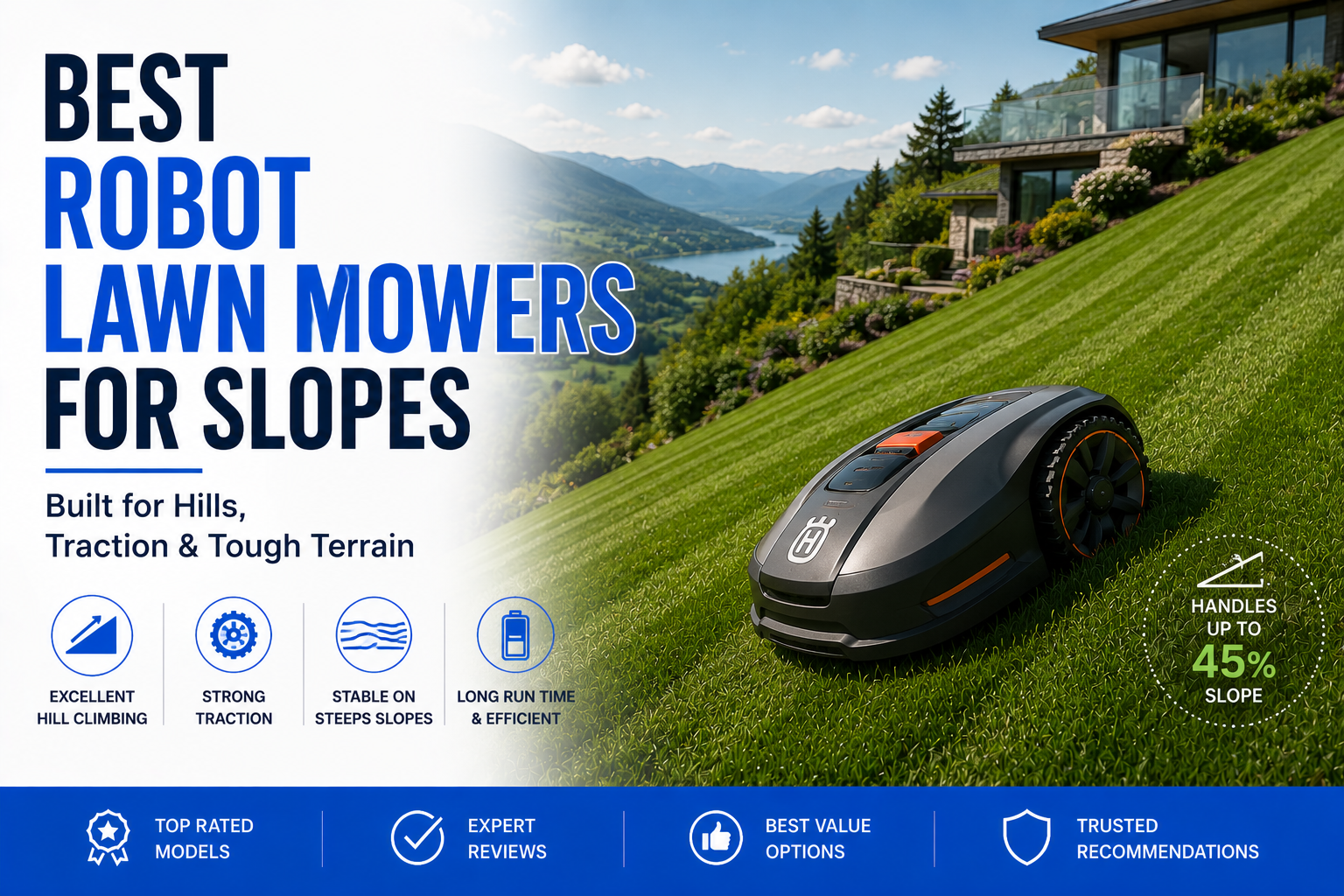
As an Amazon Associate, HomeBotGuide may earn from qualifying purchases at no extra cost to you.
The best robot lawn mower for slopes uses strong wheel traction, a low center of gravity, accurate tilt sensing, and enough torque to climb without tearing the grass. Always compare both the maximum slope rating and whether it applies while climbing, descending, or crossing the hill.
Best Robot Lawn Mowers for Slopes at a Glance
Strong traction for steep and uneven lawns.
Lower cost with solid hill performance.
Improved grip on soft or slippery grass.
Maintains positioning around changing grades.
Best Robot Lawn Mowers for Slopes Comparison Table
| Type | Best For | Core Features | Important Limitation |
|---|---|---|---|
| AWD Mower | Steep lawns | Four-wheel traction and strong climbing | High purchase cost |
| High-Torque RWD Mower | Moderate slopes | Good hill power and simpler design | Less stable on severe cross-slopes |
| Deep-Tread Mower | Soft or damp grass | Improved grip | May mark delicate turf |
| Low-Center Mower | Uneven ground | Better stability | Limited ground clearance |
| Hybrid Navigation Mower | Complex hillside lawns | Multiple sensors and mapping | More calibration |
| Boundary-Wire Slope Mower | Predictable hilly lawns | Stable perimeter control | Wire installation |
What to Consider First
Start with the actual lawn size, slope, shape, passage width, tree cover, obstacles, boundary method, and maintenance tolerance. A mower must fit the property before its smart features matter.
- Measure the lawn instead of relying on lot size.
- Check slope, traction, and edge safety.
- Review navigation and boundary requirements.
- Plan for blades, batteries, docking, and storage.
Main Options to Consider
Four-wheel traction and strong climbing
Good hill power and simpler design
Improved grip
Better stability
Slope Ratings Are Not Standardized
Some brands list percent grade, others use degrees. Convert carefully and verify whether the rating applies in every direction.
- Measure the real lawn area, slopes, and narrow passages.
- Confirm boundary, signal, and docking requirements.
- Review blade, wheel, battery, and storage maintenance.
- Schedule operation when children, pets, and wildlife are clear.
Climbing vs Crossing a Slope
A mower may climb a hill safely but become unstable when traveling sideways across it.
- Measure the real lawn area, slopes, and narrow passages.
- Confirm boundary, signal, and docking requirements.
- Review blade, wheel, battery, and storage maintenance.
- Schedule operation when children, pets, and wildlife are clear.
Traction and Wheel Design
Deep tread, wider tires, and AWD improve grip but can damage soft turf if wheel slip occurs.
- Measure the real lawn area, slopes, and narrow passages.
- Confirm boundary, signal, and docking requirements.
- Review blade, wheel, battery, and storage maintenance.
- Schedule operation when children, pets, and wildlife are clear.
Wet Grass
Moisture reduces traction and can cause clumping, rutting, or uncontrolled sliding.
- Measure the real lawn area, slopes, and narrow passages.
- Confirm boundary, signal, and docking requirements.
- Review blade, wheel, battery, and storage maintenance.
- Schedule operation when children, pets, and wildlife are clear.
Boundary Placement on Hills
Keep wires or virtual borders away from drop-offs, retaining walls, ponds, and unstable edges.
- Measure the real lawn area, slopes, and narrow passages.
- Confirm boundary, signal, and docking requirements.
- Review blade, wheel, battery, and storage maintenance.
- Schedule operation when children, pets, and wildlife are clear.
Safety Sensors
Tilt, lift, rollover, and wheel-slip detection are especially important on steep lawns.
- Measure the real lawn area, slopes, and narrow passages.
- Confirm boundary, signal, and docking requirements.
- Review blade, wheel, battery, and storage maintenance.
- Schedule operation when children, pets, and wildlife are clear.
Cut Quality on Slopes
Uneven weight distribution can change cutting height or leave missed strips.
- Measure the real lawn area, slopes, and narrow passages.
- Confirm boundary, signal, and docking requirements.
- Review blade, wheel, battery, and storage maintenance.
- Schedule operation when children, pets, and wildlife are clear.
Maintenance
Inspect tires, wheel hubs, blades, and underside buildup more frequently on hilly terrain.
- Measure the real lawn area, slopes, and narrow passages.
- Confirm boundary, signal, and docking requirements.
- Review blade, wheel, battery, and storage maintenance.
- Schedule operation when children, pets, and wildlife are clear.
Robot Mowers Still Need Oversight
Automated mowing reduces weekly labor but still requires boundary testing, lawn preparation, blade replacement, wheel cleaning, safe scheduling, and seasonal storage.
How We Evaluated the Options
We prioritized coverage, navigation, slope ability, traction, safety, cut quality, docking, maintenance, theft protection, replacement parts, warranty, and total ownership value.
Final Verdict
The best robot lawn mower for slopes uses strong wheel traction, a low center of gravity, accurate tilt sensing, and enough torque to climb without tearing the grass. Always compare both the maximum slope rating and whether it applies while climbing, descending, or crossing the hill.
Best Robot Lawn Mowers for Slopes FAQ
What slope can a robot mower handle?
It depends on the model; compare the exact degree or percent rating.
Is AWD necessary?
It is especially useful on steep, uneven, or wet terrain.
Can robot mowers mow across a hill?
Some can, but cross-slope stability is often lower than climbing ability.
Do they slip on wet grass?
Yes, wet slopes reduce traction significantly.
Can they damage the lawn?
Wheel spin can tear soft turf on steep areas.
Are slope ratings measured in degrees or percent?
Both are used, so always confirm the unit.
Do boundary wires work on hills?
Yes when installed within the manufacturer's slope and edge limits.
Can they handle bumpy ground?
Some can, but rough terrain may reduce cut consistency.
Are wider wheels better?
They often improve traction and weight distribution.
What is the biggest safety concern?
Sliding or tipping near drop-offs, water, and retaining walls.