
Best Monitoring Robots for Elderly People Living Alone
Discover the best monitoring robots for elderly people. Compare safety monitoring, emergency alerts, remote communication, and smart caregiving features. This guide compares the main options, practical benefits, limitations, maintenance, safety, and long-term value.
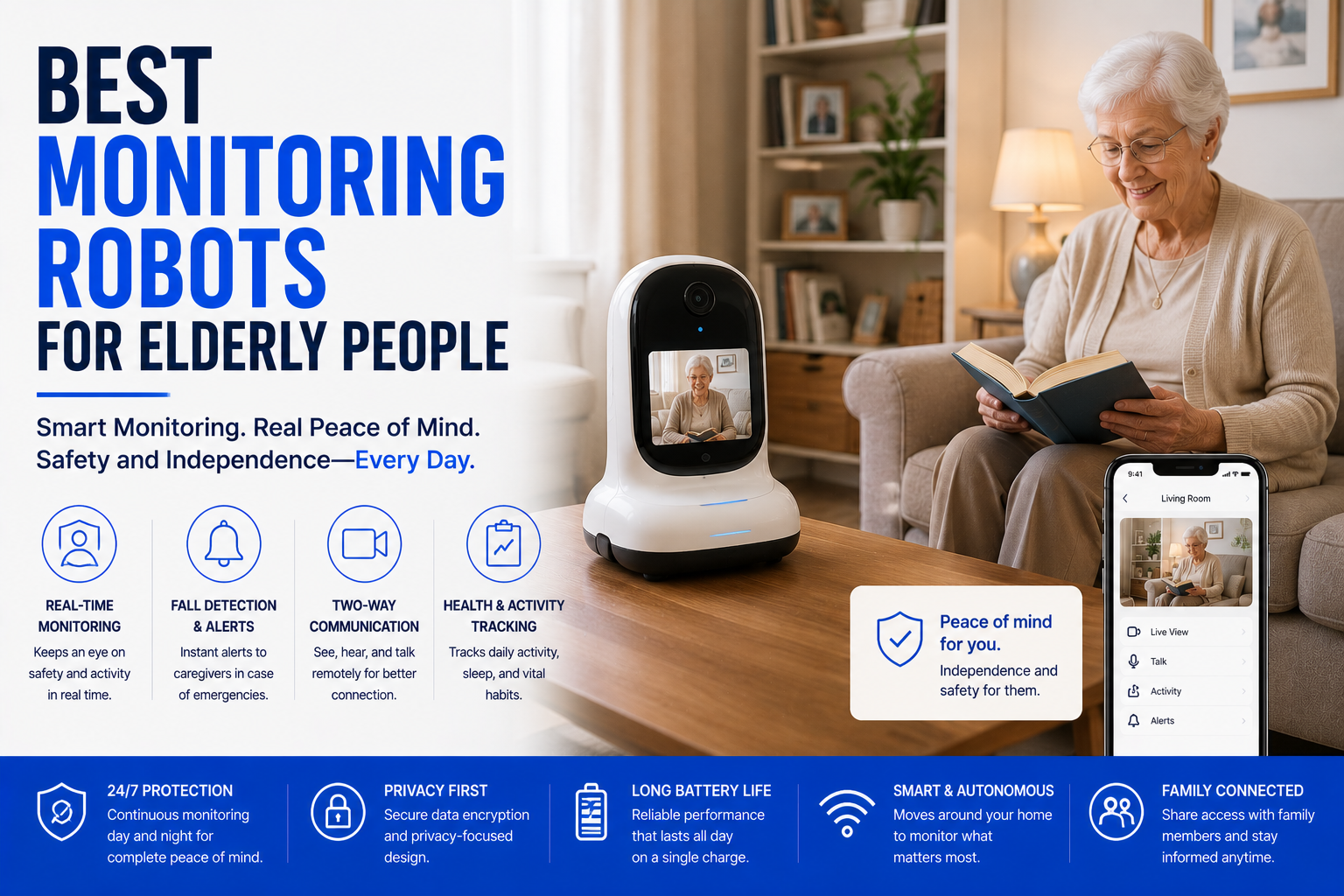
As an Amazon Associate, HomeBotGuide may earn from qualifying purchases at no extra cost to you.
The best monitoring robot for an older adult living alone combines remote video, two-way audio, simple family access, reliable docking, and strong privacy controls. It should complement dedicated fall detection, medical alert services, smoke alarms, and human caregiving rather than acting as the only safety system.
Best Monitoring Robots for Elderly People Living Alone at a Glance
Moves between rooms for remote visual contact.
Provides a larger screen and mobile family presence.
Tracks motion, sound, or activity changes.
Combines remote awareness with emergency response.
Best Monitoring Robots for Elderly People Living Alone Comparison Table
| Type | Best For | Core Features | Important Limitation |
|---|---|---|---|
| Mobile Camera Robot | Remote check-ins | Video, audio, app driving | Cannot climb stairs |
| Telepresence Robot | Family visits | Large display and mobile communication | Higher cost |
| AI Monitoring Robot | Activity awareness | Motion and sound alerts | False alerts |
| Fixed Sensor Network | Continuous monitoring | Door, motion, smoke, leak sensors | No mobile view |
| Medical Alert System | Emergency response | Wearable button and monitoring center | Limited visual context |
| Robot + Sensor System | Layered support | Mobile verification plus fixed alerts | More setup complexity |
What to Consider First
Start with the real environment, user needs, safety requirements, access, power, privacy, and maintenance. The strongest option is the one that fits the actual routine reliably.
- Match the product to the real task and environment.
- Check safety, power, privacy, and access requirements.
- Review maintenance and replacement-part needs.
- Keep a manual or human backup available.
Main Options to Consider
Video, audio, app driving
Large display and mobile communication
Motion and sound alerts
Door, motion, smoke, leak sensors
Monitoring vs Surveillance
The system should support safety and connection with consent, not create constant unwanted observation.
- Confirm compatibility with the actual user or environment.
- Review safety, privacy, and maintenance requirements.
- Test access, navigation, alerts, and backup plans.
- Keep human or manual support available.
Remote Video and Audio
Clear communication and simple family access are more important than novelty AI features.
- Confirm compatibility with the actual user or environment.
- Review safety, privacy, and maintenance requirements.
- Test access, navigation, alerts, and backup plans.
- Keep human or manual support available.
Mobility
A robot can investigate different rooms, but stairs, closed doors, rugs, and clutter limit coverage.
- Confirm compatibility with the actual user or environment.
- Review safety, privacy, and maintenance requirements.
- Test access, navigation, alerts, and backup plans.
- Keep human or manual support available.
Alerts
Motion, sound, inactivity, and routine alerts can provide context but may create false alarms.
- Confirm compatibility with the actual user or environment.
- Review safety, privacy, and maintenance requirements.
- Test access, navigation, alerts, and backup plans.
- Keep human or manual support available.
Privacy and Consent
Use visible indicators, restricted accounts, clear access schedules, and informed consent.
- Confirm compatibility with the actual user or environment.
- Review safety, privacy, and maintenance requirements.
- Test access, navigation, alerts, and backup plans.
- Keep human or manual support available.
Emergency Response
A robot cannot physically assist after a fall or guarantee emergency response.
- Confirm compatibility with the actual user or environment.
- Review safety, privacy, and maintenance requirements.
- Test access, navigation, alerts, and backup plans.
- Keep human or manual support available.
Wi-Fi and Power
Outages can disable remote monitoring, so independent backups remain necessary.
- Confirm compatibility with the actual user or environment.
- Review safety, privacy, and maintenance requirements.
- Test access, navigation, alerts, and backup plans.
- Keep human or manual support available.
Layered Safety
Combine robots with medical alerts, smoke and carbon-monoxide alarms, phones, caregivers, and emergency plans.
- Confirm compatibility with the actual user or environment.
- Review safety, privacy, and maintenance requirements.
- Test access, navigation, alerts, and backup plans.
- Keep human or manual support available.
Automation Still Requires Oversight
Connected robots reduce repetitive work or improve remote access, but they still require setup, supervision, maintenance, secure accounts, and backup plans.
How We Evaluated the Options
We prioritized practical usefulness, safety, reliability, navigation, communication, maintenance, privacy, replacement parts, warranty, and total ownership value.
Final Verdict
The best monitoring robot for an older adult living alone combines remote video, two-way audio, simple family access, reliable docking, and strong privacy controls. It should complement dedicated fall detection, medical alert services, smoke alarms, and human caregiving rather than acting as the only safety system.
Best Monitoring Robots for Elderly People Living Alone FAQ
Can a monitoring robot help an elderly person living alone?
It can support check-ins and communication, but it should not be the only safety system.
Can it detect falls?
Some systems may offer related alerts, but dedicated medical alert devices are safer.
Can family members drive it remotely?
Many mobile monitoring robots allow trusted remote control.
Does it work on multiple floors?
Most cannot climb stairs.
Are monitoring robots private?
They can be when consent and access controls are handled carefully.
What happens during a Wi-Fi outage?
Remote access usually stops.
Can it call emergency services?
Some systems integrate alerts, but capabilities vary.
Is a telepresence robot better than a camera?
It adds mobility and interaction, while fixed cameras provide continuous coverage.
Can it monitor medication use?
It may remind or observe routines but cannot verify safe medication management.
What is the best setup?
Use the robot as one layer alongside medical alerts, sensors, caregivers, and phones.