
Future AI Robots for the Home – The Next Generation of Smart Living
Future AI robots for the home could become one of the biggest changes in smart living. Instead of only vacuuming floors or answering voice commands, the next generation of home robots may help families manage routines, monitor safety, support seniors, assist kids with learning, coordinate smart devices, care for pets, and make everyday life easier.
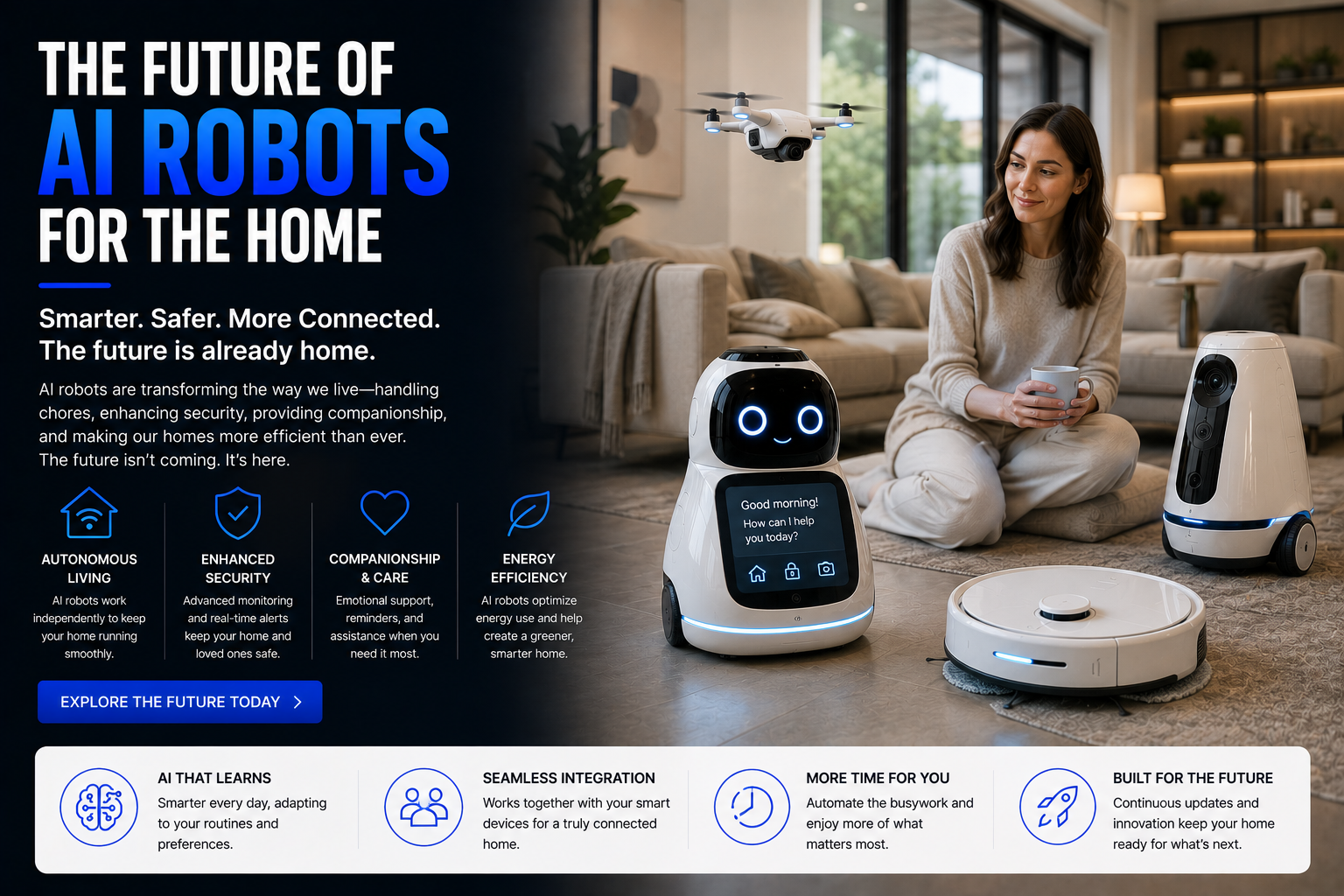
Quick Answer: What Are Future AI Home Robots?
Future AI home robots are expected to be more autonomous, conversational, mobile, and personalized than today's smart home devices. The biggest opportunities are likely in AI home assistants, humanoid robots, companion robots, senior care robots, home monitoring robots, security robots, educational robots, pet care robots, and smart household automation.
Best Future AI Robot Categories by Use Case
| Use Case | Future Robot Category | Why It Matters |
|---|---|---|
| Families | AI home robots and home assistant robots | Could help with reminders, schedules, smart home control, homework routines, and family organization. |
| Seniors | Companion robots and elder care robots | Could support medication reminders, check-ins, communication, wellness routines, and aging in place. |
| Smart homes | Personal assistant robots and smart home robots | Could coordinate lights, thermostats, cameras, locks, cleaning devices, and household automation. |
| Security | Home monitoring robots and security robots | Could patrol indoor spaces, detect unusual activity, and work with smart cameras. |
| Kids and learning | Educational robots | Could support STEM learning, language practice, coding basics, and interactive tutoring. |
| Pets | Pet care robots | Could help with feeding, monitoring, play, litter cleaning, and alerts when owners are away. |
What Will Future AI Home Robots Look Like?
Future AI robots will likely be far more intelligent, helpful, and personalized than most current home robots. Today, many home robots focus on one job, such as vacuuming, mopping, mowing, pool cleaning, or monitoring. Future robots may combine mobility, voice AI, smart home control, computer vision, object recognition, and personalized routines into one more capable assistant.
The biggest upgrade will not only be better hardware. It will be better decision-making. A future home robot may understand who is home, what time of day it is, what tasks usually happen next, which rooms need attention, whether a senior has missed a routine, or whether something unusual is happening in the house.
The biggest difference between today's home robots and future AI home robots will be autonomy. Future robots should need fewer commands and provide more helpful action based on context.
How We Evaluate Future AI Home Robot Potential
HomeBotGuide evaluates home robotics categories by looking at real household usefulness, smart home compatibility, AI capability, safety concerns, privacy tradeoffs, ease of use, price direction, and whether the technology solves a real problem for families, seniors, homeowners, pet owners, or caregivers.
For future robotics topics, we avoid treating every concept as guaranteed. Instead, we focus on categories that already show practical demand: cleaning, monitoring, elder care, companionship, smart home control, home security, education, and personal assistance.
Major Future AI Home Robot Trends
Humanoid Robots
Humanoid robots may eventually help with carrying items, simple household tasks, companionship, senior assistance, and natural interaction with people.
Advanced Home Assistants
AI assistants may become more conversational, proactive, and able to understand long-term household routines instead of only answering single commands.
Healthcare Support
Healthcare robots may help with medication reminders, wellness monitoring, rehabilitation routines, caregiver communication, and daily check-ins.
Personalized Learning
Educational robots could adapt lessons to each child, helping with coding, STEM learning, language practice, reading, and interactive tutoring.
Smart Security
Security robots may patrol homes, recognize unusual activity, coordinate with cameras, and provide mobile awareness that fixed cameras cannot.
Household Automation
Future robots may coordinate cleaning, maintenance, reminders, energy use, deliveries, smart locks, lighting, and home routines from one system.
Looking for AI Robots Available Now?
Future robots are exciting, but current AI home robots, smart home robots, companion robots, and assistant devices are already starting to give families a preview of what is coming.
Browse AI Home RobotsFuture AI Robots for Families
Family-focused AI robots may become central household coordinators. Instead of each family member managing separate reminders, apps, calendars, and devices, a future home robot could help coordinate schedules, school routines, sports activities, shopping lists, homework time, chores, appointments, and smart home settings.
For parents, the most useful robot will not be the most futuristic-looking one. It will be the one that saves time, reduces forgotten tasks, and makes the home easier to manage. That could include voice reminders, room-to-room alerts, homework support, family calendar updates, and automatic routines connected to smart home devices.
Future family robots may also support kids through educational activities, coding games, language practice, STEM projects, reading help, and age-appropriate interactive learning.
Future AI Robots for Seniors and Elder Care
One of the strongest markets for future home robotics is elderly care. Many seniors want to stay independent at home longer, while families want safer ways to monitor routines, medication, communication, and wellness without being physically present all day.
Future elder care robots may help with medication reminders, daily check-ins, emergency alerts, fall-related monitoring, appointment reminders, video calls, cognitive engagement, and caregiver notifications.
The key point is that robots should support caregivers, not replace them. The best future systems will likely combine companionship, safety monitoring, communication, and routine support while keeping human family members involved.
For senior care, privacy, safety, reliability, and caregiver access matter more than flashy features. Any robot used around older adults should be simple, stable, and easy to understand.
Future AI Robots for Smart Homes
| Future Capability | Potential Benefit | Best Related Robot Type |
|---|---|---|
| Predictive Automation | Homes adapt to routines before users manually ask. | AI home robot |
| Advanced Voice AI | More natural conversations and better understanding. | Home assistant robot |
| Computer Vision | Improved awareness of people, pets, rooms, and objects. | Home monitoring robot |
| Smart Device Coordination | Robots connect lights, locks, cameras, thermostats, and appliances. | Smart home robot |
| Energy Management | Smarter use of electricity, climate control, and appliances. | Personal assistant robot |
| Safety Monitoring | More awareness of routines, emergencies, and unusual activity. | Security robot |
| Personalization | Unique routines for parents, children, seniors, and guests. | AI home robot |
Future Home Robots We May See Soon
- Humanoid household assistants that can move naturally around homes.
- AI-powered companion robots for seniors, families, and people living alone.
- Advanced pet care robots that combine feeding, monitoring, and interaction.
- Robotic caregivers that support reminders, wellness routines, and communication.
- Autonomous home monitoring robots that patrol rooms and detect unusual activity.
- Mobile smart home assistants that connect with appliances, cameras, and voice systems.
- AI-powered educational tutors for coding, STEM, reading, and language learning.
- Household maintenance robots for small inspection, organization, or repair support.
- Indoor delivery robots that move items between rooms.
- Multi-purpose family assistant robots that combine scheduling, communication, and automation.
What Makes a Future AI Robot Actually Useful?
It Solves a Real Problem
A robot that only looks impressive will not matter much. The best future robots will save time, improve safety, reduce stress, or help people stay independent.
It Works Without Constant Help
Future home robots need better navigation, better setup, stronger app support, and fewer errors for normal households to trust them.
It Connects With the Smart Home
Robots become more valuable when they work with lights, cameras, locks, thermostats, appliances, speakers, and existing smart home routines.
It Respects Privacy
Because future robots may use cameras, microphones, maps, and personal routines, privacy controls will be critical for buyer trust.
Challenges Future AI Robots Must Overcome
Affordability
Many advanced robots are still expensive. Prices must come down before true home robot adoption becomes mainstream.
Safety
Robots operating around children, pets, stairs, furniture, kitchens, and seniors must be predictable and safe in real homes.
Privacy
Future robots may collect more household data than traditional smart devices, which makes privacy controls and secure data handling extremely important.
Battery Life
Mobile robots need better batteries, smarter charging, and more efficient motors to work for long periods without constant docking.
Real-World Reliability
Homes are messy, unpredictable, and full of different layouts. Robots must work reliably outside perfect demo environments.
Consumer Trust
People need to trust that AI robots will behave safely, clearly, and predictably before allowing them deeper access to daily life.
Who Should Pay Attention to Future AI Home Robots?
Busy Families
Families may benefit from robots that manage schedules, reminders, smart home routines, cleaning coordination, and learning support.
Seniors and Caregivers
Caregiving households may benefit from robots that support reminders, check-ins, monitoring, communication, and independent living.
Smart Home Owners
People already using smart devices may benefit first because future robots will likely connect with cameras, speakers, locks, and appliances.
Who Should Wait Before Buying Advanced AI Robots?
Not every household needs to rush into advanced AI robots. If your main need is cleaning, a proven robot vacuum, robot mop, robotic pool cleaner, or robot lawn mower may offer more practical value today than an expensive general-purpose robot.
People who are highly privacy-sensitive, dislike app-based devices, or need medical-grade reliability should be especially careful with early AI robot products.
For most buyers, the smartest approach is to start with a robot that solves one clear problem, then upgrade as AI home robots become more capable and affordable.
Will Every Home Eventually Have an AI Robot?
It is possible that AI home robots become common over time, but adoption will depend on price, usefulness, reliability, safety, privacy, and trust. Smart speakers became popular because they were affordable and easy to understand. Home robots will need to prove they are worth the space, setup, and cost.
The most successful future robots will likely focus on practical household problems first: cleaning, monitoring, reminders, elder care support, smart home control, companionship, and education.
In other words, the future of home robots will not be won by the robot that looks the most futuristic. It will be won by the robot that makes everyday life easier.
What Future AI Robots Could Mean for Daily Life
Future AI robots could reduce daily stress, improve household organization, support independent living, assist caregivers, help kids learn, strengthen communication, improve home security, and automate repetitive tasks.
Rather than replacing people, future robots will likely work alongside humans. The best systems will help families focus less on repetitive tasks and more on the activities that matter most.
The real goal of future AI home robotics is not simply automation. It is creating homes that feel safer, smarter, healthier, more organized, and more supportive.
Related AI Home Robot Guides
Future AI Robots FAQ
What are future AI home robots?
Future AI home robots are advanced robotic assistants expected to provide more autonomy, intelligence, mobility, personalization, and household support than many current smart devices.
Will humanoid robots become common in homes?
Humanoid robots may become more common if they become affordable, safe, reliable, and useful enough for normal household tasks.
Can future robots replace caregivers?
Future robots may help caregivers with reminders, monitoring, communication, and routine support, but they should not be viewed as full replacements for human care.
Will AI robots become smarter?
Yes, AI robots are expected to improve as artificial intelligence, sensors, navigation, computer vision, batteries, and smart home systems advance.
Are future home robots safe?
Safety will be one of the biggest requirements for adoption, especially around children, seniors, pets, stairs, kitchens, and private spaces.
Will future robots help seniors?
Many future robots are expected to support aging in place through reminders, communication, monitoring, companionship, and caregiver coordination.
Could every home eventually have a robot?
It is possible, but only if robots become affordable, reliable, easy to use, and clearly helpful for everyday life.
What are the most useful home robots today?
For most homes, the most practical robots today are robot vacuums, robot mops, robotic pool cleaners, robot lawn mowers, pet care devices, and smart home monitoring devices.
Do future AI robots need WiFi?
Most advanced AI home robots will likely need WiFi or app connectivity for updates, voice features, smart home integration, and remote access.
Are AI home robots good for families?
They can be useful for families if they help with reminders, routines, learning, monitoring, smart home control, or daily organization.
Are AI robots private?
Privacy depends on the product. Buyers should check camera controls, microphone settings, cloud storage, app permissions, and data policies before buying.
What industries will benefit most from home robotics?
Elder care, healthcare support, smart homes, education, security, pet care, cleaning, and personal productivity are likely to benefit strongly.
The Future of Home Robotics Is Already Beginning
Future AI home robots may transform how families live, learn, communicate, care for loved ones, manage homes, monitor safety, and interact with technology. The smartest approach is to understand where the technology is going while choosing practical robots that solve real household problems today.
Explore AI Home Robots