
Window Cleaning Robot vs Manual Cleaning: Which Is Better?
Window cleaning robots and manual window cleaning both help keep glass cleaner, but they are not the same. This guide compares robotic window cleaners, manual glass cleaning, squeegees, microfiber cloths, spray bottles, ladder cleaning, high-window cleaning, apartment window cleaning, patio door cleaning, mirror cleaning, shower glass cleaning, safety, cost, convenience, streaks, maintenance, and long-term value.
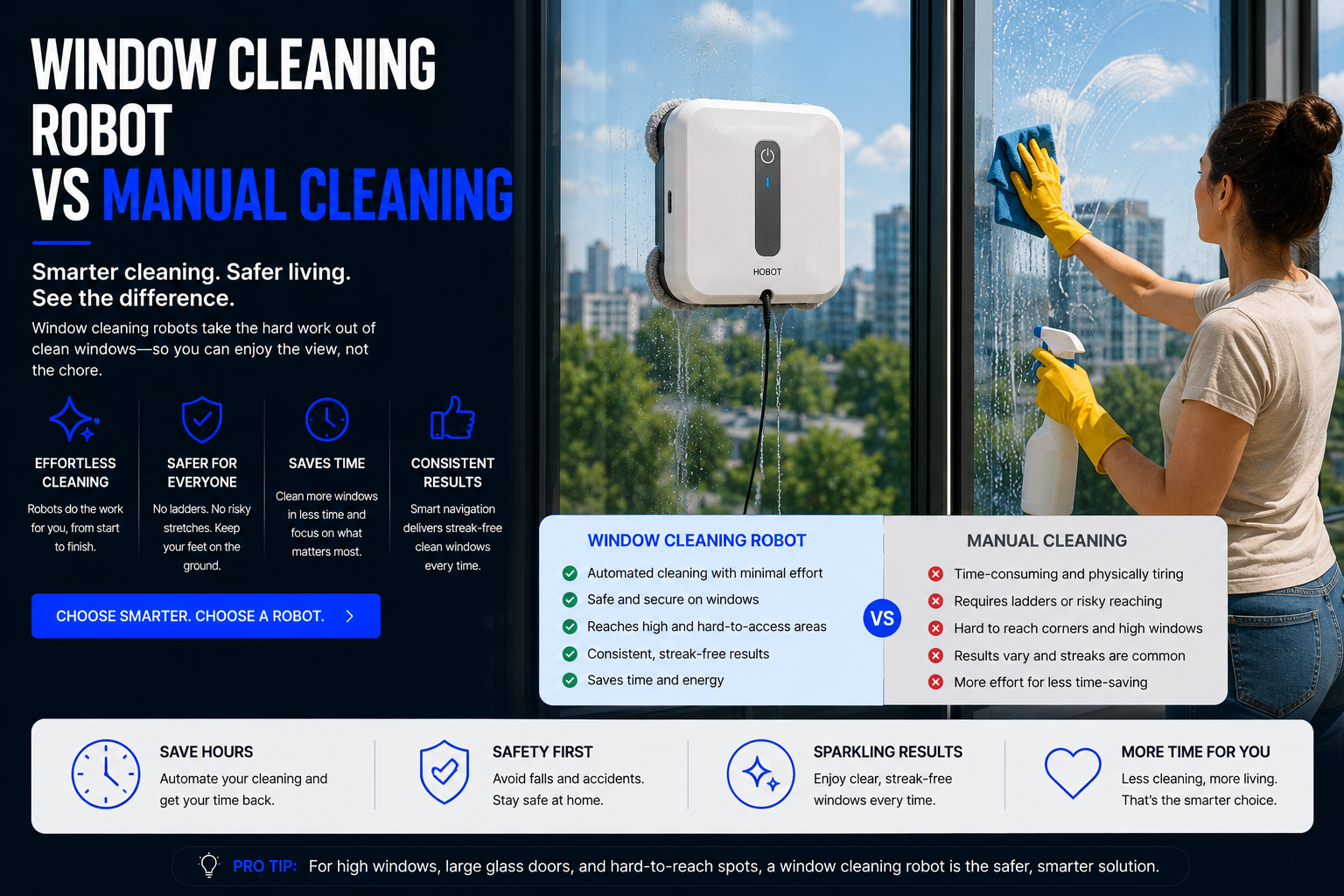
Window Cleaning Robot vs Manual Cleaning: Quick Answer
A window cleaning robot is better if you want easier routine glass maintenance, less repetitive wiping, help with large windows, patio doors, mirrors, apartment glass, and some hard-to-reach surfaces. Manual window cleaning is better if you want lower cost, full control, deeper scrubbing, edge detail, corner cleaning, heavy grime removal, and the ability to clean any glass shape.
For many homeowners, the best answer is not one or the other. A window cleaning robot can handle regular maintenance on large flat glass, while manual cleaning is still useful for corners, frames, tracks, heavy dirt, sticky residue, mineral buildup, bird mess, and detailed finishing.
Best rule: choose a window cleaning robot for convenience and routine maintenance; choose manual cleaning for deep cleaning, heavy grime, edges, corners, and complete control.
Window Cleaning Robot vs Manual Cleaning Comparison
| Category | Window Cleaning Robot | Manual Window Cleaning |
|---|---|---|
| Convenience | More convenient for repeated routine cleaning | Requires physical effort every time |
| Upfront Cost | Higher upfront cost | Lower cost for cloths, spray, and squeegee |
| Best Surfaces | Large flat glass, patio doors, mirrors, some apartment windows | Any glass size, edges, frames, tracks, and corners |
| Heavy Grime | May struggle without pre-cleaning | Better for deep scrubbing and stubborn dirt |
| Streak Control | Depends on pads, solution, glass condition, and robot path | Depends on technique, tools, and cleaner used |
| Safety | Can reduce reaching, but needs suction, rope, and proper setup | Can involve ladders, reaching, and manual risk |
| Speed | Good for hands-off cleaning, but not always faster | Can be faster for small jobs or spot cleaning |
| Maintenance | Requires pad washing, sensor cleaning, cord care, suction checks | Requires tool cleaning and replacement supplies |
| Best For | Routine maintenance and large glass surfaces | Deep cleaning and precision control |
What Is a Window Cleaning Robot?
A window cleaning robot is an automatic glass-cleaning device that attaches to windows using suction and moves across the surface with cleaning pads. Some models use square microfiber pads, some use rotating pads, and some include automatic spray systems.
Window cleaning robots are designed to reduce manual wiping and help with routine cleaning on smooth glass surfaces. They are commonly used on windows, patio doors, balcony glass, large mirrors, shower doors, and some hard-to-reach glass panels.
Most robotic window cleaners are best for maintenance cleaning. They can help remove light dust, fingerprints, pet marks, smudges, pollen, and routine grime. They are usually not the best tool for years of buildup, paint, sticky residue, heavy mineral spots, or very dirty exterior glass without pre-cleaning.
What Is Manual Window Cleaning?
Manual window cleaning means cleaning glass by hand using tools such as microfiber cloths, squeegees, spray bottles, cleaning solution, scrubbers, extension poles, ladders, towels, or professional window cleaning tools.
Manual cleaning gives you full control. You can scrub edges, clean corners, wipe frames, remove residue, handle small panes, clean tracks, and apply pressure where the glass is dirtiest.
The downside is that manual cleaning takes more physical effort. It may involve bending, reaching, ladder use, repeated wiping, drying, and more time on large glass surfaces.
When a Window Cleaning Robot Is Better
Large Flat Windows
Robotic window cleaners work best on large, flat glass surfaces where the robot has enough space to move properly.
Patio Doors
Sliding glass doors and patio doors are strong use cases because they collect fingerprints, pet marks, and dust often.
Routine Maintenance
A window robot is useful for keeping already-reasonably-clean glass maintained with less manual wiping.
Apartment Glass
Apartment windows and balcony doors can be easier to maintain with a robot when safety instructions are followed.
Reduced Reaching
A robot may reduce some bending, reaching, stretching, and repetitive arm movement during glass cleaning.
Smart Home Users
Window robots fit naturally into a home automation setup with robot vacuums, robot mops, and home maintenance robots.
When Manual Window Cleaning Is Better
Heavy Dirt and Grime
Manual cleaning is better for thick dirt, bird mess, sticky residue, construction dust, and stubborn buildup.
Edges and Corners
Manual tools can clean edges, tracks, frames, corners, and tight areas that robots may miss.
Small Window Panes
Very small windows, divided panes, and narrow glass panels may not give a robot enough space to move.
Textured Glass
Many robots are designed for smooth glass and may not work well on textured or uneven glass.
Lower Budget
Manual tools cost much less upfront than a robotic window cleaner.
Full Control
Manual cleaning lets you apply pressure, change technique, and focus on problem spots immediately.
Cleaning Quality: Which Gets Windows Cleaner?
Manual cleaning can usually deliver the deepest clean because you can scrub problem areas directly, use a squeegee carefully, wipe edges, clean frames, and apply more pressure where needed.
A window cleaning robot can still deliver good results on flat glass when the pads are clean, the right amount of solution is used, and the glass is not extremely dirty. The robot is especially useful for regular maintenance cleaning rather than one-time deep cleaning.
If the glass is already maintained, a robot can keep it looking cleaner with less effort. If the glass is neglected, manual cleaning usually needs to come first.
Safety: Robot vs Manual Cleaning
Manual window cleaning can become risky when ladders, high glass, awkward reaches, wet surfaces, or exterior windows are involved. Window cleaning robots may reduce some reaching and ladder use, but they also need safe setup.
A window cleaning robot relies on suction, power, safety rope attachment, backup battery, and correct glass compatibility. It should not be used casually on high exterior glass without following the manufacturer’s instructions.
The safest option depends on the window. For low indoor glass, manual cleaning is simple. For large or high glass, a robot may reduce some physical risk, but only when used correctly.
Cost Comparison
Manual window cleaning is cheaper upfront. A basic microfiber cloth, spray bottle, squeegee, and cleaning solution cost far less than a window cleaning robot.
A window cleaning robot costs more upfront, but it can save time and effort over repeated cleaning sessions. It may be more valuable if you have many windows, large patio doors, mirrors, balcony glass, or family and pets that create frequent smudges.
The value depends on how often you clean windows, how much glass your home has, and how much you dislike manual window cleaning.
Maintenance Comparison
| Maintenance Area | Window Cleaning Robot | Manual Cleaning Tools |
|---|---|---|
| Cleaning Pads | Wash after every use | Wash cloths and scrubbers |
| Solution Use | Use correct amount to avoid slipping or streaks | Use as needed by hand |
| Sensors | Wipe sensors and edge detection areas | Not needed |
| Safety Equipment | Inspect safety rope and backup battery | Inspect ladders, poles, and tools |
| Power | Check cord, adapter, and backup battery | No power needed |
| Storage | Store robot, pads, rope, cord, and accessories dry | Store cloths, squeegee, solution, and pole |
Which Is Better by Window Type?
Patio Doors
A window cleaning robot is often better for maintenance cleaning because patio doors are large, flat, and frequently smudged.
Small Divided Windows
Manual cleaning is usually better because window robots may not fit or move properly on small panes.
High Windows
A robot may help reduce reaching, but safety setup is critical. Manual cleaning may still be needed for edges and heavy buildup.
Apartment Windows
A robot can be helpful for apartment glass and balcony doors, but only when the safety rope and suction setup are secure.
Mirrors
Large mirrors can work well with a robot. Small mirrors or framed decorative mirrors may be easier manually.
Shower Glass
A robot may help maintain shower glass, but manual cleaning is better for heavy soap scum and mineral buildup.
Outdoor Windows
Manual cleaning is better for heavy outdoor dirt. A robot can help maintain exterior glass after it is already reasonably clean.
Common Mistakes When Comparing Robot and Manual Cleaning
- Expecting a robot to deep clean: Window robots are best for maintenance cleaning, not heavy buildup.
- Ignoring edges: Robots may miss corners, tracks, and frames that manual cleaning handles better.
- Using dirty pads: Dirty pads can make robotic cleaning look worse than it should.
- Using too much liquid: Too much solution can cause streaks or slipping.
- Buying a robot for tiny windows: Small panes may not work with robotic cleaners.
- Ignoring safety: High windows require proper safety rope setup and compatible glass.
- Thinking manual is always better: Manual cleaning is deeper, but a robot may be easier for routine repeated cleaning.
- Thinking robots replace all cleaning: A robot reduces work, but manual detail cleaning may still be needed.
Final Verdict: Window Robot or Manual Cleaning?
Choose a window cleaning robot if you want convenience, easier routine cleaning, help with large glass, less repetitive wiping, and a smarter home maintenance routine.
Choose manual window cleaning if you want the lowest cost, complete control, deeper scrubbing, edge cleaning, frame cleaning, track cleaning, and the ability to remove heavy dirt.
For most homes, the best system is both. Use a robotic window cleaner for routine maintenance on large flat glass, and use manual cleaning for corners, frames, tracks, heavy grime, and detail work.
Future of Window Cleaning Robots and Manual Cleaning
Window cleaning robots will likely improve as suction systems, sensors, AI navigation, spray systems, cleaning pads, backup batteries, and smart home integration become better. Future models may clean more evenly, detect edges more accurately, reduce streaks, and handle more glass types.
Manual cleaning will not disappear because some tasks require direct control. Corners, frames, heavy buildup, small panes, textured glass, and detailed finishing may still need human cleaning.
The future is likely hybrid: window robots for regular maintenance and manual tools for detail cleaning, just like many homes use robot vacuums plus regular vacuums for deeper cleaning.
Related Window Cleaning Robot Guides
Related Home Robot Guides
Window Cleaning Robot vs Manual Cleaning FAQ
Is a window cleaning robot better than manual cleaning?
A window cleaning robot is better for convenience and routine maintenance, while manual cleaning is better for deep cleaning, corners, frames, and heavy grime.
Do window cleaning robots clean as well as humans?
They can clean well on large flat glass, but manual cleaning usually gives better detail control.
Can a window robot replace manual cleaning?
Not completely. It can reduce manual cleaning but may not replace edge work, frames, tracks, or deep cleaning.
Are window cleaning robots worth it?
They can be worth it if you have large windows, patio doors, mirrors, apartment glass, or frequent glass smudges.
Is manual window cleaning cheaper?
Yes. Manual cleaning tools cost much less upfront than a robotic window cleaner.
Which is safer for high windows?
It depends. Robots may reduce reaching, but they require proper suction, safety rope setup, and compatible glass.
Do window cleaning robots leave streaks?
They can leave streaks if pads are dirty, too much solution is used, or the glass is heavily soiled.
Does manual cleaning leave fewer streaks?
Manual cleaning can leave fewer streaks with good technique, clean tools, and proper squeegee use.
Can window robots clean corners?
Some clean closer to edges than others, but manual cleaning is usually better for corners.
Can window robots clean frames and tracks?
No. Frames and tracks usually require manual cleaning.
Are robots good for patio doors?
Yes. Patio doors are one of the best uses for robotic window cleaners because they are large and flat.
Are robots good for small windows?
Not always. Small panes may not give the robot enough space to move properly.
Can robots clean outdoor windows?
Some can clean certain outdoor windows, but safety setup and glass compatibility are very important.
Should I manually clean before using a window robot?
If the glass is very dirty, yes. Robots work best on glass that is already reasonably clean.
What is the best setup for most homes?
Use a window robot for routine maintenance and manual cleaning for deep cleaning, edges, frames, tracks, and problem spots.
Shop Window Cleaning Robots
Window cleaning robots can make glass maintenance easier, especially for large windows, patio doors, mirrors, apartment glass, and routine cleaning. Compare robotic window cleaners, manual cleaning needs, high-window robots, budget window robots, spray window cleaners, and home maintenance robots before choosing the best method for your home.
Shop Window Cleaning Robots