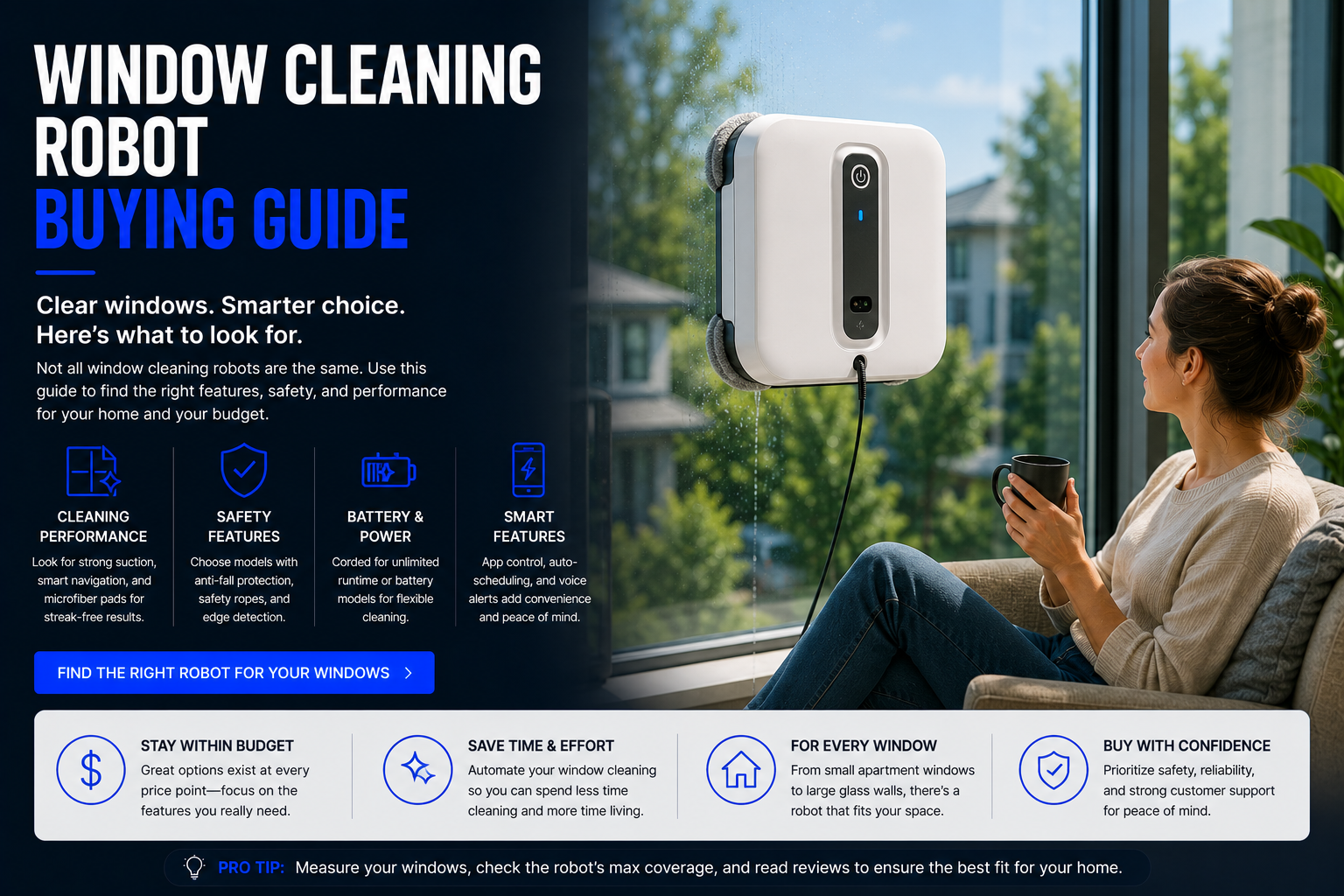
Window Cleaning Robot Buying Guide: How to Choose the Right Robot
Choosing the right window cleaning robot depends on your window type, glass size, safety needs, home layout, budget, cleaning expectations, suction power, spray system, edge detection, backup battery, safety rope, and whether you need a robot for apartments, high windows, patio doors, mirrors, shower glass, framed windows, frameless glass, or everyday home maintenance.
How Do You Choose the Right Window Cleaning Robot?
To choose the right window cleaning robot, start with your glass type and window layout. Then compare suction strength, safety rope, backup battery, framed or frameless glass compatibility, minimum window size, cleaning pad quality, spray system, power cord length, navigation pattern, noise level, ease of maintenance, and whether the robot is designed for indoor use, outdoor use, high windows, apartments, large glass doors, or routine home cleaning.
The best window cleaning robot is not always the most expensive model. A simple home with framed windows, mirrors, and patio doors may only need a budget robotic window cleaner. A home with tall glass, exterior windows, frameless panels, large modern windows, or frequent cleaning needs may require a more advanced model with stronger safety features and better navigation.
Window cleaning robots can reduce manual wiping, help with large glass surfaces, make window maintenance easier, and fit into a smart home cleaning system with robot vacuums, robot mops, home maintenance robots, AI home robots, and home monitoring robots. But they are not magic deep cleaners. The right model should match your actual windows and expectations.
Quick answer: choose a window cleaning robot based on suction safety, glass compatibility, window size, safety rope, backup battery, cleaning pads, spray system, power reach, route planning, and whether your windows are framed, frameless, high, indoor, outdoor, or apartment-style.
What Is a Window Cleaning Robot?
A window cleaning robot is an automatic glass-cleaning device that attaches to a window or smooth glass surface using suction. Once attached, it moves across the glass with cleaning pads, microfiber cloths, wheels, tracks, sensors, or programmed cleaning paths.
The category includes robotic window cleaners, automatic glass cleaners, window washing robots, smart window cleaning robots, budget window cleaning robots, spray window cleaning robots, high-window cleaning robots, apartment window robots, and home maintenance robots designed for glass surfaces.
Most window cleaning robots are designed for maintenance cleaning. They can help remove dust, fingerprints, light smudges, pet nose marks, water marks, and routine grime. Very dirty exterior glass, heavy mineral buildup, bird mess, paint, construction dust, and sticky residue may still require manual pre-cleaning.
How Window Cleaning Robots Work
Most window cleaning robots work by creating suction against the glass. The suction motor keeps the robot attached vertically while the robot moves across the window. Cleaning pads wipe the glass as the robot follows a programmed route.
Some models use square designs that move in more structured patterns. Others use round spinning pads. Some include spray systems that mist water or cleaning solution. Some include app controls, remote controls, backup batteries, edge sensors, frameless glass detection, or automatic stop features.
A window cleaning robot usually needs power from an outlet, although the backup battery may help the robot stay attached temporarily if power is interrupted. Most are not fully cordless in the same way robot vacuums are cordless. The power cord, extension cord, safety rope, and attachment point are all important parts of setup.
Window Cleaning Robot Buying Guide
Check Your Window Type
The first buying decision is window type. Traditional framed windows are usually easier for robotic window cleaners because the frame helps the robot detect edges and stay within the cleaning area.
Frameless glass requires stronger edge detection. If your glass has no frame, do not assume every window cleaning robot will work. Look specifically for frameless glass support before buying.
Measure Your Window Size
Many window cleaning robots require a minimum glass size. Very small windows, divided panes, narrow panels, decorative windows, or irregular glass shapes may not give the robot enough space to move properly.
Large glass surfaces such as patio doors, sliding doors, balcony glass, and large mirrors are often better fits because the robot has more room to follow its cleaning pattern.
Prioritize Suction Strength
Suction strength is one of the most important safety and performance features. The robot must stay attached to vertical glass while it cleans. Weak suction can lead to slipping, poor movement, or safety concerns.
Good suction also helps the cleaning pads stay in contact with the surface. For high windows, exterior glass, or large panels, do not choose only by price. Safety and suction matter first.
Check Safety Rope and Backup Battery
A safety rope helps protect the robot if suction fails or the robot detaches. A backup battery may help the robot stay attached temporarily during a power interruption, depending on the model.
If you are using the robot on high windows, apartment glass, balcony doors, or exterior-facing windows, safety setup is not optional. The safety rope must be attached correctly to a secure anchor point.
Choose the Right Cleaning Pad System
Window cleaning robots use microfiber pads, cloth pads, or spinning pads to wipe the glass. Pad quality affects streaking, dust pickup, and overall cleaning results.
Washable pads are helpful because window robots need clean pads to work well. Dirty pads can spread grime instead of removing it. If you clean many windows, extra replacement pads are useful.
Decide Whether You Need a Spray System
Some window cleaning robots include automatic spray systems. Others require you to dampen the pad manually. Spray systems can improve convenience, especially for routine cleaning and larger glass surfaces.
However, more liquid is not always better. Too much cleaning solution can cause streaks, slipping, or poor movement. Follow the manufacturer’s instructions for water or approved cleaning solution.
Compare Navigation and Edge Detection
Basic window robots may follow simple movement patterns. More advanced robots may use smarter route planning, edge sensors, automatic path detection, or improved navigation.
If you have large windows, frameless glass, balcony glass, or high windows, better navigation and edge detection can make the robot easier and safer to use.
Check Power Cord Reach
Many window cleaning robots need plug-in power while cleaning. That means the power cord and extension setup must safely reach the full window area.
Before buying, think about outlet placement, window height, extension cord safety, and where the safety rope will attach. A robot with great features can still be inconvenient if the cord does not reach your windows.
Think About Noise Level
Window cleaning robots use suction motors, so they are not silent. Budget models may be louder than premium models. If you plan to clean many windows or use the robot in an apartment, noise may matter.
Noise is not always a dealbreaker, but it is part of real ownership. A robot that sounds too loud may not be used as often.
Match the Robot to Your Use Case
A homeowner with large patio doors needs a different robot than an apartment renter with balcony glass. A person cleaning mirrors and shower glass needs different features than someone cleaning high exterior windows.
The best window cleaning robot is the one that fits the surfaces you will actually clean most often.
Window Cleaning Robot Types Compared
| Robot Type | Best For | Main Benefit | Possible Limitation |
|---|---|---|---|
| Budget Window Cleaning Robot | Basic home windows and mirrors | Lower price and simple cleaning | Fewer advanced features |
| Spray Window Cleaning Robot | Routine glass maintenance | Automatic misting can improve convenience | Spray quality varies by model |
| High-Window Cleaning Robot | Tall glass and hard-to-reach areas | Can reduce manual reaching | Safety setup is critical |
| Apartment Window Robot | Renters, condos, balcony glass | Helpful for large apartment windows | Must follow safety rules carefully |
| Premium Smart Window Robot | Frequent cleaning and larger homes | Better navigation, sensors, and controls | Higher price |
Most Important Features to Compare
Suction Power
Strong suction keeps the robot attached and helps the pads maintain contact with the glass.
Safety Rope
A safety rope is especially important for high windows, exterior glass, apartments, and balcony windows.
Backup Battery
Backup power may help the robot stay attached temporarily during a power interruption.
Edge Detection
Edge detection matters most for frameless glass and windows without physical borders.
Spray System
Automatic spray can make routine cleaning easier, but it does not replace deep cleaning for very dirty glass.
Cleaning Pads
Good microfiber pads reduce streaking and improve dust, fingerprint, and smudge removal.
Framed vs Frameless Windows
Framed windows are usually easier for window cleaning robots. The physical frame creates a border that helps guide the robot and reduce the risk of moving beyond the glass edge.
Frameless glass is more demanding. The robot needs reliable edge detection because there may be no frame to stop it. If you have frameless balcony glass, frameless shower panels, glass railings, or modern frameless windows, compatibility is one of the most important buying factors.
Do not buy a robot for frameless glass unless the manufacturer clearly says the model supports it. A cheaper robot that works on framed windows may not be safe or effective on frameless glass.
Indoor vs Outdoor Window Cleaning Robots
Indoor glass is usually easier to clean because it often has fingerprints, dust, pet nose marks, light smudges, and normal household residue. Window cleaning robots can be useful for mirrors, patio doors, shower glass, and large interior glass.
Outdoor glass is more difficult. Exterior windows may collect pollen, dirt, rain spots, dust, bird mess, mineral deposits, and weather buildup. A window robot can help with maintenance, but heavily dirty outdoor glass may need manual pre-cleaning.
If you plan to use the robot outside, safety rope setup, suction reliability, power cord safety, weather conditions, and glass compatibility matter much more. Never use a window robot outdoors in unsafe conditions.
Best Window Cleaning Robot by Use Case
For Apartments
Apartment users should prioritize safety rope attachment, stable suction, compact design, and simple controls. Balcony doors and large flat apartment windows are often good matches.
For High Windows
High windows require a safety-first approach. Look for strong suction, backup battery, a secure safety rope system, and clear operating instructions.
For Patio Doors
Sliding glass doors and patio doors are some of the best surfaces for window cleaning robots because they are large, flat, and easy for the robot to navigate.
For Mirrors
Many window robots can clean large mirrors if the mirror is big enough and the surface is compatible. Small mirrors may not provide enough movement space.
For Shower Glass
A window robot may help maintain shower glass, but soap scum and mineral buildup often need manual pre-cleaning first.
For Large Homes
Homes with many windows may benefit from better navigation, more pads, improved spray systems, and easier maintenance.
Budget vs Premium Window Cleaning Robots
Budget window cleaning robots are best for simple windows, patio doors, mirrors, framed glass, routine cleaning, and first-time buyers. They usually focus on basic suction, movement, cleaning pads, and simple controls.
Premium window cleaning robots may offer stronger suction, smarter navigation, improved edge detection, app control, quieter motors, better spray systems, larger cleaning coverage, and more refined safety features.
If your windows are simple, budget may be enough. If you have high glass, frameless glass, many windows, frequent cleaning needs, or exterior-facing windows, premium features may be worth paying for.
Common Window Cleaning Robot Buying Mistakes
- Buying only by price: The cheapest model may not have the safety or compatibility your windows need.
- Ignoring frameless glass: Not every robot works on frameless windows or glass railings.
- Skipping safety rope setup: The safety rope matters, especially for high windows and exterior glass.
- Expecting deep cleaning: Window robots are best for maintenance cleaning, not heavy grime removal.
- Using dirty pads: Dirty pads can leave streaks and spread grime.
- Using too much solution: Too much liquid can cause slipping or streaking.
- Ignoring power cord reach: Plug-in robots need safe access to power.
- Using on small panes: Small divided windows may not be compatible.
- Ignoring noise: Suction motors can be louder than expected.
- Forgetting maintenance: Pads, sensors, suction areas, cords, and storage all matter.
Are Window Cleaning Robots Worth It?
Window cleaning robots can be worth it if you have large windows, patio doors, apartment glass, mirrors, shower glass, or hard-to-reach surfaces that need routine maintenance. They can reduce manual wiping and make glass cleaning less annoying.
They are less useful if your windows are very small, heavily divided, textured, cracked, extremely dirty, or unsafe to access. They also may not replace professional window cleaning for high exterior glass, commercial buildings, or deep grime.
For many homes, the best way to think about a window cleaning robot is as a maintenance helper. It keeps reasonably clean glass cleaner with less effort, but occasional manual cleaning may still be needed.
Future of Window Cleaning Robots
Window cleaning robots are likely to improve as sensors, suction motors, battery backup systems, app controls, cleaning pads, spray systems, and AI navigation become better. Future models may clean faster, detect edges more accurately, reduce streaks, handle frameless glass better, and integrate more smoothly with smart homes.
As home robotics grows, window cleaning robots may become part of a larger home maintenance system with robot vacuums, robot mops, robotic pool cleaners, robot lawn mowers, home monitoring robots, AI home robots, and smart assistant robots.
The long-term direction is clear: more cleaning tasks will become automated, and window robots will likely become smarter, safer, quieter, and easier to use.
Related Window Cleaning Robot Guides
Related Home Robot Guides
Window Cleaning Robot Buying Guide FAQ
What is a window cleaning robot?
A window cleaning robot is an automatic glass-cleaning device that attaches to windows with suction and moves across the glass using cleaning pads.
How do window cleaning robots work?
Most use suction to stay attached to glass while motors move the robot across the window. Cleaning pads wipe the surface as the robot moves.
Are window cleaning robots worth it?
They can be worth it for large windows, patio doors, mirrors, apartments, and routine glass maintenance.
Do window cleaning robots really clean windows?
Yes, they can clean dust, fingerprints, light smudges, pet marks, and routine grime, but very dirty glass may need manual pre-cleaning.
Can window cleaning robots clean outside windows?
Some can clean certain outside windows, but only when the setup is safe, compatible, and follows the manufacturer’s instructions.
Can window cleaning robots clean inside windows?
Yes, indoor glass is often one of the best uses for robotic window cleaners.
Do window cleaning robots work on frameless glass?
Some do, but not all. Frameless glass requires reliable edge detection.
Do window cleaning robots work on framed windows?
Yes, framed windows are usually easier for most window cleaning robots.
Can window cleaning robots clean mirrors?
Many can clean large mirrors if the mirror is compatible and large enough.
Can window cleaning robots clean shower doors?
Some can help maintain shower glass, but heavy soap scum or mineral buildup may need manual cleaning first.
Can window cleaning robots clean skylights?
Some may work on skylights, but compatibility, angle, power reach, and safety setup must be checked carefully.
Are window cleaning robots safe?
They can be safe when used correctly with strong suction, a safety rope, backup power, compatible glass, and proper setup.
Can a window cleaning robot fall?
It is possible if suction fails, the robot is used incorrectly, or the glass is incompatible. That is why safety ropes and correct setup matter.
What happens if the power goes out?
Many models include a backup battery that helps the robot stay attached temporarily, but you should still follow the safety instructions.
Do window cleaning robots leave streaks?
They can leave streaks if pads are dirty, glass is heavily soiled, too much liquid is used, or the robot is not suitable for the surface.
Do window cleaning robots use water?
Some use water, some use cleaning solution, and some require damp pads. Follow the manufacturer’s instructions.
Do window cleaning robots need cleaning solution?
Not always. Some work with water or damp pads, while others support approved cleaning solutions.
How often should cleaning pads be washed?
Pads should usually be washed after use or whenever they become dirty, because dirty pads can cause streaks.
How long do window cleaning robots last?
Lifespan depends on build quality, usage, maintenance, storage, pad care, suction motor condition, and power system care.
Are window cleaning robots noisy?
They can be noisy because they use suction motors. Noise level varies by model.
Do window cleaning robots work on textured glass?
Many are designed for smooth glass and may not work well on textured or uneven glass.
Can window cleaning robots clean tinted windows?
Some may work, but check compatibility and avoid using harsh cleaning solutions that could damage tint.
Are window cleaning robots good for apartments?
Yes, they can be useful for apartment windows and balcony glass, but safety setup is very important.
Are window cleaning robots good for elderly homeowners?
They may help reduce reaching and manual wiping, but setup and safety still need to be manageable.
Are window cleaning robots better than manual cleaning?
They are better for convenience and routine maintenance, but manual cleaning may still be better for heavy grime, corners, and deep cleaning.
How much should I spend on a window cleaning robot?
Spend based on your windows. Simple framed windows may only need a budget model, while high or frameless glass may need premium features.
Can window cleaning robots replace professional window cleaning?
Not completely. They can reduce routine cleaning, but professional cleaning may still be needed for high exterior glass or heavy buildup.
What features matter most?
The most important features are suction strength, safety rope, backup battery, window compatibility, edge detection, cleaning pads, spray system, and power reach.
Shop Window Cleaning Robots
The right window cleaning robot should match your glass type, window size, safety needs, cleaning habits, and budget. Compare budget robotic window cleaners, high-window robots, apartment window robots, spray window robots, smart glass cleaners, and home maintenance robots before choosing the best option for your home.
Shop Window Cleaning Robots