
Robot Lawn Mower vs Traditional Mowing: Which Is Better?
Robot lawn mowers and traditional lawn mowers both cut grass, but they fit very different homeowners. This guide compares robotic lawn mowers, push mowers, gas mowers, electric mowers, riding mowers, automatic mowing systems, smart lawn mowers, boundary wire robot mowers, wire-free robot mowers, and traditional mowing routines to help you decide which option is better for your yard, budget, schedule, and lawn care style.
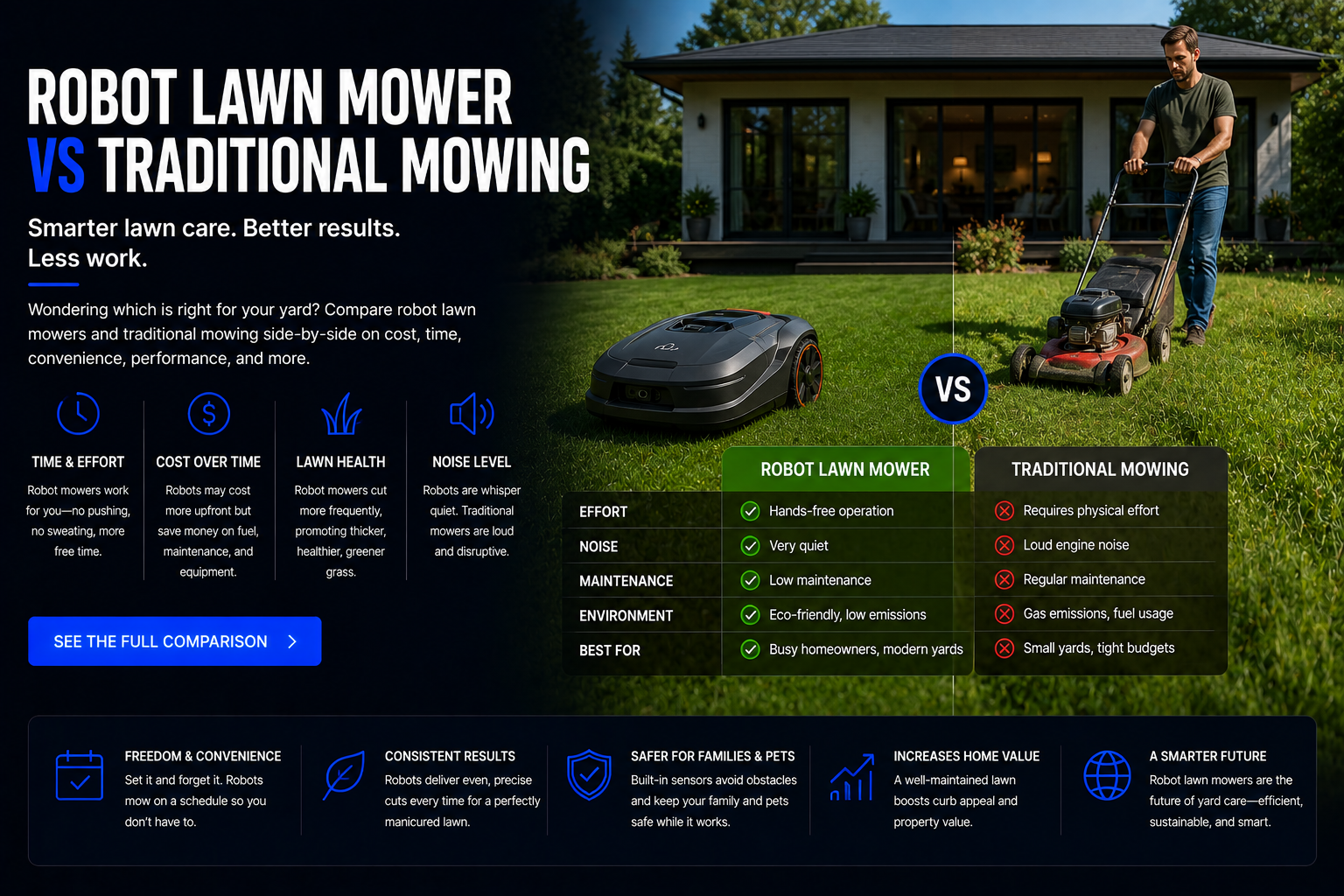
Robot Lawn Mower vs Traditional Mowing: Quick Answer
A robot lawn mower is better if you want automatic mowing, less weekly yard work, quieter operation, frequent grass trimming, and a smarter lawn care routine. Traditional mowing is better if you want lower upfront cost, full manual control, faster one-time mowing, better handling of overgrown grass, and fewer setup requirements.
For small to medium lawns with simple layouts, a robotic lawn mower can be a strong upgrade because it keeps grass trimmed automatically on a schedule. For large, rough, steep, or complex yards, traditional mowing may still be easier unless you choose a higher-end robot lawn mower with better navigation, slope handling, multi-zone support, and smart mapping.
The best choice depends on your lawn size, grass growth, yard shape, slopes, obstacles, pets, kids, budget, mowing expectations, and whether you prefer hands-off automation or direct control.
Best overall rule: choose a robot lawn mower for consistent automated maintenance, and choose traditional mowing if your priority is low upfront cost, full control, or handling tough grass conditions.
Robot Lawn Mower vs Traditional Mower Comparison
| Category | Robot Lawn Mower | Traditional Mowing |
|---|---|---|
| Convenience | Very convenient after setup because mowing is automated | Requires manual mowing each time |
| Upfront Cost | Usually higher upfront cost | Usually lower for basic push or electric mowers |
| Time Savings | Saves significant weekly mowing time | Requires your time and effort |
| Grass Cutting Style | Frequent small trims | Less frequent larger cuts |
| Setup | May require boundary wire, mapping, app setup, or dock placement | Usually ready after fuel, charge, or basic assembly |
| Noise | Usually quieter | Can be louder, especially gas mowers |
| Best Yard Type | Small to medium lawns, simple layouts, maintained grass | Any yard, especially rough, tall, or complex lawns |
| Maintenance | Blade replacement, cleaning, dock care, boundary or sensor checks | Blade sharpening, fuel or battery care, oil, belts, engine or motor care |
| Control | Automated and schedule-based | Full manual control |
| Long-Term Value | Strong if used regularly | Strong if you do not mind mowing manually |
What Is a Robot Lawn Mower?
A robot lawn mower is an automatic lawn mowing machine that cuts grass on a schedule with little day-to-day effort from the homeowner. Instead of mowing the whole lawn once per week like a traditional mower, most robot lawn mowers trim small amounts of grass more frequently.
Robot lawn mowers may use boundary wires, sensors, GPS, RTK positioning, cameras, app controls, smart mapping, or wire-free navigation depending on the model. Some are designed for small yards, while others are built for larger lawns, slopes, multi-zone yards, and more advanced outdoor automation.
The robot lawn mower category includes budget robot lawn mowers, robotic mowers for homeowners, wire-free robot lawn mowers, boundary wire robot mowers, robot lawn mowers for small yards, robot lawn mowers for large yards, robot lawn mowers for slopes, and smart gardening robots.
What Is Traditional Mowing?
Traditional mowing means cutting grass manually using a push mower, self-propelled mower, electric mower, gas mower, battery mower, zero-turn mower, or riding lawn mower. This is the classic way homeowners maintain lawns.
Traditional mowing gives you full control over where, when, and how the lawn is cut. You can handle tall grass, uneven patches, thick areas, edges, obstacles, and seasonal cleanup more directly. The downside is that mowing takes time, energy, noise, storage space, and regular maintenance.
For homeowners who enjoy yard work or have difficult lawn conditions, traditional mowing can still be the better choice. For homeowners who dislike mowing or want outdoor automation, a robot lawn mower may be more attractive.
When a Robot Lawn Mower Is Better
You Want Automatic Lawn Care
Robot lawn mowers are best for homeowners who want the lawn maintained automatically without setting aside time every week to mow.
Your Lawn Is Simple
Small or medium lawns with open layouts, mild slopes, and fewer obstacles are usually the best match for robotic mowing.
You Prefer Frequent Trimming
Robot mowers cut small amounts often, which can help maintain a consistently trimmed appearance.
You Want Quieter Mowing
Many robotic lawn mowers operate more quietly than gas-powered traditional mowers.
You Like Smart Home Automation
Robot mowers fit well into smart home systems, smart gardening robots, and outdoor home maintenance automation.
You Want Less Physical Effort
A robot mower can reduce pushing, walking, heat exposure, and repetitive lawn mowing labor.
When Traditional Mowing Is Better
Your Grass Gets Tall
Traditional mowers are usually better for overgrown grass, seasonal cleanup, and lawns that are not cut frequently.
Your Yard Is Complex
Yards with many zones, rough terrain, holes, roots, toys, steep slopes, and obstacles may be easier to mow manually.
You Want Lower Upfront Cost
Basic push mowers and some electric mowers usually cost less upfront than robotic lawn mowers.
You Want Full Control
Traditional mowing lets you decide exactly where to mow, how low to cut, and when to handle problem areas.
You Have Large Rough Areas
Large yards, fields, thick grass, and uneven terrain may still require riding mowers or stronger traditional equipment.
You Do Not Want Setup
Traditional mowing does not require boundary wire installation, smart mapping, app setup, or charging station placement.
Cost Comparison: Robot Lawn Mower vs Traditional Mower
Traditional mowers often cost less upfront, especially basic push mowers, corded electric mowers, and entry-level battery mowers. Robot lawn mowers usually cost more upfront because they include automation, sensors, batteries, charging docks, safety systems, navigation, and software.
However, cost should not be judged only by the purchase price. Traditional mowing requires your time, physical effort, fuel or electricity, maintenance, storage, blade care, and sometimes professional lawn service. A robot mower may cost more upfront but can save time every week if it fits your yard properly.
The best value depends on how much your time is worth, how often you mow, whether you pay for lawn service, and how well your yard matches robotic mowing.
Maintenance Comparison
| Maintenance Task | Robot Lawn Mower | Traditional Mower |
|---|---|---|
| Blade Care | Replace small blades regularly | Sharpen or replace larger blades |
| Cleaning | Clean grass buildup, wheels, sensors, underside | Clean deck, wheels, bag, chute, underside |
| Power System | Battery and charging dock care | Battery, fuel, oil, spark plugs, or motor care depending on type |
| Navigation | Boundary wire, sensors, GPS, maps, or app settings | Manual navigation by user |
| Storage | Dock plus mower storage | Mower storage space in garage or shed |
| Seasonal Care | Winter storage, battery care, dock protection | Fuel stabilizing, battery care, oil, cleaning, storage |
Lawn Quality: Which Cuts Better?
Robot lawn mowers and traditional mowers cut grass differently. A traditional mower usually cuts a larger amount of grass in one session. A robot lawn mower typically cuts very small amounts more often, which helps keep the lawn at a consistent height.
For maintained lawns, robotic mowing can create a neat, consistent look because the grass is trimmed frequently. For tall or overgrown grass, traditional mowing is usually better because a robot mower is not designed to cut heavy growth all at once.
Robot mower blades are usually smaller and need to stay sharp. Traditional mower blades are larger and can handle heavier cutting, but they also need sharpening. In both cases, dull blades can tear grass and reduce lawn quality.
Setup: Robot Mower vs Traditional Mower
Traditional mowing is usually easier to start. You charge the battery, add fuel, or plug in the mower, then mow. Robot lawn mowers require more setup because they need a charging station, mowing schedule, safety settings, and sometimes boundary wire installation or lawn mapping.
Boundary wire robot mowers usually take more work upfront because the wire must be placed around the mowing zone. Wire-free robot mowers can reduce installation work but may cost more and require proper signal conditions.
The tradeoff is simple: robot mowers require more setup at the beginning, while traditional mowing requires more effort every time you mow.
Safety: Robot Lawn Mower vs Traditional Mower
Both robot lawn mowers and traditional mowers require safe use. Traditional mowers are powerful machines controlled directly by a person. Robot mowers are automated and usually include lift sensors, tilt sensors, obstacle sensors, blade stop systems, PIN locks, alarms, and safety programming.
Robot lawn mowers should still be used carefully around children, pets, toys, hoses, garden tools, and yard debris. Homeowners should follow the manufacturer’s instructions, keep the lawn clear, and schedule mowing at appropriate times.
Traditional mowers also require safety precautions, including proper footwear, eye protection, careful handling, and awareness of thrown objects. Neither option should be treated casually.
Noise and Neighborhood Convenience
Robot lawn mowers are generally quieter than gas-powered traditional mowers, which can make them more convenient in neighborhoods, townhomes, and homes where noise matters. Quieter mowing can also be useful for people who work from home or prefer less disruption.
Traditional gas mowers can be loud, while electric and battery-powered mowers are usually quieter than gas models. Still, robot mowers often have an advantage because they cut small amounts of grass and operate with smaller motors.
If noise is one of your biggest complaints about mowing, a robotic lawn mower may be worth considering.
Robot Lawn Mower vs Lawn Service
Some homeowners compare robot lawn mowers not only to traditional mowing, but also to hiring a lawn service. A lawn service handles the work for you, but it usually comes with recurring costs and less direct control over timing.
A robot lawn mower has a higher upfront cost but can reduce ongoing mowing labor. However, it does not usually replace trimming, edging, fertilizing, weed control, irrigation work, landscaping, or seasonal cleanup.
For homeowners who only need regular grass cutting, a robot mower may reduce reliance on lawn service. For homeowners who want full lawn care, a service may still be useful.
Which Is Better by Yard Type?
Small Flat Yards
Robot lawn mowers can be excellent for small flat yards because the mowing area is easier to manage and setup is simpler.
Medium Suburban Yards
A robot mower can work well if the yard layout is not too complex. Traditional mowing may still be better if the yard has many obstacles or rough areas.
Large Yards
Large yards require a robot mower rated for larger areas, longer runtime, better navigation, and possibly multi-zone support. Traditional mowing with a riding mower may still be faster for very large properties.
Sloped Yards
Robot mowers can handle some slopes, but slope rating matters. Traditional mowing may be better for steep, uneven, or difficult hills unless you buy a robot mower built for slopes.
Complex Landscaped Yards
Yards with flower beds, narrow passages, tree roots, disconnected zones, and many obstacles may require a premium robot mower or traditional mowing.
Busy Family Homes
Robot mowers can reduce weekly mowing work, but families should manage toys, pets, and yard clutter before scheduled mowing.
Pros and Cons of Robot Lawn Mowers
Pros
- Automates routine mowing
- Saves weekly time
- Quieter operation
- Frequent trimming keeps grass consistent
- Good for smart home and outdoor automation
- Reduces physical mowing effort
Cons
- Higher upfront cost
- Setup may take time
- May struggle with complex yards
- Not ideal for overgrown grass
- Still needs trimming and maintenance
- Parts and batteries may add long-term cost
Best Match
- Small to medium yards
- Maintained lawns
- Busy homeowners
- Smart home users
- People who dislike mowing
- Simple layouts with clear mowing zones
Pros and Cons of Traditional Mowing
Pros
- Lower upfront cost for basic mowers
- Full manual control
- Handles tall grass better
- Works on many yard types
- No boundary setup needed
- Faster for some large lawns
Cons
- Requires your time
- More physical effort
- Can be noisy
- Needs regular maintenance
- May require fuel, oil, or battery care
- Less automated convenience
Best Match
- Overgrown grass
- Complex yards
- Very large properties
- Lower budgets
- Homeowners who enjoy mowing
- Rough or uneven lawns
Future of Robot Lawn Mowers and Traditional Mowing
Robot lawn mowers are likely to become more capable as smart gardening robots, AI navigation, battery systems, outdoor sensors, and wire-free mapping improve. Future models may offer easier setup, better obstacle detection, improved slope handling, smarter lawn mapping, stronger theft protection, and better integration with home maintenance robots.
Traditional mowing will not disappear because many yards still need manual control, trimming, edging, seasonal cleanup, and heavy-duty mowing. However, more homeowners may use robot mowers for routine grass maintenance while keeping traditional tools for edges and special tasks.
The future of lawn care may be hybrid: robot lawn mowers for frequent automatic trimming, smart irrigation systems for watering, outdoor security robots for monitoring, and traditional tools for detailed finishing work.
Final Verdict: Which Is Better?
A robot lawn mower is better for homeowners who want convenience, automation, quiet mowing, and consistent lawn maintenance. It is especially useful for small or medium lawns that are already maintained and not too complex.
Traditional mowing is better for homeowners who want lower upfront cost, full control, faster handling of tall grass, and flexibility across difficult yard conditions.
For many modern homeowners, the best answer may not be one or the other. A robot lawn mower can handle routine mowing, while a traditional mower or string trimmer can still be useful for edges, cleanup, tall grass, and special lawn care situations.
Related Robot Lawn Mower Guides
Related Home Robot Guides
Robot Lawn Mower vs Traditional Mowing FAQ
Is a robot lawn mower better than a traditional mower?
A robot lawn mower is better for convenience and automated maintenance, while a traditional mower is better for full control, tall grass, rough yards, and lower upfront cost.
Can a robot lawn mower replace a regular mower?
For some simple lawns, yes. But many homeowners still need a trimmer or regular mower for edges, tall grass, cleanup, or difficult areas.
Are robot lawn mowers worth it?
Robot lawn mowers can be worth it if your lawn fits the mower’s capacity and you want to reduce weekly mowing work.
Do robot lawn mowers cut as well as regular mowers?
Robot mowers cut differently. They trim small amounts frequently, while regular mowers cut more grass in one session. Both can work well when used correctly.
Are robot lawn mowers good for small yards?
Yes, small yards are often one of the best uses for robot lawn mowers because the area is easier to manage.
Are robot lawn mowers good for large yards?
They can be, but you need a model rated for large yards with strong battery life, navigation, and mowing capacity.
Do robot lawn mowers work on slopes?
Some robot lawn mowers work on slopes, but slope rating varies by model. Check the specifications before buying.
Is traditional mowing cheaper?
Traditional mowing usually has lower upfront cost, especially with basic push or electric mowers. Robot mowers cost more upfront but can save time.
Do robot lawn mowers need boundary wire?
Many models use boundary wire, especially budget robot mowers. Wire-free models are available but often cost more.
Do robot lawn mowers work in the rain?
Some can operate in damp conditions, but mowing wet grass may reduce cut quality. Many models include rain sensors or weather settings.
Are robot lawn mowers safe around pets?
Robot mowers include safety features, but they should still be used carefully. Keep pets indoors or supervised when the mower is running.
Do robot lawn mowers save time?
Yes, they can save significant time by automating routine mowing after setup.
What are the disadvantages of robot lawn mowers?
Disadvantages include higher upfront cost, setup time, maintenance, possible boundary wire installation, and limited performance in complex or overgrown lawns.
Who should stick with traditional mowing?
Homeowners with rough lawns, tall grass, very complex yards, very large properties, or tight budgets may prefer traditional mowing.
Can I use both a robot mower and traditional mower?
Yes. Many homeowners may use a robot mower for routine maintenance and traditional tools for edging, cleanup, or special lawn tasks.
Shop Robot Lawn Mowers
Robot lawn mowers can make lawn care easier for homeowners who want automatic mowing, quieter operation, and less weekly yard work. Compare robotic mowers, traditional mowing needs, budget robot mowers, wire-free models, smart lawn mowers, and outdoor home automation tools before choosing the best option for your yard.
Shop Robot Lawn Mowers