
Best Telepresence Robots for Seniors
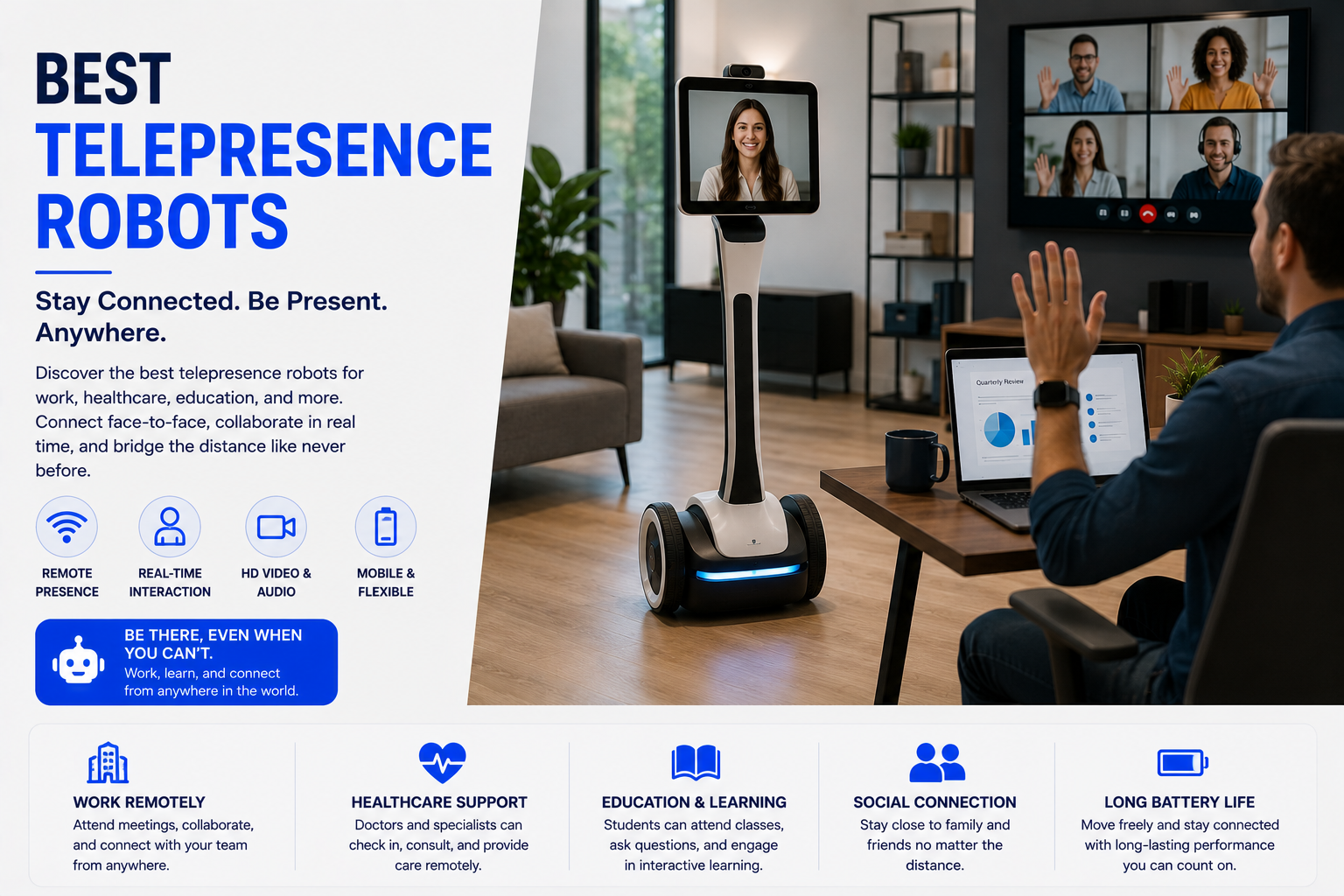
Compare the best telepresence robots for seniors that support family visits, communication, independence, remote connection, and aging at home. The best telepresence robot should make remote communication feel more natural while remaining easy to control, secure, and reliable in the actual space.
As an Amazon Associate, HomeBotGuide may earn from qualifying purchases at no extra cost to you.
A senior-focused telepresence robot is most useful when the older adult welcomes remote visits and family members need room-to-room communication without requiring the resident to carry a phone. Ohmni-style systems are strong for family check-ins, while Temi-style robots add autonomous movement and smart-home functions. Neither should replace medical alert services, professional care, or emergency response.
Best Telepresence Robots for Seniors at a Glance
Best for Family VisitsOhmni-Style Senior RobotRemote mobility, large video display, and hands-free conversation.Best for Smart-Home SupportTemi-Style Robot
Calls, navigation, reminders, entertainment, and connected-home control.Best for Simple Check-InsCompact Mobile Camera
Lower-cost room-to-room video and audio.Best Safety CombinationRobot + Medical Alert
Remote visits plus dedicated emergency-response support.
Best Telepresence Robots for Seniors Comparison Table
| Option | Best For | Core Features | Important Limitation |
|---|---|---|---|
| Ohmni-Style Robot | Family visits and aging in place | Remote driving, large display, simple calls | High purchase cost |
| Temi-Style Robot | Independent connected living | Autonomous navigation, smart-home control | More setup and software complexity |
| Compact Camera Robot | Visual check-ins | Video, audio, patrols | No large face-to-face display |
| Medical Telepresence Robot | Clinical environments | Secure telehealth, advanced peripherals | Not designed for ordinary homes |
| Smart Display | Easy stationary calls | Voice and touch calling | No mobility |
| Medical Alert System | Emergency response | Wearable button and monitoring center | Limited social connection |
What Telepresence Robots Can Actually Do
Telepresence robots combine live video, microphones, speakers, a display, remote driving, and sometimes autonomous navigation. They give a remote person limited control over viewpoint and movement inside another location.
They do not replace in-person care, emergency response, physical assistance, or ordinary communication backups. Their value comes from mobility and repeated access, not from performing household tasks.
- Support room-to-room mobile video calls.
- Allow remote users to choose their viewpoint.
- Join meetings, classes, tours, and family events.
- Provide remote visits for older adults or homebound users.
- Return to a charging dock on supported models.
Main Types to Consider
Ohmni-Style RobotRemote driving, large display, simple calls
Temi-Style RobotAutonomous navigation, smart-home control
Compact Camera RobotVideo, audio, patrols
Medical Telepresence RobotSecure telehealth, advanced peripherals
Ohmni and Senior-Focused Telepresence
OhmniLabs presents telepresence as a way for families to visit older adults remotely and communicate hands-free. The remote user can navigate, which reduces the need for the resident to manage a tablet or move between rooms.
- Confirm mobility and Wi-Fi in the actual space.
- Test camera, audio, remote driving, and docking.
- Review permissions, privacy, and guest access.
- Maintain a phone, tablet, or human backup.
Temi for Aging at Home
Temi combines mobile video, autonomous navigation, voice interaction, media, and smart-home control. This can support communication and routine independence, but the home must have safe floors, adequate space, and reliable connectivity.
- Confirm mobility and Wi-Fi in the actual space.
- Test camera, audio, remote driving, and docking.
- Review permissions, privacy, and guest access.
- Maintain a phone, tablet, or human backup.
Evidence and Older-Adult Experience
Research on mobile telepresence robots suggests they can support social connection and family involvement, but benefits depend on acceptance, usability, privacy, staff or family support, and whether the robot fits the person's routines.
- Confirm mobility and Wi-Fi in the actual space.
- Test camera, audio, remote driving, and docking.
- Review permissions, privacy, and guest access.
- Maintain a phone, tablet, or human backup.
Telepresence Is Not Emergency Care
A robot may lose Wi-Fi, battery, camera access, or mobility. Dedicated medical alert systems, smoke and carbon-monoxide alarms, reliable phones, caregivers, and emergency plans remain necessary.
- Confirm mobility and Wi-Fi in the actual space.
- Test camera, audio, remote driving, and docking.
- Review permissions, privacy, and guest access.
- Maintain a phone, tablet, or human backup.
Remote Presence Has Physical Limits
Most telepresence robots cannot climb stairs, open doors, operate elevators independently, recover from every obstacle, or provide physical help.
They can lose Wi-Fi, battery, audio, camera access, or docking ability. Keep alternative communication and human support available.
Camera, Screen, and Audio Quality
Evaluate camera height, field of view, zoom, low-light quality, stabilization, microphone pickup, echo cancellation, speaker volume, screen size, and latency. Clear audio often matters more than maximum video resolution.
Mobility, Navigation, and Docking
Test thresholds, rugs, narrow doorways, furniture, slopes, stairs, turning radius, speed, obstacle avoidance, remote steering, autonomous destinations, and return-to-dock behavior in the real environment.
Connectivity and Remote Access
Compare Wi-Fi bands, roaming between access points, browser or app access, guest links, cellular options, firewall requirements, bandwidth, updates, and what happens when the connection is interrupted.
Privacy, Consent, and Security
A mobile camera can reveal more than a stationary device. Use informed consent, restricted accounts, visible call indicators, secure passwords, multifactor authentication when available, current firmware, limited recording, and clear guest permissions.
How to Test a Telepresence Robot
Test the RouteDrive every intended room and doorway.
Test CommunicationCheck video, audio, latency, and lighting.
Test DockingReturn from multiple rooms and low battery.
Test Failure ModesSimulate Wi-Fi loss and blocked paths.
How We Evaluated the Options
We prioritized video and audio quality, mobility, obstacle avoidance, remote control, autonomous navigation, docking, battery, privacy, guest access, app and browser support, Wi-Fi reliability, accessibility, subscriptions, warranty, repair, and long-term software support.
Best Telepresence Robots for Seniors Checklist
PurposeChoose family, senior, work, school, healthcare, or tour use.
MobilityVerify floors, doors, obstacles, and docking.
CommunicationTest camera, screen, microphones, and speakers.
OwnershipReview privacy, subscriptions, batteries, and support.
- The robot solves a clearly defined remote-presence need.
- Floor plan, thresholds, rugs, doorways, and stairs are compatible.
- Camera height and video quality fit the use case.
- Microphones and speakers are clear in real rooms.
- Remote driving and obstacle avoidance are easy to use.
- Automatic docking works from expected locations.
- Wi-Fi coverage and bandwidth are reliable.
- Guest access and privacy permissions are controlled.
- Subscriptions, batteries, repairs, and support are understood.
- A phone, tablet, or human backup remains available.
Final Verdict
A senior-focused telepresence robot is most useful when the older adult welcomes remote visits and family members need room-to-room communication without requiring the resident to carry a phone. Ohmni-style systems are strong for family check-ins, while Temi-style robots add autonomous movement and smart-home functions. Neither should replace medical alert services, professional care, or emergency response.
Shop Telepresence TechnologyExplore Telepresence RobotsBest Telepresence Robots for Seniors FAQ
How can a telepresence robot help a senior?
It can support family visits, room-to-room video calls, remote check-ins, entertainment, and selected smart-home controls.
Can a senior use it without technical skills?
The remote family member can often control movement, but the senior still needs simple privacy, call, and emergency controls.
Can a telepresence robot detect falls?
Some systems may offer related features, but telepresence robots should not replace a dedicated medical alert system.
Is telepresence helpful for loneliness?
It can make remote family contact more natural and frequent, but it should supplement real human relationships and community.
Can the robot remind a senior about appointments?
Some systems support reminders, but reminders do not confirm that a task or medication was completed safely.
What if the senior has dementia?
The robot may help some people and confuse others. Introduction should be gradual and guided by caregivers who know the person.
Can family members enter the home remotely at any time?
Access should be controlled by consent, scheduling, account permissions, and visible camera indicators.
Does the robot work during an internet outage?
Remote visits usually stop, so families need phone and emergency backup plans.
Can it move through narrow homes?
Performance depends on width, thresholds, rugs, furniture, lighting, and turning space.
What is the safest setup?
Use the robot for voluntary communication while keeping medical alerts, caregivers, alarms, and direct human support.