
Best STEM Robots for Kids
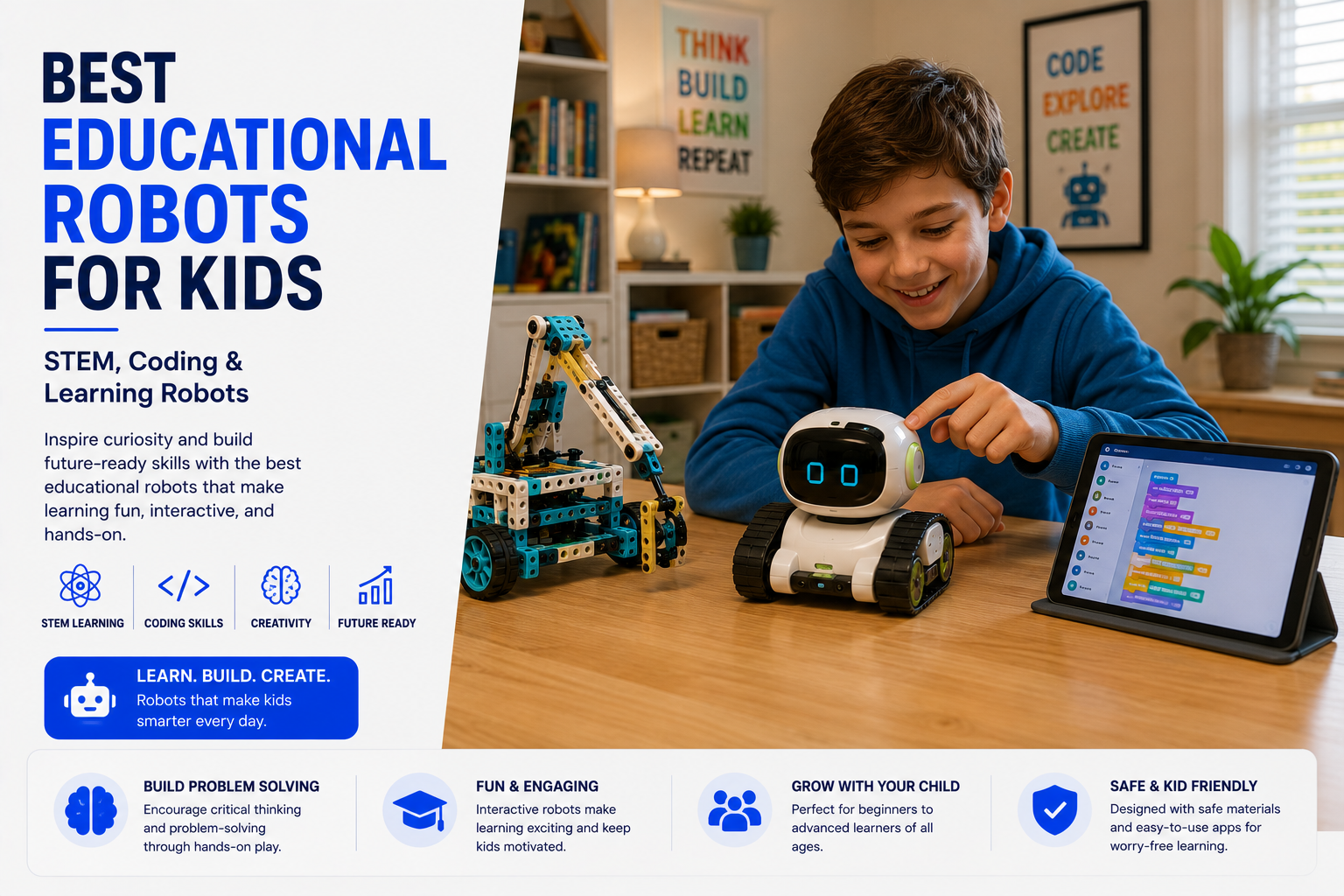
Explore the best STEM robots for kids focused on science, technology, engineering, coding, AI learning, creativity, and interactive education. The strongest educational robots combine age-appropriate play with a real learning progression, open-ended challenges, and reliable software support.
As an Amazon Associate, HomeBotGuide may earn from qualifying purchases at no extra cost to you.
Construction-based robotics kits provide the broadest STEM value because children design structures, connect motors and sensors, write code, test results, and rebuild. Sphero-style robots are better for coding and physics experiments, while electronics kits are best for circuits and invention. The strongest choice is the system that matches the child's preferred way of learning.
Best STEM Robots for Kids at a Glance
Combines coding, engineering, motion, sensors, and iterative design.
Supports speed, angles, forces, data, and sensor experiments.
Teaches inputs, outputs, circuits, invention, and prototyping.
Introduces image recognition, models, sensors, and ethical discussion.
Best STEM Robots for Kids Comparison Table
| Type | Best For | Learning Features | Important Limitation |
|---|---|---|---|
| Construction Robot | Engineering and coding | Bricks, motors, sensors, mechanisms | High cost and part management |
| Motion Robot | Coding and physics | Movement, sensors, data, lights | Less mechanical building |
| Electronics Kit | Circuits and invention | Inputs, outputs, modules | May not look like a robot |
| AI Vision Robot | Computer vision and AI | Camera, models, recognition | Privacy and complexity |
| Screen-Free STEM Robot | Early elementary | Logic, motion, challenges | Limited advanced expansion |
| Classroom STEM System | Structured learning | Curriculum, assessments, teacher tools | May require multiple kits |
What Educational Robots Can Actually Teach
Educational robots can make coding, engineering, electronics, mathematics, and science visible through movement and physical feedback. Their best use is active creation: planning, building, programming, testing, debugging, and explaining results.
A robot does not create learning automatically. The quality of challenges, guidance, reflection, progression, and child interest matters more than the number of sensors or animations.
- Sequencing, loops, conditions, and debugging.
- Engineering design and mechanical problem solving.
- Sensors, measurement, data, and cause and effect.
- Creativity, storytelling, teamwork, and persistence.
- Progression from physical coding to blocks and text.
Main Types to Consider
Bricks, motors, sensors, mechanisms
Movement, sensors, data, lights
Inputs, outputs, modules
Camera, models, recognition
LEGO Education SPIKE Systems
LEGO Education robotics combines familiar construction pieces with programmable hubs, motors, sensors, and structured lessons. It is especially effective for engineering design because children can change the physical machine and the code together.
- Match the robot to the child’s age and readiness.
- Prioritize open-ended projects over passive features.
- Confirm device support, lesson access, and replacement parts.
- Review child privacy, accounts, cameras, and microphones.
Sphero Robots and Cross-Curricular STEM
Sphero promotes coding robots for PK–12 and offers lessons beyond computer science. Rolling robots can support investigations involving speed, measurement, geometry, forces, storytelling, and data collection.
- Match the robot to the child’s age and readiness.
- Prioritize open-ended projects over passive features.
- Confirm device support, lesson access, and replacement parts.
- Review child privacy, accounts, cameras, and microphones.
littleBits and Modular Electronics
Modular electronics kits teach circuits through snap-together inputs, outputs, power, logic, and mechanical components. They encourage invention and rapid prototypes without requiring soldering.
- Match the robot to the child’s age and readiness.
- Prioritize open-ended projects over passive features.
- Confirm device support, lesson access, and replacement parts.
- Review child privacy, accounts, cameras, and microphones.
AI and Vision-Based Robotics
Newer educational robots can introduce computer vision, image recognition, voice, and AI concepts. Parents should distinguish genuine programmable AI activities from products that simply use an online chatbot or prerecorded interactions.
- Match the robot to the child’s age and readiness.
- Prioritize open-ended projects over passive features.
- Confirm device support, lesson access, and replacement parts.
- Review child privacy, accounts, cameras, and microphones.
Learning Value Depends on Active Use
Driving a robot with a remote is entertaining but teaches less than predicting, programming, measuring, redesigning, and debugging.
Parents and teachers can improve value by asking children to explain the plan, compare results, change one variable, document failures, and invent a new challenge.
Age, Reading, and Motor Skills
Age labels are only a starting point. Consider reading ability, fine-motor control, attention, frustration tolerance, device experience, and whether the child prefers stories, building, movement, puzzles, art, or competition.
Apps, Coding Languages, and Progression
Screen-free sequencing is best for early learners. Visual blocks reduce syntax errors for beginners, while JavaScript or Python gives older children deeper control. The strongest platforms provide a clear path between levels.
Safety, Privacy, and Connected Features
Check small parts, charging, batteries, gears, motors, cameras, microphones, accounts, cloud storage, advertising, data sharing, parental consent, and deletion. Connected toys used by children may be subject to COPPA requirements.
Durability and Long-Term Cost
Include tablets or computers, subscriptions, batteries, expansion kits, replacement motors, sensors, wheels, cables, storage, warranty, lesson access, and operating-system support.
How to Build a Better Learning Routine
Choose one concept or challenge.
Ask what the robot should do.
Observe, change, and run again.
Add a rule, sensor, story, or design constraint.
How We Evaluated the Options
We prioritized age fit, learning progression, coding depth, engineering value, curriculum, open-ended use, durability, device compatibility, privacy, offline operation, replacement parts, subscriptions, accessibility, and long-term support.
Final Verdict
Construction-based robotics kits provide the broadest STEM value because children design structures, connect motors and sensors, write code, test results, and rebuild. Sphero-style robots are better for coding and physics experiments, while electronics kits are best for circuits and invention. The strongest choice is the system that matches the child's preferred way of learning.
Best STEM Robots for Kids FAQ
What makes a robot a STEM robot?
A STEM robot supports hands-on learning in science, technology, engineering, mathematics, coding, electronics, or design.
Are construction robots better than prebuilt robots?
Construction robots provide more engineering practice, while prebuilt robots let children begin coding and experimentation faster.
Can STEM robots teach science as well as coding?
Yes. They can support lessons in motion, forces, energy, measurement, light, sound, sensors, and data.
What is the best STEM robot for a creative child?
Choose an open-ended construction or electronics platform that supports original inventions rather than only fixed missions.
Do STEM robots help with problem solving?
Research on educational robotics shows positive potential for computational thinking, collaboration, problem solving, and STEM engagement when activities are well designed.
Are AI robots appropriate for children?
They can be when age-appropriate, transparent, supervised, and privacy-conscious, but AI claims and data practices require careful review.
How much parent help is needed?
Younger children need setup and guided challenges, while older children may work independently after learning the platform.
Are replacement parts important?
Yes. Motors, sensors, cables, connectors, wheels, and construction parts determine the system's usable life.
Can STEM robots support school projects?
Yes, particularly platforms with lesson libraries, project documentation, coding exports, and measurable sensor data.
What is the biggest limitation of STEM robots?
Without structured challenges or adult guidance, many become expensive remote-control toys instead of learning tools.