
Are Robots Good for Elderly Care?
Learn how robots are helping with elderly care. Explore the benefits, limitations, costs, and future of robotic assistance for seniors. This guide compares the main options, practical benefits, limitations, maintenance, safety, and long-term value.
As an Amazon Associate, HomeBotGuide may earn from qualifying purchases at no extra cost to you.
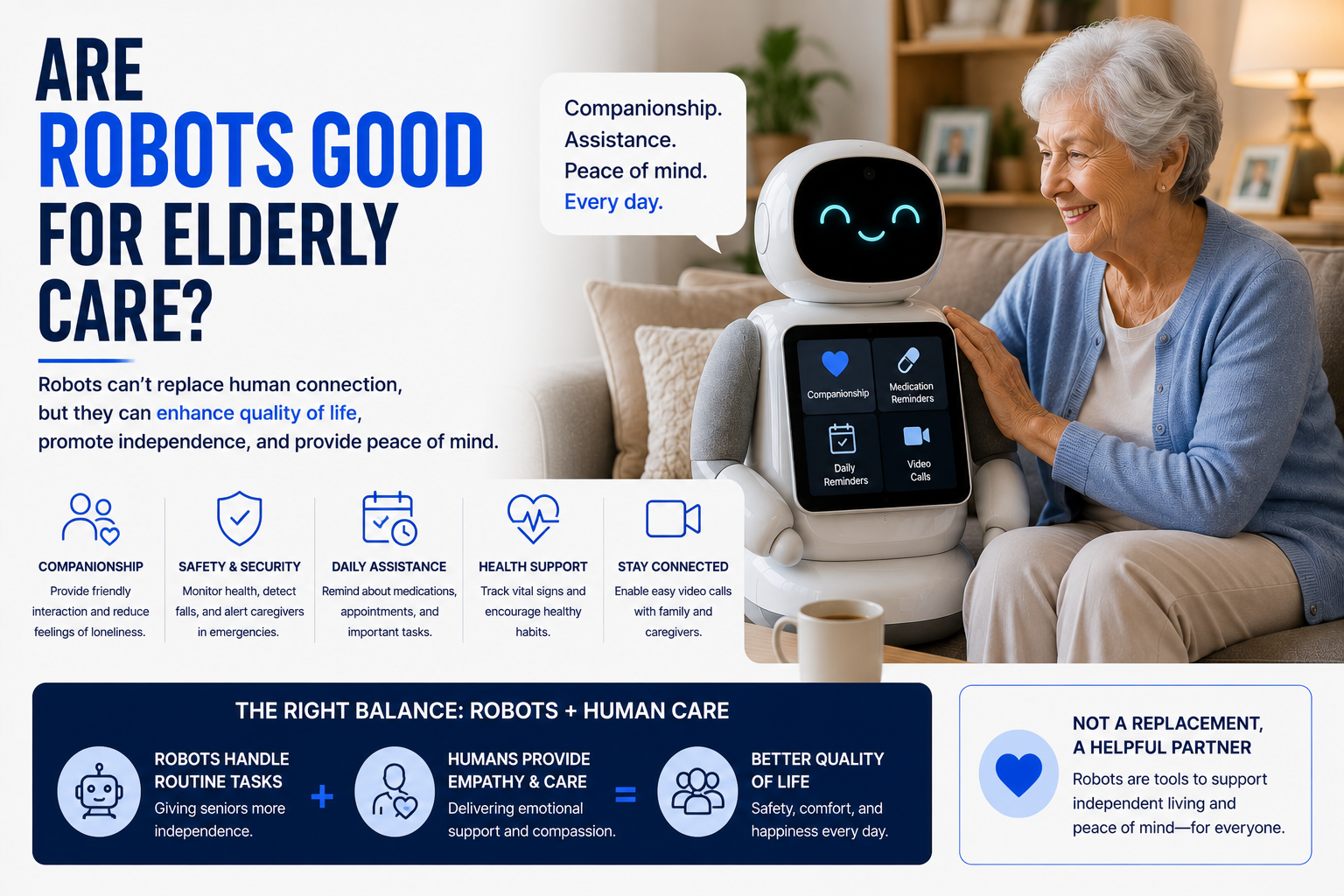
Robots can be good for elderly care when they reduce repetitive work, support communication, provide reminders, or extend family visibility. They are not substitutes for caregivers, healthcare professionals, emergency response, or human companionship. The strongest use is as one layer in a broader support system.
Are Robots Good for Elderly Care? at a Glance
Reduce physical floor-cleaning work and bending.
Support mobile family visits and remote check-ins.
Provide conversation, games, and routine prompts.
Extend remote awareness between fixed sensors.
Are Robots Good for Elderly Care? Comparison Table
| Type | Best For | Core Features | Important Limitation |
|---|---|---|---|
| Cleaning Robot | Physical task reduction | Automated vacuuming and mopping | Still needs maintenance |
| Telepresence Robot | Family connection | Mobile video and communication | No physical assistance |
| Companion Robot | Engagement | Conversation, music, reminders | Cannot replace human relationships |
| Monitoring Robot | Remote awareness | Camera, audio, alerts | Privacy concerns |
| Medication Reminder Robot | Routine prompting | Timed alerts and logs | Cannot verify safe use |
| Humanoid Care Robot | Future assistance | Potential mobility and manipulation | Immature and expensive |
What to Consider First
Start with the real user, property, safety need, privacy limits, connectivity, and maintenance requirements. The strongest option is the one that fits the actual routine reliably.
- Match the product to the real task and environment.
- Check safety, power, privacy, and access requirements.
- Review maintenance and replacement-part needs.
- Keep a manual or human backup available.
Main Options to Consider
Automated vacuuming and mopping
Mobile video and communication
Conversation, music, reminders
Camera, audio, alerts
Where Robots Help Most
Robots perform best at narrow, repeated tasks such as floor cleaning, reminders, video visits, and selected monitoring.
- Confirm the feature solves a real need.
- Review safety, privacy, and maintenance requirements.
- Test alerts, navigation, and backup plans.
- Keep human or manual support available.
Independence and Aging in Place
Well-chosen devices can reduce physical workload and make communication easier.
- Confirm the feature solves a real need.
- Review safety, privacy, and maintenance requirements.
- Test alerts, navigation, and backup plans.
- Keep human or manual support available.
Companionship and Engagement
Companion robots may provide stimulation, but emotional benefit varies widely by person.
- Confirm the feature solves a real need.
- Review safety, privacy, and maintenance requirements.
- Test alerts, navigation, and backup plans.
- Keep human or manual support available.
Monitoring and Privacy
Remote cameras can reassure families, but consent and limited access are essential.
- Confirm the feature solves a real need.
- Review safety, privacy, and maintenance requirements.
- Test alerts, navigation, and backup plans.
- Keep human or manual support available.
Medical and Emergency Limits
Robots cannot diagnose illness, lift someone safely, or guarantee emergency response.
- Confirm the feature solves a real need.
- Review safety, privacy, and maintenance requirements.
- Test alerts, navigation, and backup plans.
- Keep human or manual support available.
Cost and Support
Hardware, subscriptions, batteries, repairs, and software discontinuation affect long-term value.
- Confirm the feature solves a real need.
- Review safety, privacy, and maintenance requirements.
- Test alerts, navigation, and backup plans.
- Keep human or manual support available.
User Acceptance
The older adult's comfort, cognition, hearing, vision, dexterity, and preferences should guide every decision.
- Confirm the feature solves a real need.
- Review safety, privacy, and maintenance requirements.
- Test alerts, navigation, and backup plans.
- Keep human or manual support available.
Best Role for Robots
Use them to complement caregivers, medical alerts, smart-home sensors, and regular human contact.
- Confirm the feature solves a real need.
- Review safety, privacy, and maintenance requirements.
- Test alerts, navigation, and backup plans.
- Keep human or manual support available.
Automation Still Requires Oversight
Connected devices can reduce repetitive work or improve awareness, but they still require setup, supervision, maintenance, secure accounts, and backup plans.
How We Evaluated the Options
We prioritized practical usefulness, safety, reliability, communication, privacy, maintenance, replacement parts, warranty, and total ownership value.
Final Verdict
Robots can be good for elderly care when they reduce repetitive work, support communication, provide reminders, or extend family visibility. They are not substitutes for caregivers, healthcare professionals, emergency response, or human companionship. The strongest use is as one layer in a broader support system.
Are Robots Good for Elderly Care? FAQ
Can robots help seniors live independently?
They can support selected routines and reduce some physical tasks.
Can robots replace caregivers?
No. They cannot provide complete physical, medical, or emotional care.
Are companion robots good for loneliness?
They may help some users but should complement human contact.
Can robots remind seniors about medication?
Yes, but they cannot confirm safe or correct use.
Can a robot detect a fall?
Some systems may detect related events, but dedicated medical alert devices are safer.
Are elderly care robots expensive?
Costs range from affordable cleaning robots to expensive telepresence and companion systems.
Do seniors accept robots?
Acceptance varies by personality and usability.
Are cameras necessary?
No, and privacy-sensitive alternatives include radar and motion sensors.
What is the most useful robot for many seniors?
A robot vacuum often delivers the clearest practical benefit.
What is the biggest limitation?
Robots cannot replace human judgment, physical care, or emergency response.