
Are Delivery Robots Worth It?
Learn whether delivery robots are worth it. Explore benefits, limitations, costs, safety, automation, real-world uses, and the future of robotic delivery. The right platform must match the route, payload, operating rules, customer handoff, and support model rather than relying on autonomy claims alone.
As an Amazon Associate, HomeBotGuide may earn from qualifying purchases at no extra cost to you.
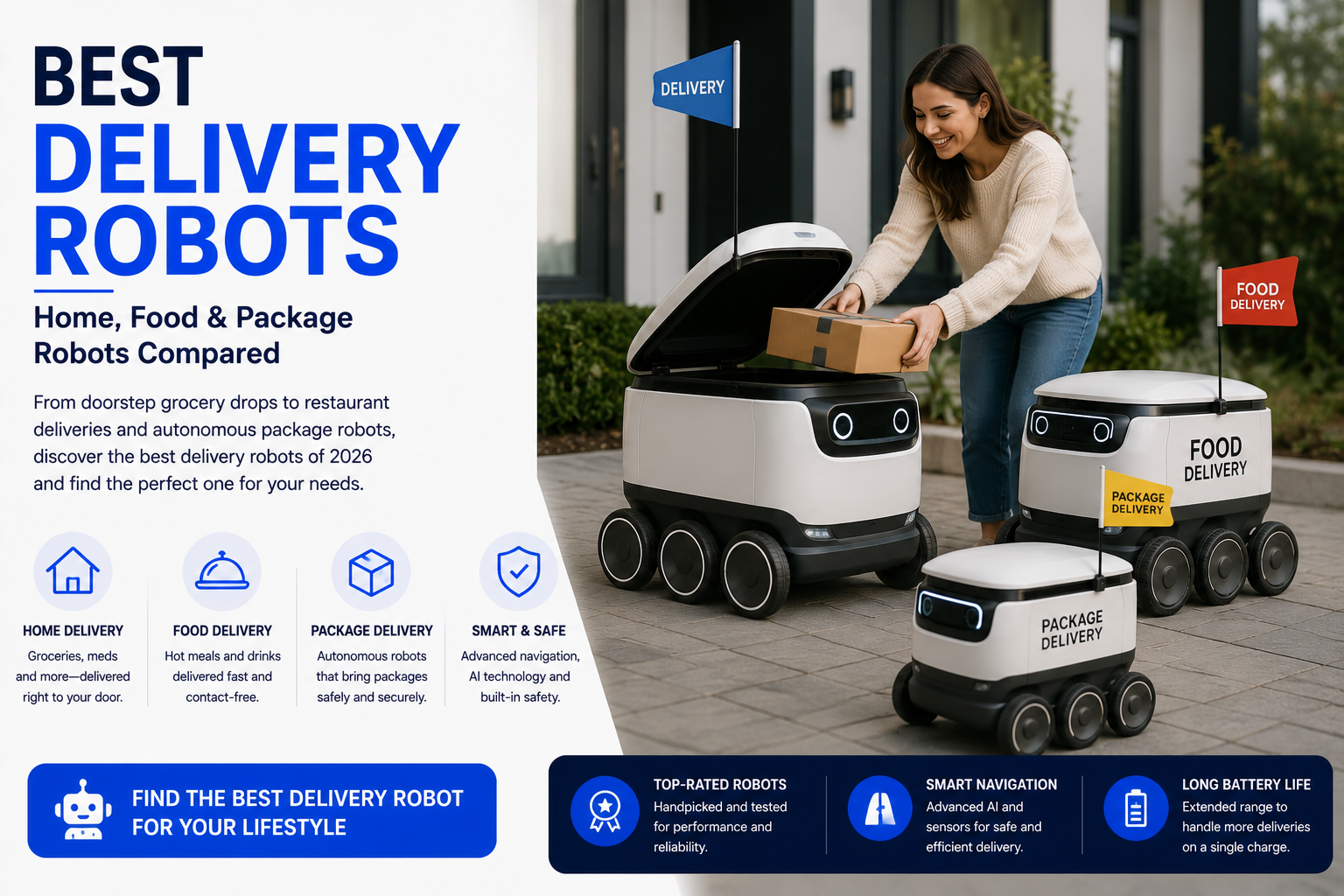
Delivery robots are worth it when routes are short, repeatable, relatively flat, legally permitted, and dense enough to keep a fleet busy. They are less attractive for long distances, stairs, poor sidewalks, heavy payloads, severe weather, or low delivery volume. Their best current use is as part of a hybrid delivery network rather than a complete replacement for human couriers.
Are Delivery Robots Worth It? at a Glance
Campuses, neighborhoods, resorts, industrial sites, and planned communities.
Robots handle suitable trips while people cover exceptions and complex deliveries.
Frequent predictable routes spread fleet, mapping, charging, and support costs.
Sidewalk quality, crossings, weather, regulations, and accessibility determine feasibility.
Are Delivery Robots Worth It? Comparison Table
| Option | Best For | Core Capability | Important Limitation |
|---|---|---|---|
| Sidewalk Delivery Robot | Food, groceries, parcels | Low-speed electric operation, locked cargo, remote assistance | Limited range, payload, stairs, and sidewalk access |
| Road-Going Delivery Vehicle | Larger neighborhood routes | Higher speed and payload, roadway operation | More regulation, insurance, and vehicle cost |
| Campus Robot Fleet | Universities and business parks | Mapped routes, dense demand, controlled service area | Demand can be seasonal or concentrated |
| Indoor/Outdoor AMR | Hospitals and industrial sites | Material movement between buildings | Requires workflow integration and access control |
| Human Courier | Complex and flexible delivery | Stairs, handoff, oversized loads, judgment | Higher labor cost and variable availability |
| Hybrid Network | Broad service coverage | Dispatches robots only when route and order fit | Requires fleet orchestration and fallback capacity |
What Delivery Robots Can Actually Do
Delivery robots automate a defined part of the last mile. They can carry secure cargo, follow mapped routes, avoid obstacles, report status, notify customers, and request remote help when conditions exceed their autonomous capability.
They do not eliminate operations. A real service still needs merchants, dispatch, charging, maintenance, remote support, customer service, insurance, local permission, and a plan for failed deliveries.
- Move small goods across short repeatable routes.
- Provide tracking and secure app-based handoff.
- Operate on electric power at low speed.
- Collect route, battery, intervention, and service data.
- Escalate edge cases to remote or local staff.
Main Delivery Robot Models
Low-speed electric operation, locked cargo, remote assistance
Higher speed and payload, roadway operation
Mapped routes, dense demand, controlled service area
Material movement between buildings
Where Delivery Robots Already Make Sense
Delivery robots are strongest in campuses, planned communities, mixed-use developments, resorts, industrial sites, and other areas with repeat routes and concentrated demand. Starship reports more than 10 million completed deliveries, while Cartken operates robots in campuses, city streets, malls, hotels, kitchens, and industrial environments.
- Validate the route and operating conditions before deployment.
- Confirm local permission, insurance, and incident procedures.
- Measure completed deliveries, interventions, downtime, and customer acceptance.
- Plan charging, cleaning, maintenance, and physical recovery.
Benefits Beyond Labor Savings
Robots can provide predictable availability, electric low-speed transport, secure cargo compartments, real-time tracking, contactless handoff, and detailed fleet data. They can also reduce the need to use a car for very short local errands when the order fits the robot.
- Validate the route and operating conditions before deployment.
- Confirm local permission, insurance, and incident procedures.
- Measure completed deliveries, interventions, downtime, and customer acceptance.
- Plan charging, cleaning, maintenance, and physical recovery.
Limits That Change the Economics
A robot may need remote assistance, charging, cleaning, mapping, maintenance, recovery, insurance, and local permits. Stairs, curb cuts, construction, snow, standing water, vandalism, oversized loads, and low order density can quickly erase a cost advantage.
- Validate the route and operating conditions before deployment.
- Confirm local permission, insurance, and incident procedures.
- Measure completed deliveries, interventions, downtime, and customer acceptance.
- Plan charging, cleaning, maintenance, and physical recovery.
The Future Is Likely Hybrid
Current platforms commonly retain remote human support for edge cases. Cartken describes teleoperation and instant override, while delivery marketplaces can dispatch either a robot or a human based on order and route conditions. This hybrid model is more realistic than expecting one robot type to serve every address.
- Validate the route and operating conditions before deployment.
- Confirm local permission, insurance, and incident procedures.
- Measure completed deliveries, interventions, downtime, and customer acceptance.
- Plan charging, cleaning, maintenance, and physical recovery.
Autonomy Has a Defined Operating Limit
A delivery robot is autonomous only within its operational design domain: the routes, speeds, weather, lighting, surfaces, traffic, and other conditions it was designed and validated to handle.
When conditions fall outside that domain, the system should slow, stop, request remote assistance, reroute, or be physically recovered. Safe fallback behavior is as important as normal navigation.
Navigation, Sensors, and Remote Assistance
Commercial robots may combine cameras, radar, lidar, ultrasonic sensors, wheel encoders, inertial sensors, satellite positioning, maps, and machine learning. The exact sensor mix matters less than how reliably the complete system detects obstacles, localizes, predicts movement, and stops safely.
Safety, Accessibility, and Public-Space Use
Sidewalk deployments must account for pedestrians, wheelchair users, strollers, service animals, bicycles, curb ramps, narrow paths, crossings, and emergency access. Route design should avoid blocking or forcing vulnerable users into unsafe movements.
Battery, Charging, and Fleet Availability
Battery life should be evaluated as completed deliveries per charge under real payload, weather, terrain, waiting time, and remote-intervention conditions. Fleet availability also depends on charging turnaround, spare robots, maintenance, and depot location.
Cargo Security and Customer Handoff
Compare compartment volume, payload, insulation, tamper detection, lock control, chain of custody, age-restricted item policies, cleaning, and app-based customer verification. The handoff process must work for people without creating long waits or accessibility barriers.
How to Evaluate a Pilot Deployment
Measure completion rate, interventions, delays, and inaccessible addresses.
Measure cost per completed delivery, utilization, charging, and downtime.
Track incidents, near misses, emergency stops, and community complaints.
Measure delivery time, order condition, adoption, and repeat use.
Regulation, Insurance, and Compliance
Rules differ for sidewalk personal-delivery devices, low-speed road vehicles, private property, campuses, and industrial sites. Confirm state and local law, speed and weight limits, insurance, permits, data reporting, accessibility obligations, and property-owner approval.
How We Evaluated Delivery Robots
We prioritized operational fit, safety design, obstacle detection, fallback behavior, route accessibility, payload, battery, teleoperation, fleet software, cybersecurity, maintenance, integration, regulatory support, customer handoff, and total cost per completed delivery.
Final Verdict
Delivery robots are worth it when routes are short, repeatable, relatively flat, legally permitted, and dense enough to keep a fleet busy. They are less attractive for long distances, stairs, poor sidewalks, heavy payloads, severe weather, or low delivery volume. Their best current use is as part of a hybrid delivery network rather than a complete replacement for human couriers. The best deployment begins with a narrow, measurable operating area and expands only after safety, completion rate, customer acceptance, and cost targets are met.
Are Delivery Robots Worth It? FAQ
Are delivery robots cheaper than human couriers?
They can be cheaper on high-volume, short, repeatable routes, but the calculation must include fleet purchase or lease, mapping, charging, maintenance, teleoperation, insurance, and local operating costs.
How far can delivery robots travel?
Range varies by platform and operating conditions. Sidewalk robots are generally designed for short local routes rather than long-distance delivery.
Can delivery robots climb stairs?
Most commercial sidewalk delivery robots cannot climb ordinary stairs, so they need accessible routes and ground-level handoff points.
Are delivery robots fully autonomous?
Many handle most driving autonomously within a defined operating area but use remote human assistance for unusual situations.
Are delivery robots safe around pedestrians?
They use cameras, radar or lidar, ultrasonic sensors, low speeds, braking, lights, and remote oversight, but safe deployment still depends on testing, maintenance, route design, and local rules.
Do delivery robots work in rain or snow?
Weather capability varies. Heavy snow, flooding, ice, extreme heat, and poor visibility can reduce performance or stop service.
Can a delivery robot be stolen?
Cargo compartments are usually locked and robots are tracked, but vandalism, theft attempts, and physical recovery remain operational risks.
What items can delivery robots carry?
Common loads include meals, groceries, small packages, supplies, lab materials, and internal business items within the robot's payload and compartment limits.
Will delivery robots replace drivers?
They are more likely to handle a subset of repetitive local trips while human couriers continue serving complex, long, urgent, oversized, or inaccessible deliveries.
What determines whether a deployment succeeds?
Route accessibility, order density, payload fit, weather, local permission, charging, remote support, merchant integration, and customer acceptance are the biggest factors.