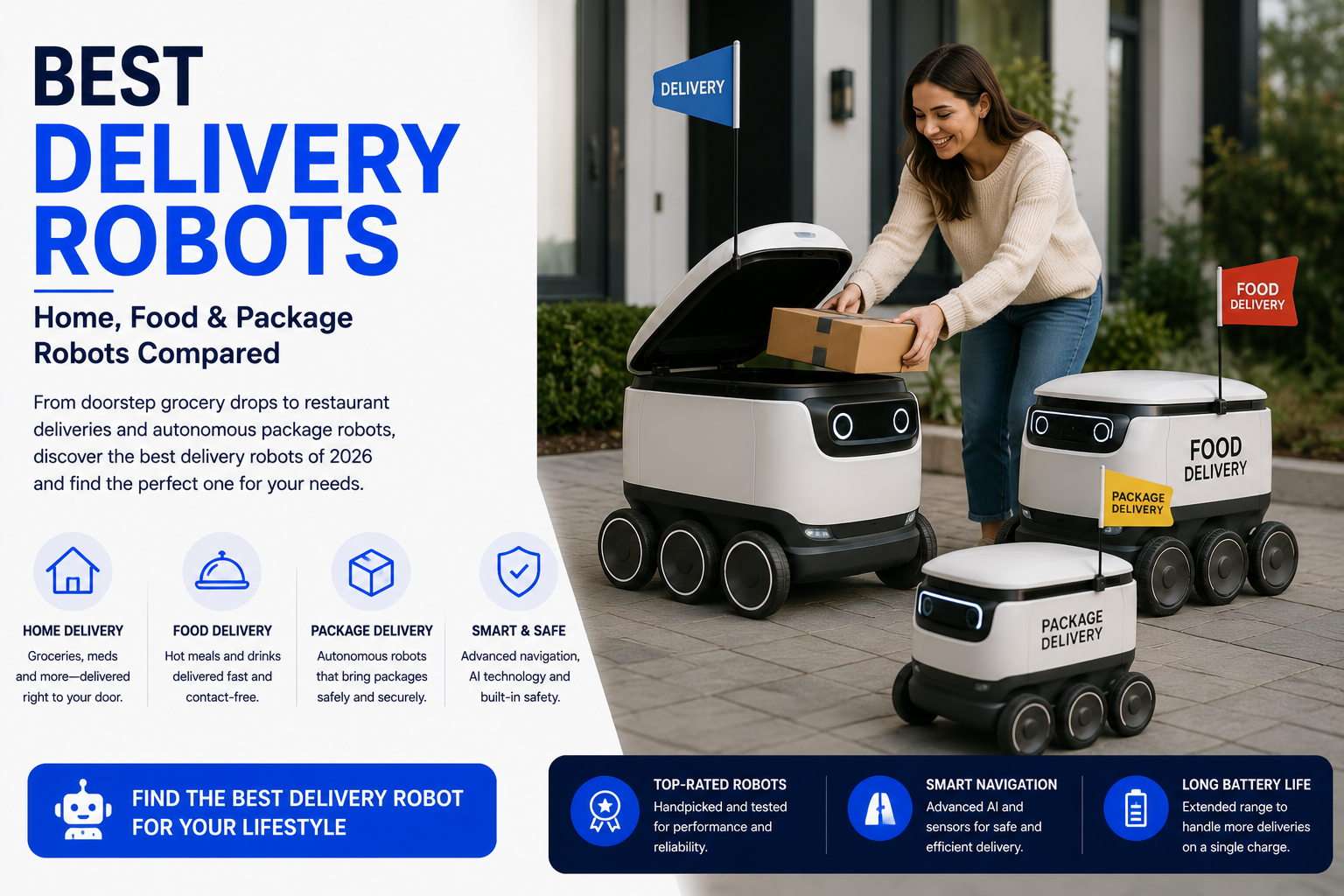
Best Delivery Robots
Delivery robots are changing how food, groceries, packages, supplies, and household items move across neighborhoods, buildings, campuses, hotels, offices, and private properties. The best delivery robot depends on where it will operate, what it needs to carry, how far it must travel, and whether it needs indoor navigation, outdoor autonomy, secure storage, remote monitoring, or smart home integration.
The best delivery robot depends on the environment. Sidewalk delivery robots are best for food, groceries, and neighborhood deliveries. Indoor delivery robots are better for hotels, offices, hospitals, and apartment buildings. Secure package robots are most useful for controlled properties, while larger autonomous delivery vehicles are better for commercial routes. Most households should view delivery robots as an emerging service rather than a normal consumer appliance.
Best Delivery Robots at a Glance
Best Delivery Robots Comparison Table
| Delivery Robot Type | Best For | Main Features | Best Environment |
|---|---|---|---|
| Sidewalk Delivery Robot | Food, groceries, and small packages | Autonomous navigation, obstacle detection, secure cargo compartment, remote supervision | Neighborhoods, campuses, and planned communities |
| Indoor Delivery Robot | Meals, supplies, documents, and room service | Hallway navigation, elevator integration, indoor mapping, touchscreen access | Hotels, hospitals, offices, and apartments |
| Home Property Delivery Robot | Moving items across private property | Short-range navigation, app control, cameras, cargo storage | Large homes, estates, gated properties, and private communities |
| Food Delivery Robot | Restaurant and prepared meal delivery | Insulated storage, app tracking, secure access, route planning | Urban districts, campuses, and neighborhoods |
| Package Delivery Robot | Parcel and retail order delivery | Locked compartment, recipient verification, tracking, tamper alerts | Residential communities and business districts |
| Commercial Autonomous Delivery Vehicle | Larger loads and longer routes | Multiple cargo compartments, road navigation, fleet management, remote monitoring | Retail, logistics, industrial, and commercial routes |
What Is a Delivery Robot?
A delivery robot is an autonomous or remotely supervised machine designed to transport food, packages, groceries, medicine, supplies, documents, or other goods from one location to another. Depending on the design, it may travel on sidewalks, roads, hallways, elevators, campuses, or private property.
Most delivery robots use cameras, distance sensors, mapping, GPS, artificial intelligence, obstacle detection, and remote supervision. Some operate independently for most of the route but allow a human operator to intervene when the robot encounters an unusual situation.
- Transports items without a human walking beside it.
- May navigate indoors, outdoors, or both.
- Can use locked or insulated cargo compartments.
- May connect to customer, business, or fleet-management apps.
- Can reduce repetitive short-distance transport work.
- Still depends on safe routes, regulations, maintenance, and supervision.
What Delivery Robots Do Best
Delivery robots work best on predictable routes between nearby homes, businesses, rooms, or buildings.
Food, groceries, parcels, medicine, and supplies fit better than oversized or unusually heavy items.
Robots are especially useful when the same delivery route is completed many times each day.
Locked compartments and app access can allow recipients to collect items without direct handoff.
Best Overall Delivery Robot Type
For most current delivery programs, the best overall design is a compact autonomous sidewalk robot with a secure cargo compartment, dependable obstacle detection, remote supervision, app-based tracking, and enough battery life to complete several short trips.
This design works well because it balances capacity, cost, navigation, and safety. It is smaller and more efficient than a road vehicle but can carry more than a flying drone. It is especially practical in college campuses, planned communities, pedestrian-friendly neighborhoods, and mixed-use developments.
- Compact enough for sidewalks and pedestrian routes.
- Secure storage for food, groceries, or packages.
- Live location tracking.
- Obstacle and pedestrian detection.
- Remote operator support.
- Weather-resistant exterior.
- Good battery range for repeated local trips.
- Recipient verification before opening.
Best Delivery Robots for Home Use
True consumer delivery robots for individual households remain limited. Most homeowners encounter delivery robots as part of a local restaurant, grocery, retail, apartment, or community delivery service rather than buying and operating the robot personally.
For private property, a small mobile cargo robot may be useful for carrying groceries, tools, packages, laundry, or supplies between a gate, driveway, garage, guest house, workshop, or main home. However, the property needs smooth routes, reliable connectivity, and enough space for safe navigation.
- Best suited to large or controlled properties.
- Can transport items between buildings or entrances.
- Requires safe paths without major stairs or obstacles.
- Needs secure storage for unattended items.
- Should include cameras and remote control.
- May overlap with home assistant or mobile monitoring robots.
Best Food Delivery Robots
Food delivery robots are designed to move restaurant meals, beverages, snacks, and prepared orders across short routes. They typically use insulated cargo compartments to help protect the food while an app lets the customer follow the trip and unlock the compartment.
They work best in dense areas where destinations are close together. College campuses, apartment developments, business districts, and planned communities are often better environments than spread-out suburban routes.
- Insulated or temperature-conscious cargo area.
- Secure compartment access.
- Real-time order tracking.
- Pedestrian and obstacle detection.
- Remote support if navigation fails.
- Good performance on short local routes.
Best Delivery Robot by Use Case
| Delivery Need | Best Robot Type | Why |
|---|---|---|
| Restaurant meals | Insulated sidewalk delivery robot | Designed for short trips, food protection, customer tracking, and secure pickup. |
| Groceries | Large-compartment sidewalk robot | Offers more cargo space for bags and household items. |
| Apartment room delivery | Indoor elevator-capable robot | Can travel through lobbies, hallways, and supported elevators. |
| Hotel room service | Indoor service delivery robot | Moves meals, towels, toiletries, and guest supplies between floors. |
| Packages | Secure parcel delivery robot | Uses locked storage, verification, tracking, and tamper monitoring. |
| Hospital supplies | Indoor healthcare delivery robot | Transports medicine, linens, meals, samples, and equipment on repeat routes. |
How to Choose the Best Delivery Robot
Decide whether the robot will travel on sidewalks, roads, hallways, elevators, campuses, or private property.
Food, groceries, parcels, medicine, and business supplies require different capacity and storage features.
Look for obstacle detection, emergency stopping, remote supervision, visibility, and secure operating speeds.
Include the robot, software, connectivity, maintenance, insurance, support, charging, and fleet management.
Best Package Delivery Robots
Package delivery robots need stronger security than simple indoor transport robots. A good package robot should use a locked cargo compartment, recipient verification, live tracking, tamper detection, and a clear method for handling failed deliveries.
Capacity also matters. A robot designed for restaurant meals may not have the shape or space needed for larger retail boxes. Businesses should evaluate the normal dimensions and weight of their packages before choosing a platform.
- Secure locking cargo compartment.
- Recipient code or app verification.
- Tamper alerts and location tracking.
- Weather-resistant package storage.
- Clear failed-delivery procedure.
- Enough capacity for typical parcel sizes.
Best Delivery Robots for Neighborhoods
Neighborhood delivery robots work best in communities with connected sidewalks, moderate traffic, predictable crossings, and relatively short distances between businesses and homes. Planned developments and campuses are usually easier than areas with missing sidewalks, steep hills, or complicated intersections.
Communities also need clear rules for speed, right of way, parking, accessibility, and what happens when a robot blocks a path or cannot complete a crossing.
- Connected sidewalks and accessible routes.
- Short delivery distances.
- Moderate slopes and manageable crossings.
- Reliable cellular or wireless coverage.
- Clearly marked robot visibility.
- Remote assistance for unusual situations.
Related guide: Best Delivery Robots for Neighborhoods.
Best Indoor Delivery Robots
Indoor delivery robots are among the most practical delivery robots because buildings offer controlled routes. Hotels use them for toiletries and room service. Hospitals may use them for meals, linens, medication, and supplies. Offices can use them for documents, food, mail, and equipment.
The most important features are accurate indoor mapping, elevator integration, door access, human-safe movement, simple loading, and the ability to communicate with staff or recipients.
- Reliable hallway navigation.
- Elevator and automatic-door compatibility.
- Human-safe speed and obstacle detection.
- Multiple secure storage compartments.
- Recipient notification.
- Fleet management for larger facilities.
Delivery Robots by Environment
| Environment | Best Robot Design | Main Buying Priority |
|---|---|---|
| Residential neighborhood | Sidewalk delivery robot | Pedestrian safety, range, crossings, secure cargo, and weather resistance. |
| Apartment building | Indoor mobile delivery robot | Elevator integration, resident verification, and hallway navigation. |
| Hotel | Room-service delivery robot | Quiet operation, guest communication, elevator access, and simple loading. |
| Hospital | Healthcare logistics robot | Reliability, sanitation, secure transport, and facility integration. |
| College campus | Outdoor sidewalk robot | High trip volume, app ordering, route coverage, and remote fleet support. |
| Warehouse or office | Indoor autonomous mobile robot | Payload, route repetition, fleet control, and workplace safety. |
Delivery Robot Features That Matter Most
The best delivery robot features depend on the route and cargo, but navigation, safety, security, and reliability matter in almost every environment.
- Accurate autonomous navigation.
- Obstacle, pedestrian, and vehicle detection.
- Emergency stopping and remote intervention.
- Secure cargo compartment.
- Recipient verification.
- Live route and location tracking.
- Weather-resistant exterior.
- Battery range matched to the route.
- Charging and fleet-management system.
- Maintenance and technical support.
Delivery Robot Navigation and Safety
Delivery robots may operate around pedestrians, children, pets, bicycles, vehicles, wheelchairs, curbs, driveways, stairs, and construction areas. That makes safe navigation more important than speed.
A good system should detect obstacles, stop when uncertain, remain visible in poor lighting, and allow remote operators to assist. Operators should also have procedures for blocked routes, damaged robots, bad weather, dead batteries, and attempted interference.
- Low and controlled operating speed.
- Wide sensor coverage.
- Emergency-stop capability.
- Lights, reflectors, and audible warnings.
- Remote operator intervention.
- Safe behavior near pedestrians and accessibility devices.
- Clear recovery plan for blocked or disabled robots.
Delivery Robot Capacity and Cargo Security
Payload capacity should be based on real deliveries rather than maximum marketing numbers. A food robot needs room for containers without crushing or spilling them. A grocery robot may need space for multiple bags. A parcel robot needs compartments that fit common box dimensions.
Security features should prevent unauthorized access while keeping pickup simple for the intended recipient.
- Match compartment dimensions to typical orders.
- Check maximum weight and usable volume.
- Use insulated storage for food when appropriate.
- Look for electronic locking and access logs.
- Require app, code, or identity verification.
- Consider multiple compartments for separate orders.
Delivery Robot Battery Life and Range
Battery life affects how many trips a robot can complete before charging. The advertised maximum range may not reflect hills, cold weather, heavy loads, repeated stops, remote connectivity, or route detours.
Businesses should calculate route distance, average delivery time, charging time, and the number of deliveries required during peak hours.
- Compare real route distance, not only maximum range.
- Include return trips in the calculation.
- Account for load weight and weather.
- Check recharge time.
- Consider automatic docking.
- Plan backup coverage during charging.
Where Delivery Robots Still Struggle
Busy intersections, missing sidewalks, construction, and unpredictable traffic can interrupt routes.
Heavy rain, snow, ice, flooding, and extreme heat can reduce safety and battery performance.
Many small delivery robots cannot manage stairs, large curbs, or inaccessible entrances.
Furniture, oversized packages, heavy groceries, and complex handoffs still favor human delivery.
Delivery Robot Costs
Delivery robot costs extend beyond the machine itself. Operators may need software, fleet-management tools, charging stations, connectivity, remote supervisors, maintenance, insurance, permits, replacement parts, and technical support.
A robot can provide value when it completes many predictable trips. A robot used only occasionally may cost more than using staff or a standard delivery service.
| Cost Area | What It Includes | Why It Matters |
|---|---|---|
| Hardware | Robot, cargo system, sensors, batteries, charging equipment | Initial purchase or lease expense |
| Software | Navigation, dispatch, tracking, fleet management, customer app | May involve recurring service fees |
| Operations | Loading, monitoring, recovery, cleaning, charging | Robots still require human support |
| Maintenance | Tires, motors, sensors, batteries, repairs, replacement parts | Reliability declines without regular service |
| Compliance | Insurance, permits, safety procedures, accessibility planning | Requirements vary by location and use |
| Integration | Doors, elevators, ordering systems, payment systems, building access | Can add significant setup complexity |
Are Delivery Robots Worth It?
Delivery robots can be worth it for businesses, campuses, hotels, hospitals, offices, and communities with frequent short-distance deliveries. They are most valuable when routes are predictable, the environment is controlled, and the robot can complete many deliveries each day.
They may not be worth it for low-volume routes, complicated neighborhoods, heavy deliveries, poor weather, inaccessible entrances, or locations without reliable technical support.
- Worth it for frequent repeat deliveries.
- Worth it for controlled indoor environments.
- Worth it for dense neighborhoods or campuses.
- Worth it when labor is tied up in repetitive transport.
- Not worth it for rare or unpredictable deliveries.
- Not worth it where routes are unsafe or inaccessible.
Related guide: Are Delivery Robots Worth It?.
Delivery Robots vs Human Delivery
Delivery robots can lower the human labor required for short, repetitive routes, but human couriers remain more flexible. People can climb stairs, handle special instructions, adjust to unusual traffic, carry larger orders, verify difficult addresses, and communicate directly with customers.
The strongest delivery systems may combine both. Robots can handle predictable local routes while human drivers and couriers manage complex, long-distance, oversized, or high-touch deliveries.
- Robots are good for predictable short routes.
- Humans are better at adapting to unusual conditions.
- Robots can operate with lower direct-contact requirements.
- Humans handle stairs and complex entrances better.
- Robots need technical and remote support.
- Hybrid delivery models may provide the best coverage.
Related guide: Home Delivery Robot vs Human Delivery.
Delivery Robot Buying Checklist
Sidewalk, road, hallway, elevator, campus, warehouse, neighborhood, or private property.
Food, groceries, parcels, medicine, documents, supplies, or multiple customer orders.
Obstacle detection, emergency stopping, visibility, remote control, and route recovery.
Hardware, software, support, maintenance, charging, insurance, integration, and staffing.
Final Verdict: What Is the Best Delivery Robot?
The best delivery robot is the one designed for its operating environment. Sidewalk robots are strongest for food, groceries, and neighborhood routes. Indoor delivery robots are better for hotels, offices, hospitals, and apartment buildings. Secure parcel robots are better for package transport, while larger autonomous vehicles fit commercial delivery networks.
Before choosing, focus on route safety, cargo security, battery range, remote support, local rules, maintenance, and the number of deliveries the robot can realistically complete.
Related Delivery and Home Robot Guides
Best Delivery Robots FAQ
What is the best delivery robot?
The best delivery robot depends on the route. Sidewalk robots are best for food and neighborhood deliveries, while indoor robots are better for hotels, hospitals, offices, and apartment buildings.
Can consumers buy home delivery robots?
Consumer options are limited. Most people use delivery robots through local restaurants, retailers, campuses, communities, or building services rather than owning the robot directly.
How do delivery robots navigate?
Delivery robots may use cameras, GPS, maps, distance sensors, artificial intelligence, obstacle detection, and remote human supervision.
Are delivery robots safe around pedestrians?
They can operate safely when they use controlled speeds, obstacle detection, emergency stopping, visible lights, audible warnings, and remote supervision.
Can delivery robots carry groceries?
Yes, some delivery robots have larger compartments designed for grocery bags, household supplies, and multiple items.
Can delivery robots carry packages?
Yes. Package delivery robots may use locked compartments, recipient codes, live tracking, and tamper alerts to protect parcels.
Can delivery robots use elevators?
Some indoor delivery robots can use compatible elevators, but the building may require special integration with access-control and elevator systems.
Do delivery robots work in rain or snow?
Weather resistance varies. Rain, snow, ice, flooding, and extreme temperatures can reduce traction, navigation reliability, and battery performance.
Are delivery robots cheaper than human couriers?
They may reduce costs on frequent, predictable routes, but hardware, software, maintenance, remote supervision, charging, and insurance must be included.
Are delivery robots worth it?
They can be worth it for high-volume short routes in neighborhoods, campuses, hotels, hospitals, offices, and controlled facilities.
We may earn a commission from qualifying purchases at no extra cost to you.