
Are Robot Mops Worth It?
Are robot mops worth buying? Discover the benefits, drawbacks, maintenance requirements, and whether a robot mop fits your cleaning needs. This guide compares the main cleaning systems, floor compatibility, practical tradeoffs, maintenance needs, and long-term value.
As an Amazon Associate, HomeBotGuide may earn from qualifying purchases at no extra cost to you.
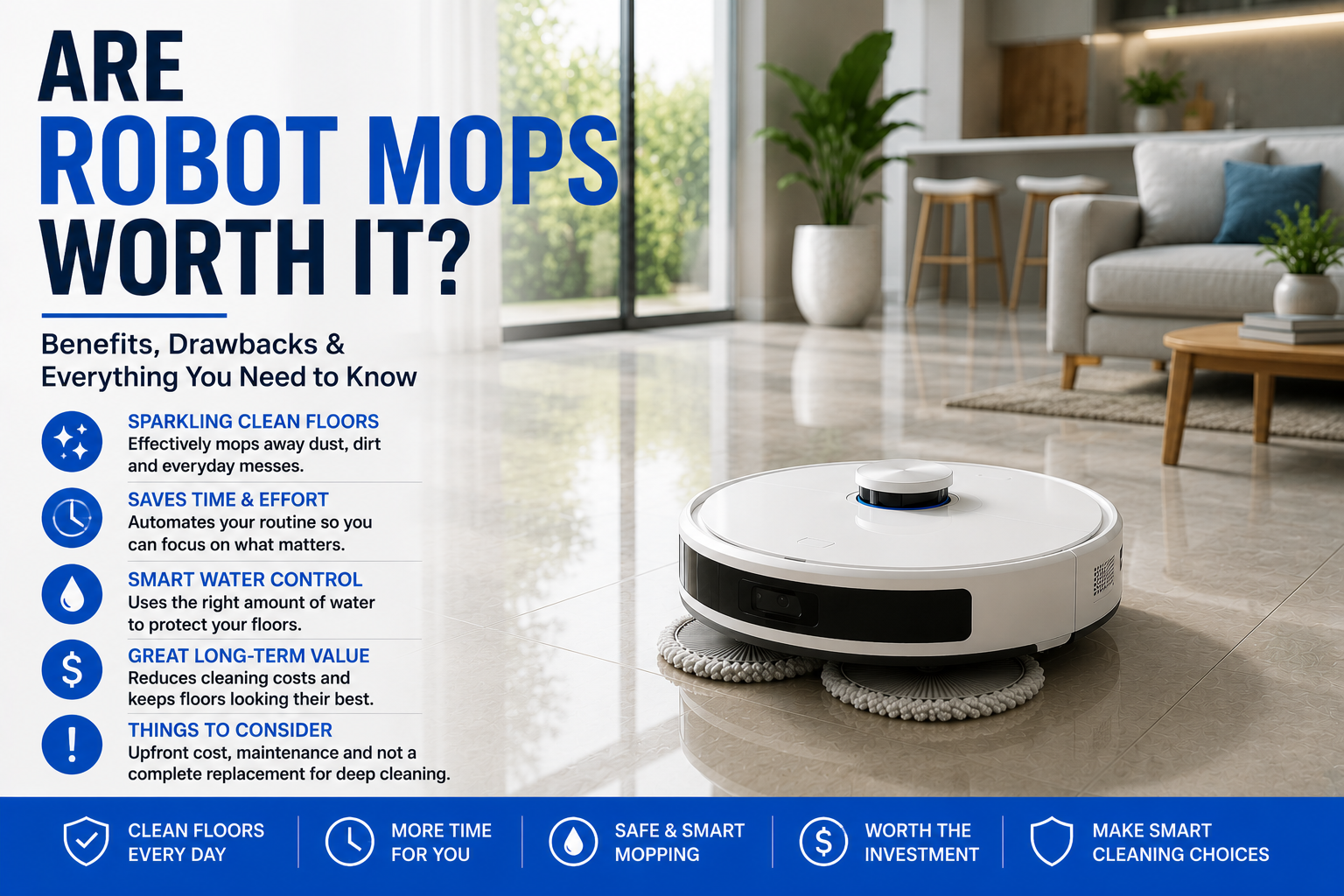
Robot mops are worth it for homes with large areas of sealed hard flooring, frequent paw prints or fine dust, and owners who value routine maintenance cleaning. They are less worthwhile in carpet-heavy homes, small spaces, or households expecting a robot to replace deep scrubbing, grout cleaning, and manual spill cleanup.
Are Robot Mops Worth It? at a Glance
Frequent maintenance saves meaningful active cleaning time.
Handles light daily tracks after dry debris is removed.
Reduces pad handling and water refilling.
Limited usable floor area reduces the value.
Are Robot Mops Worth It? Comparison Table
| Type | Best For | Core Features | Important Limitation |
|---|---|---|---|
| Large Sealed Floors | High value | Frequent automated maintenance | Dock and tank upkeep |
| Pet Home | Strong value | Paw prints and fine dirt | Accidents require manual cleanup |
| Tile Home | Strong value | Active scrubbing on durable surfaces | Grout still needs attention |
| Hardwood Home | Conditional value | Light controlled damp cleaning | Moisture sensitivity |
| Apartment | Mixed value | Convenient small-area cleaning | Storage and dock footprint |
| Carpet-Heavy Home | Low value | Limited hard-floor zones | Poor return on cost |
What to Consider First
Start with floor compatibility, hard-floor area, moisture tolerance, cleaning frequency, and how much dock and pad maintenance you are willing to perform.
- Verify floor and finish compatibility.
- Choose the right scrubbing and water-control system.
- Review carpet handling and no-mop zones.
- Plan for pad, tank, tray, and dock cleaning.
Main Options to Consider
Frequent automated maintenance
Paw prints and fine dirt
Active scrubbing on durable surfaces
Light controlled damp cleaning
The Main Benefit
Robot mops reduce the amount of active time spent maintaining hard floors between deeper manual cleans.
- Confirm the floor is compatible with damp robotic cleaning.
- Remove dry debris before wet cleaning.
- Review pad, tank, tray, and dock maintenance.
- Keep a manual mop available for deep cleaning.
Where They Save the Most Time
Large kitchens, open tile areas, pet entry zones, and frequent light soil create the strongest use case.
- Confirm the floor is compatible with damp robotic cleaning.
- Remove dry debris before wet cleaning.
- Review pad, tank, tray, and dock maintenance.
- Keep a manual mop available for deep cleaning.
What They Do Not Replace
They still leave corners, grout, stairs, sticky spills, and heavily soiled areas for manual cleaning.
- Confirm the floor is compatible with damp robotic cleaning.
- Remove dry debris before wet cleaning.
- Review pad, tank, tray, and dock maintenance.
- Keep a manual mop available for deep cleaning.
Maintenance Cost
Pads, filters, cleaning solution, tanks, dock trays, pumps, and batteries all require attention.
- Confirm the floor is compatible with damp robotic cleaning.
- Remove dry debris before wet cleaning.
- Review pad, tank, tray, and dock maintenance.
- Keep a manual mop available for deep cleaning.
Floor Compatibility
The home must have sealed hard floors that tolerate controlled damp cleaning.
- Confirm the floor is compatible with damp robotic cleaning.
- Remove dry debris before wet cleaning.
- Review pad, tank, tray, and dock maintenance.
- Keep a manual mop available for deep cleaning.
Self-Washing Docks
These docks provide the biggest convenience improvement but add purchase cost, size, and odor-control tasks.
- Confirm the floor is compatible with damp robotic cleaning.
- Remove dry debris before wet cleaning.
- Review pad, tank, tray, and dock maintenance.
- Keep a manual mop available for deep cleaning.
Pet Homes
Robot mops help with paw prints and dust, but pet accidents should never be spread by an unattended robot.
- Confirm the floor is compatible with damp robotic cleaning.
- Remove dry debris before wet cleaning.
- Review pad, tank, tray, and dock maintenance.
- Keep a manual mop available for deep cleaning.
Who Should Skip One
Skip it when hard-floor area is small, clutter is high, or manual mopping already takes little time.
- Confirm the floor is compatible with damp robotic cleaning.
- Remove dry debris before wet cleaning.
- Review pad, tank, tray, and dock maintenance.
- Keep a manual mop available for deep cleaning.
Robot Mops Still Need Oversight
Automated mopping reduces routine work but does not replace floor preparation, spill cleanup, pad washing, tank maintenance, grout care, or periodic manual deep cleaning.
How We Evaluated the Options
We prioritized scrubbing action, water control, mapping, floor safety, carpet avoidance, pad care, dock reliability, maintenance, consumable cost, warranty, and total ownership value.
Final Verdict
Robot mops are worth it for homes with large areas of sealed hard flooring, frequent paw prints or fine dust, and owners who value routine maintenance cleaning. They are less worthwhile in carpet-heavy homes, small spaces, or households expecting a robot to replace deep scrubbing, grout cleaning, and manual spill cleanup.
Are Robot Mops Worth It? FAQ
Are robot mops worth the money?
They are when hard-floor maintenance is frequent and time-consuming.
Can they replace manual mopping?
No, but they can reduce how often deep mopping is needed.
Are they good for pet homes?
Yes for paw prints and fine dirt, but not for accidents.
Do robot mops clean grout?
They usually cannot deep-clean recessed grout.
Are they safe for hardwood?
Only on approved sealed floors with low water settings.
Do self-washing docks justify the cost?
They can for frequent users who want less pad handling.
How much maintenance do they need?
Pads, tanks, trays, filters, and sensors need regular cleaning.
Are they useful in apartments?
Sometimes, especially with mostly hard floors and enough dock space.
Can they remove dried stains?
Active systems may help, but manual treatment is often faster.
What is the biggest drawback?
They automate maintenance cleaning, not complete floor restoration.