
Are Self-Emptying Robot Vacuums Worth It?
Discover the benefits and drawbacks of self-emptying robot vacuums and whether the added convenience justifies the higher price. This guide explains the major options, practical tradeoffs, maintenance needs, and buying considerations.
As an Amazon Associate, HomeBotGuide may earn from qualifying purchases at no extra cost to you.
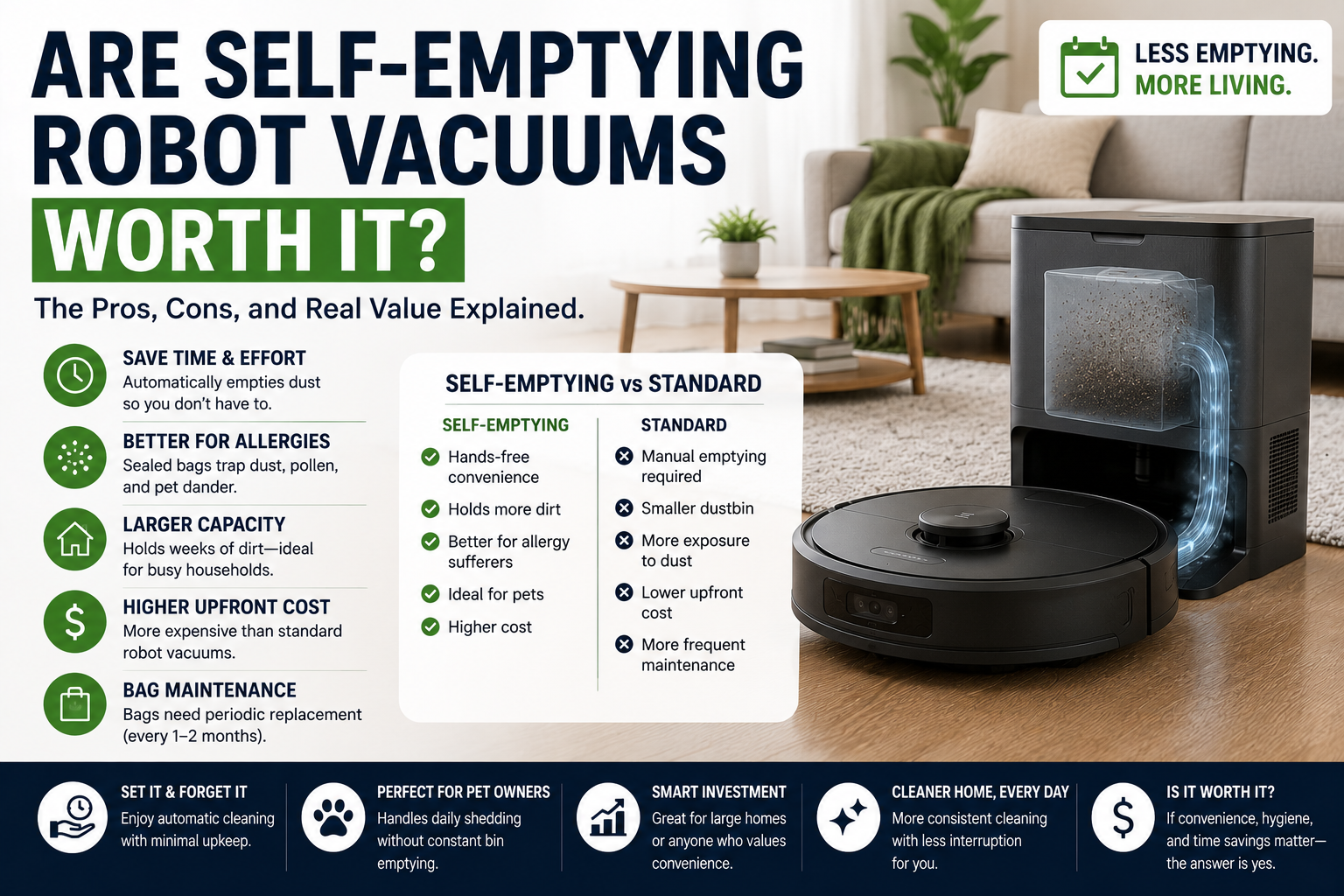
Self-emptying robot vacuums are worth it for pet owners, large homes, allergy-sensitive households, and anyone who runs the robot frequently. They are less worthwhile in small homes with light debris, especially when dock space, noise, bags, and higher purchase cost outweigh the convenience.
Are Self-Emptying Robot Vacuums Worth It? at a Glance
Heavy shedding fills onboard bins quickly.
The robot can finish long routes without manual emptying.
Reduce direct contact with dust and debris.
Manual bin emptying may already be easy.
Are Self-Emptying Robot Vacuums Worth It? Comparison Table
| Type | Best For | Core Features | Important Limitation |
|---|---|---|---|
| Pet Household | High value | Less frequent contact with hair and debris | Dock bags may fill faster |
| Large Home | High value | Fewer interruptions during long runs | Large dock footprint |
| Allergy-Sensitive Home | Strong value | Sealed disposal reduces dust exposure | Choose bagged systems |
| Apartment | Mixed value | Convenience in a small space | Dock size and noise |
| Light-Debris Home | Lower value | Long intervals between emptying | Premium cost may not pay off |
| Budget Buyer | Lower value | Basic robots cost much less | More manual bin handling |
What to Consider First
Begin with the actual home layout, floor types, cleaning frequency, debris load, and maintenance tolerance. The strongest choice is the system that can complete the real routine reliably.
- Match the cleaning method to the actual surfaces.
- Check navigation, battery, and dock requirements.
- Review ongoing maintenance and consumable cost.
- Confirm replacement parts and support.
Main Options to Consider
Less frequent contact with hair and debris
Fewer interruptions during long runs
Sealed disposal reduces dust exposure
Convenience in a small space
The Main Benefit
The dock lets the robot empty itself after a run or during long cleaning sessions, reducing daily handling.
- Follow the manufacturer guidance for the specific model.
- Check compatibility with the real floor plan and surfaces.
- Review maintenance and replacement-part requirements.
- Keep a manual cleaning backup available.
Where the Convenience Is Greatest
Heavy pet hair, large floor plans, and frequent schedules create the strongest case.
- Follow the manufacturer guidance for the specific model.
- Check compatibility with the real floor plan and surfaces.
- Review maintenance and replacement-part requirements.
- Keep a manual cleaning backup available.
Dust Exposure
Bagged docks usually contain fine dust better than bagless bins, which matters for sensitive users.
- Follow the manufacturer guidance for the specific model.
- Check compatibility with the real floor plan and surfaces.
- Review maintenance and replacement-part requirements.
- Keep a manual cleaning backup available.
Ongoing Cost
Replacement bags, filters, seals, and dock maintenance add to total ownership cost.
- Follow the manufacturer guidance for the specific model.
- Check compatibility with the real floor plan and surfaces.
- Review maintenance and replacement-part requirements.
- Keep a manual cleaning backup available.
Noise
The emptying cycle is much louder than normal robot operation, though it is brief.
- Follow the manufacturer guidance for the specific model.
- Check compatibility with the real floor plan and surfaces.
- Review maintenance and replacement-part requirements.
- Keep a manual cleaning backup available.
Clogs and Reliability
Long hair, bulky debris, and poor bin-door design can block the airflow path.
- Follow the manufacturer guidance for the specific model.
- Check compatibility with the real floor plan and surfaces.
- Review maintenance and replacement-part requirements.
- Keep a manual cleaning backup available.
Dock Size
Self-emptying bases require more wall and floor space than standard chargers.
- Follow the manufacturer guidance for the specific model.
- Check compatibility with the real floor plan and surfaces.
- Review maintenance and replacement-part requirements.
- Keep a manual cleaning backup available.
When to Skip It
A simple robot may be a better value in a small home where the bin is easy to empty.
- Follow the manufacturer guidance for the specific model.
- Check compatibility with the real floor plan and surfaces.
- Review maintenance and replacement-part requirements.
- Keep a manual cleaning backup available.
Automation Still Requires Maintenance
Robot vacuums reduce repetitive floor cleaning but still require preparation, brush care, filter replacement, dock maintenance, and periodic manual deep cleaning.
How We Evaluated the Options
We prioritized real-world cleaning, navigation, battery, serviceability, bin and dock design, obstacle handling, replacement parts, warranty, software support, and total ownership value.
Final Verdict
Self-emptying robot vacuums are worth it for pet owners, large homes, allergy-sensitive households, and anyone who runs the robot frequently. They are less worthwhile in small homes with light debris, especially when dock space, noise, bags, and higher purchase cost outweigh the convenience.
Are Self-Emptying Robot Vacuums Worth It? FAQ
Are self-emptying robot vacuums worth the extra cost?
They are when frequent cleaning or heavy debris makes manual emptying inconvenient.
How often do bags need replacement?
Often every few weeks, depending on home size and debris.
Are bagless docks cheaper?
They avoid bags but require more direct dust handling.
Do docks clog?
They can, especially with long hair or oversized debris.
Are they good for pet owners?
Yes, pet homes benefit more than most households.
Are they useful in apartments?
Sometimes, but dock size and noise may outweigh the convenience.
Do they reduce allergies?
Sealed bagged systems can reduce dust exposure during disposal.
How loud are they?
Usually similar to a powerful upright vacuum for a few seconds.
Do they need maintenance?
Yes, including inlet, filter, seal, and bag-chamber cleaning.
What is the biggest drawback?
Higher cost and a much larger charging base.