
Home Delivery Robot vs Human Delivery
Home delivery robots promise lower operating costs, contactless service, predictable short routes, and more automated local deliveries. Human drivers and couriers remain faster, more flexible, and better at handling stairs, unusual entrances, traffic problems, oversized packages, and customer requests. The best option depends on distance, delivery volume, neighborhood design, cargo size, weather, and the amount of human judgment required.
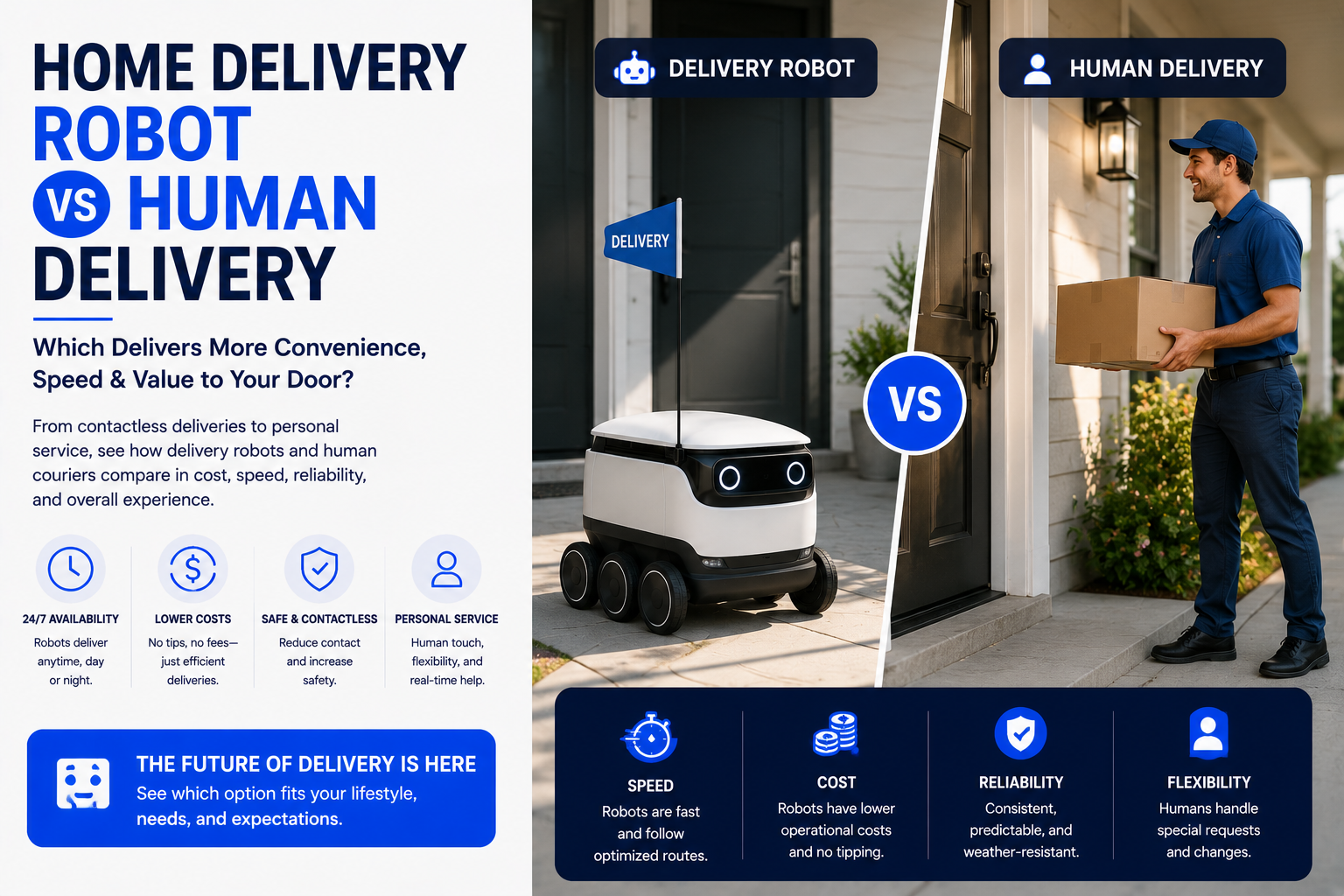
Delivery robots are better for short, predictable, high-volume routes in controlled neighborhoods, campuses, apartment complexes, hotels, offices, and similar environments. Human delivery is better for longer routes, heavy or oversized items, stairs, complex addresses, bad weather, special requests, and situations requiring judgment. The most practical future is likely a hybrid system in which robots handle repetitive local trips while human couriers manage complex deliveries.
Home Delivery Robot vs Human Delivery at a Glance
Home Delivery Robot vs Human Delivery Comparison
| Factor | Home Delivery Robot | Human Delivery |
|---|---|---|
| Operating cost | Can lower per-trip labor costs when completing many repeat deliveries. | Includes driver or courier wages, benefits, vehicle costs, and scheduling. |
| Initial cost | Requires robot hardware, software, charging, integration, maintenance, and supervision. | Can begin with existing workers, vehicles, bikes, or delivery contractors. |
| Speed | Usually slower on individual trips because robots travel at controlled speeds. | Usually faster over longer distances and mixed road conditions. |
| Flexibility | Limited by mapped routes, sidewalks, curbs, stairs, weather, and cargo capacity. | Can adapt to changing routes, entrances, customer requests, and delivery problems. |
| Reliability | Consistent on predictable routes but vulnerable to technical failures and blocked paths. | Can improvise, but performance varies with traffic, staffing, workload, and human error. |
| Cargo capacity | Best for small food orders, groceries, medicine, and compact packages. | Better for large, heavy, fragile, or unusual deliveries. |
| Customer service | Offers app tracking and contactless pickup but limited personal assistance. | Can communicate, verify instructions, help customers, and solve handoff problems. |
| Best environment | Campuses, planned communities, hotels, apartments, offices, and dense neighborhoods. | Suburbs, rural areas, complex cities, long routes, stairs, and mixed delivery zones. |
What Is a Home Delivery Robot?
A home delivery robot is an autonomous or remotely supervised machine designed to move food, groceries, medicine, packages, or other goods to a residence. Most small delivery robots travel on sidewalks or controlled private paths and use a locked cargo compartment that the customer opens through an app or access code.
These robots generally combine cameras, mapping, GPS, obstacle sensors, artificial intelligence, wireless connectivity, and remote human support. They may navigate most of the route independently while allowing an operator to intervene when the robot encounters an unfamiliar obstacle or unsafe situation.
- Designed for short-distance last-mile deliveries.
- Usually carries small or medium-sized orders.
- May operate autonomously with remote supervision.
- Uses secure cargo storage.
- Can provide app-based tracking and notifications.
- Depends on accessible routes and reliable connectivity.
How Human Home Delivery Works
Human home delivery uses drivers, couriers, cyclists, or walking delivery workers to transport goods from a store, restaurant, warehouse, or local distribution point to the customer. Human workers may use cars, vans, motorcycles, bicycles, carts, or public transportation depending on the route.
The main advantage is adaptability. A human can change the route, carry items upstairs, call the customer, recognize an unsafe situation, find a hidden entrance, protect a fragile package, or make decisions that are difficult for an automated machine.
- Can operate across varied roads and neighborhoods.
- Handles stairs, gates, elevators, and complex entrances.
- Can communicate directly with customers.
- Can carry larger and more varied orders.
- Can make judgment calls during unexpected situations.
- Requires ongoing labor and transportation costs.
The Biggest Differences
Robots automate the physical trip, while human delivery depends on a person completing each route.
Humans can respond to unusual conditions much more effectively than current small delivery robots.
Robots become more economical when many short, repeatable trips occur inside a compact service area.
Robots support contactless pickup, while humans provide communication and direct assistance.
Which Costs Less?
A delivery robot can cost less per completed trip when it operates frequently on predictable routes. One robot can perform repeated deliveries without assigning a paid courier to each trip. However, the robot is not free after purchase.
Operators must account for hardware, fleet software, charging, connectivity, maintenance, replacement batteries, remote supervisors, insurance, permits, repairs, and recovery when a robot becomes stuck or damaged.
Human delivery usually has lower technology setup costs but higher recurring labor costs. Businesses may also pay for vehicles, fuel, maintenance, contractor fees, insurance, scheduling, and employee management.
| Cost Category | Delivery Robot | Human Delivery |
|---|---|---|
| Upfront investment | Higher because of robots, charging systems, software, and route setup. | Often lower if workers and vehicles are already available. |
| Labor | Lower direct labor per trip, but remote support and operations staff are still needed. | A person must usually be paid for each shift or delivery period. |
| Maintenance | Sensors, wheels, batteries, motors, software, and cargo locks require service. | Vehicles, bicycles, carts, or delivery equipment require maintenance. |
| Scaling | Requires additional robots, charging capacity, and fleet-management support. | Requires hiring or contracting additional delivery workers. |
| Best cost case | Frequent short routes with high daily delivery volume. | Irregular, complex, long-distance, or low-volume routes. |
Which Is Faster?
Human delivery is usually faster for individual home deliveries over moderate or long distances. Drivers can use roads, choose alternate routes, travel at normal traffic speeds, and move directly from one neighborhood to another.
Small delivery robots generally travel slowly for safety. They may need extra time at crossings, curbs, crowded sidewalks, construction zones, and blocked paths. Their speed can still be acceptable when the delivery distance is short and the service area is compact.
- Humans are faster for longer routes.
- Vehicles cover larger service areas.
- Robots can be efficient within small delivery zones.
- Robot speed is limited to protect pedestrians.
- Traffic may delay human drivers.
- Blocked sidewalks may delay robots.
Which Option Wins by Delivery Type?
| Delivery Type | Better Choice | Why |
|---|---|---|
| Restaurant meal within a campus | Delivery robot | Short predictable route with a small insulated order. |
| Large weekly grocery order | Human delivery | Higher cargo capacity and easier handling at doors, stairs, and garages. |
| Prescription delivery in a planned community | Delivery robot | Secure lightweight cargo and repeatable neighborhood routes. |
| Furniture or appliance delivery | Human delivery | Requires lifting, teamwork, customer coordination, and indoor placement. |
| Hotel room-service order | Indoor delivery robot | Controlled hallways and repeat trips make automation practical. |
| Rural home package delivery | Human delivery | Long distances, private roads, gates, and uneven terrain favor a driver. |
Which Is More Reliable?
Delivery robots can be highly consistent on routes they understand. They do not become distracted, take unscheduled breaks, forget an address, or vary their driving behavior from one shift to another.
However, robots can stop when they encounter situations outside their programming. A blocked sidewalk, damaged curb, construction barrier, dead battery, sensor problem, wireless outage, or attempted interference may prevent completion.
Human couriers are less mechanically predictable, but they can improvise. A person can walk around construction, contact the customer, use another entrance, move a package away from rain, or recognize that a location is unsafe.
- Robots are consistent on controlled routes.
- Humans are better at solving unexpected problems.
- Robots depend on software and sensor reliability.
- Humans depend on staffing and individual performance.
- Both systems need backup procedures.
- Hybrid operations can improve overall reliability.
Which Is Safer?
Safety depends on the route, machine design, driver behavior, operating speed, and delivery environment. Small sidewalk robots typically move slowly and may reduce some vehicle-related risks. They can also support contactless deliveries.
At the same time, a delivery robot can obstruct sidewalks, create trip hazards, interfere with wheelchairs, become difficult to see in poor lighting, or stop unexpectedly near a driveway or intersection.
Human drivers can recognize many hazards and communicate with pedestrians, but vehicle accidents, distracted driving, fatigue, and unsafe parking remain concerns.
- Robots should use low operating speeds.
- Robots need emergency stopping and remote intervention.
- Sidewalk accessibility must remain protected.
- Human drivers must follow safe driving and parking practices.
- Both systems need clear operating rules.
- Safety performance depends on route design and oversight.
Which Handles Packages Better?
Human delivery is better for packages that are heavy, large, fragile, oddly shaped, or require signatures and special placement. A courier can carry a parcel to a porch, apartment door, reception desk, garage, or designated safe location.
Delivery robots are better for smaller packages that fit inside a secure cargo compartment. They can provide tracking, electronic locks, access codes, and a documented pickup time.
- Humans handle larger packages.
- Humans can climb stairs and open gates.
- Robots provide locked compartment delivery.
- Robots can support app-based recipient verification.
- Robots need accessible pickup locations.
- Failed pickup procedures must be clearly defined.
Which Is Better for Food Delivery?
Delivery robots can work well for food when the restaurant and customer are close together. An insulated compartment, secure access, live tracking, and controlled travel can support predictable campus or neighborhood deliveries.
Human couriers remain better for longer distances, multiple restaurant pickups, apartment stairs, complex buildings, large orders, drinks that require careful handling, and customer-specific instructions.
- Robots work well for compact local food zones.
- Humans cover wider restaurant service areas.
- Robots reduce direct contact.
- Humans handle complicated handoffs better.
- Food temperature depends heavily on trip time.
- Order packaging must match the delivery method.
Robot vs Human Delivery by Environment
| Environment | Better Option | Main Reason |
|---|---|---|
| College campus | Delivery robot | Dense destinations, frequent orders, controlled speeds, and connected paths. |
| Planned neighborhood | Delivery robot or hybrid | Short routes can work if sidewalks and crossings are suitable. |
| Traditional suburb | Human delivery | Longer distances, driveways, missing sidewalks, and larger grocery orders. |
| Apartment tower | Human or indoor robot | Elevator integration determines whether a robot can complete the final handoff. |
| Rural community | Human delivery | Long distances, private roads, uneven terrain, and low delivery density. |
| Hotel or hospital | Indoor delivery robot | Controlled repeat routes make indoor automation practical. |
Customer Experience
Delivery robots provide a predictable, trackable, and contactless experience. Customers may receive an alert, follow the robot on a map, meet it outside, and unlock the cargo compartment through an app.
The main disadvantage is limited assistance. A robot cannot easily explain a delay, help an older customer carry groceries inside, locate a hidden apartment entrance, or discuss a damaged order.
Human delivery offers more personal service but can also introduce inconsistent communication, missed instructions, unwanted contact, or differences in service quality.
- Robots offer contactless pickup.
- Robots provide standardized app tracking.
- Humans can answer questions and offer assistance.
- Humans can adjust the handoff location.
- Robots require customers to reach an accessible pickup point.
- Both systems need clear customer support.
Environmental Impact
Small electric delivery robots may use less energy than sending a full-size vehicle on an individual short delivery. Their greatest environmental advantage appears when they replace short vehicle trips rather than walking or cycling couriers.
However, environmental impact also includes robot manufacturing, batteries, electricity generation, maintenance, replacement parts, charging infrastructure, and the vehicles used to transport or recover robots.
Human delivery can have a low environmental impact when workers walk, cycle, use electric bikes, or combine many deliveries into one efficient vehicle route.
- Small robots can reduce short vehicle trips.
- Electric operation does not eliminate manufacturing impact.
- Walking and cycling couriers can be highly efficient.
- Efficient route grouping matters.
- Low delivery density can reduce robot advantages.
- The full system should be compared, not only the final trip.
Where Each Option Struggles
Stairs, large curbs, missing sidewalks, bad weather, blocked paths, and complex entrances remain difficult.
Labor shortages, scheduling, wages, traffic, fatigue, and inconsistent service can increase operating difficulty.
Small compartments limit oversized, heavy, fragile, or high-volume household deliveries.
Every additional route generally requires more worker time, vehicle capacity, or contractor expense.
Will Delivery Robots Replace Human Drivers?
Delivery robots are unlikely to replace all human drivers and couriers. They are better suited to a specific part of the delivery market: frequent, short, lightweight, predictable trips in accessible environments.
Human delivery remains essential for long distances, large orders, rural routes, stairs, special handling, customer assistance, vehicle loading, and unexpected situations.
The more realistic future is task division. A human driver may transport many orders to a neighborhood hub, while small robots complete nearby deliveries. Inside a hotel or hospital, employees may load robots while the machines handle routine trips between floors.
- Robots may replace some repetitive routes.
- Humans will remain necessary for complex deliveries.
- Local hubs can support robot last-mile service.
- Indoor delivery is easier to automate than mixed public streets.
- Remote human operators will remain part of robot fleets.
- Hybrid systems can combine efficiency and flexibility.
The Future of Home Delivery
Future home delivery networks may use several delivery methods together. Vans could move large groups of orders between warehouses and neighborhood hubs. Sidewalk robots could handle small local deliveries. Drones may serve selected lightweight routes. Human couriers could manage oversized goods, difficult addresses, and customer service.
The success of delivery robots will depend on more than navigation technology. Communities will need accessible sidewalks, clear operating rules, secure cargo systems, reliable support, insurance standards, and public acceptance.
- More local robot delivery zones may appear.
- Apartment and community integrations may improve.
- Robots may connect with smart lockers and secure pickup points.
- Human remote supervision will likely continue.
- Regulations and accessibility rules will shape adoption.
- Hybrid fleets are more practical than complete automation.
When a Delivery Robot Is the Better Choice
- The route is short and repeated many times.
- The cargo is small enough for a secure compartment.
- The area has connected, accessible sidewalks or indoor paths.
- Customers can meet the robot at an approved pickup point.
- Weather is generally manageable.
- The operator can provide remote supervision.
- Delivery volume is high enough to justify the system.
- Contactless delivery is valuable.
When Human Delivery Is the Better Choice
- The route covers a large or scattered area.
- The order is heavy, oversized, fragile, or complicated.
- The destination has stairs, gates, or difficult entrances.
- The customer needs direct assistance.
- Weather or terrain is unpredictable.
- Delivery instructions frequently change.
- Order volume is too low to justify robot infrastructure.
- The delivery requires judgment or personal verification.
Final Verdict: Delivery Robot or Human Delivery?
Delivery robots win on frequent, lightweight, predictable trips inside controlled or highly accessible service areas. Human delivery wins on speed, flexibility, cargo capacity, customer assistance, difficult entrances, long routes, and unexpected conditions.
For most delivery networks, the strongest answer is not complete replacement. Robots can handle repetitive local movement while human workers manage transportation, loading, support, exceptions, and complex final handoffs.
Related Delivery Robot Guides
Home Delivery Robot vs Human Delivery FAQ
Are delivery robots cheaper than human delivery?
Delivery robots can cost less per trip on frequent, predictable routes, but hardware, software, charging, maintenance, remote supervision, and insurance must be included.
Are delivery robots faster than human couriers?
Usually not. Human couriers are generally faster over moderate and long distances, while robots can be efficient on short routes inside compact service areas.
Can delivery robots replace human drivers?
They can replace some repetitive short-distance trips, but humans remain necessary for long routes, heavy items, stairs, special requests, and unexpected situations.
Are delivery robots safe?
They can operate safely with low speeds, obstacle detection, emergency stopping, visibility systems, remote intervention, and accessible route planning.
Can delivery robots climb stairs?
Most small sidewalk delivery robots cannot climb normal stairs, which limits their ability to reach many porches, apartments, and building entrances.
Can delivery robots carry groceries?
Yes, but capacity varies. They are better for smaller grocery orders than large weekly household deliveries.
Which is better for food delivery?
Robots can be effective for short food deliveries in campuses and dense neighborhoods, while human couriers are better for longer routes and complex handoffs.
Which is more reliable?
Robots are consistent on predictable routes, while humans are better at solving unusual delivery problems. A hybrid system can provide the strongest reliability.
Do delivery robots work in bad weather?
Some can operate in light rain or moderate conditions, but snow, ice, flooding, extreme temperatures, and poor visibility can reduce performance.
What is the future of home delivery?
The future will likely combine human drivers, local delivery robots, smart lockers, neighborhood hubs, and other automated delivery methods.
We may earn a commission from qualifying purchases at no extra cost to you.