
AI Home Robot vs Smart Speaker: Which Is Better for Your Home?
AI home robots and smart speakers can both help with voice commands, reminders, smart home control, entertainment, routines, questions, communication, and daily support. But they are not the same. This guide compares AI home robots, smart speakers, smart displays, companion robots, home assistant robots, personal assistant robots, home monitoring robots, smart home devices, and future AI assistants so you can decide which one fits your home best.
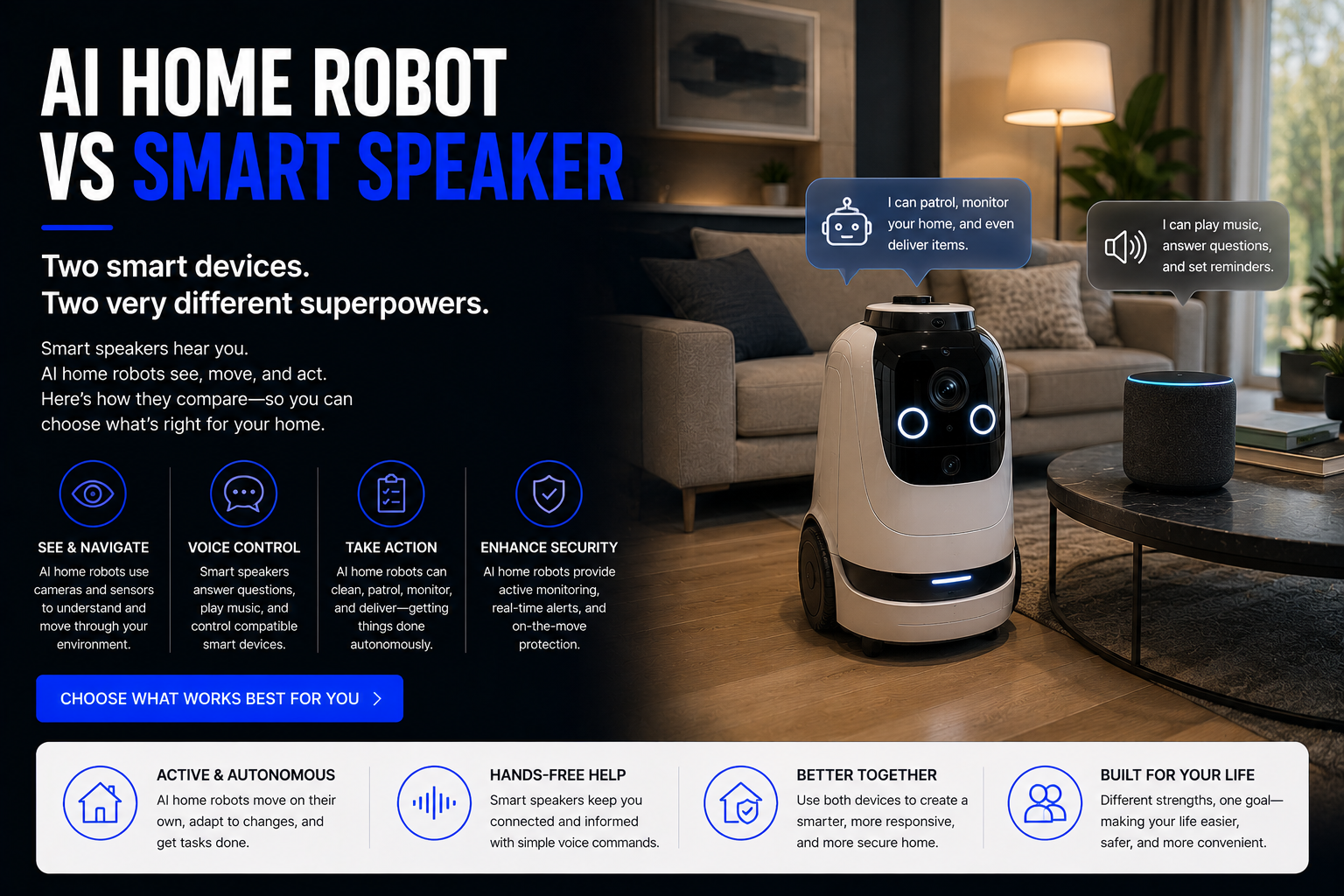
AI Home Robot vs Smart Speaker: Quick Answer
A smart speaker is usually better if you want affordable voice control, music, timers, weather, reminders, smart home commands, simple routines, and a low-cost assistant for kitchens, bedrooms, offices, or living rooms.
An AI home robot is usually better if you want something more interactive, visual, mobile, personal, or future-focused. AI home robots may offer movement, cameras, screens, personality, home monitoring, companion features, caregiver check-ins, pet monitoring, family routines, or deeper interaction than a normal smart speaker.
For most homes, a smart speaker is the best first step. For homes that want companionship, mobile monitoring, visual interaction, senior support, child learning, pet check-ins, or a more advanced smart home experience, an AI home robot may be worth considering.
Best rule: choose a smart speaker for simple affordable voice help; choose an AI home robot when mobility, visual presence, companionship, monitoring, or more personal interaction adds real value.
AI Home Robot vs Smart Speaker Comparison
| Category | AI Home Robot | Smart Speaker |
|---|---|---|
| Best For | Companionship, monitoring, mobility, visual interaction, advanced routines | Voice commands, music, timers, reminders, smart home control |
| Cost | Usually higher | Usually lower |
| Mobility | Some models can move around the home | Stationary |
| Visual Presence | May include screen, face, lights, movement, or camera | Usually voice-only unless using a smart display |
| Smart Home Control | Depends on model and ecosystem | Usually strong and widely supported |
| Companionship | Better for personality and engagement | Limited to voice interaction |
| Home Monitoring | Some models include cameras, patrols, or remote check-ins | Limited unless paired with cameras |
| Ease of Setup | Can be more complex | Usually simple |
| Privacy Concerns | May include cameras, microphones, sensors, cloud AI, remote access | Mainly microphone-based, sometimes camera-based with smart displays |
| Best Value | Best when advanced features are actually used | Best for most basic daily assistant needs |
What Is an AI Home Robot?
An AI home robot is a smart robot or assistant device that uses artificial intelligence to help with home routines, reminders, communication, monitoring, companionship, entertainment, smart home control, learning, pet care, senior support, or family organization.
AI home robots can be stationary, mobile, screen-based, voice-based, camera-based, companion-style, humanoid, or specialized for a specific home task. Some feel like smart displays with more personality. Others act like mobile home monitoring robots, companion robots, personal assistant robots, or early versions of future home robots.
The strongest reason to choose an AI home robot over a smart speaker is that the robot can feel more present. It may move, look around, show expressions, display information, check rooms, provide video calls, interact with children, support seniors, or create more engaging daily routines.
What Is a Smart Speaker?
A smart speaker is a voice-controlled assistant device that can play music, answer questions, set timers, create reminders, control smart home devices, make announcements, provide weather updates, manage simple routines, and support calls depending on the ecosystem.
Smart speakers are popular because they are affordable, easy to set up, compact, and useful in many rooms. They are often the simplest way to start a smart home.
The main limitation is that a smart speaker is usually stationary and voice-only. It can respond to commands, but it does not usually move around, show personality through motion, patrol a room, check pets visually, or feel like a robot companion.
When an AI Home Robot Is Better
Companionship
AI home robots can feel more personal than a speaker because they may include a face, screen, movement, expressions, or interactive routines.
Home Monitoring
Some AI robots include cameras, remote driving, patrol features, or room-to-room check-ins for pets, seniors, and travel monitoring.
Senior Support
Companion-style AI robots can help with reminders, communication, caregiver check-ins, and daily engagement for elderly users.
Child Learning
Some AI robots provide interactive learning, STEM activities, coding practice, language support, and family-friendly engagement.
Pet Check-Ins
Mobile or camera-based AI robots can help pet owners check rooms, talk to pets, or monitor activity while away.
Future Smart Homes
AI home robots may become central to future smart homes as voice AI, computer vision, mobility, and home automation improve.
When a Smart Speaker Is Better
Lower Cost
Smart speakers are usually much cheaper than AI home robots and provide strong value for basic daily help.
Simple Reminders
For timers, alarms, calendar reminders, medication prompts, and daily routines, smart speakers are often enough.
Music and Audio
Smart speakers are excellent for music, podcasts, radio, weather, news, and voice entertainment.
Smart Home Control
Smart speakers usually work well with lights, plugs, thermostats, cameras, locks, and routines.
Easy Setup
Smart speakers are simple to install, easy to place, and familiar to many users.
Multiple Rooms
Because smart speakers cost less, it is easier to place them in bedrooms, kitchens, offices, and living rooms.
Best Choice by Home Type
For Apartments
A smart speaker is usually the best first choice because it is affordable, compact, and easy to use. An AI home robot may make sense if you want pet monitoring, mobile check-ins, or companionship in a small space.
For Large Homes
Large homes may benefit from both. Smart speakers can be placed in multiple rooms, while an AI home robot can help with monitoring, routines, or more interactive support in key areas.
For Families with Kids
Smart speakers are good for reminders, music, alarms, and routines. AI home robots may be better for interactive learning, entertainment, coding activities, and visual engagement.
For Seniors
A smart speaker can provide simple reminders and calls. An AI companion robot may provide more engagement, visual prompts, routine support, and caregiver communication.
For Pet Owners
A smart speaker can play sounds or support simple routines. An AI robot with a camera or mobility can help with remote pet check-ins and two-way interaction.
For Smart Home Users
A smart speaker is usually better for controlling many devices. An AI home robot can add personality, monitoring, and mobility if the ecosystem supports it.
Cost and Value Comparison
Smart speakers usually offer better value for basic assistant features. If you only want music, timers, reminders, weather, questions, routines, and smart home control, a smart speaker is the practical choice.
AI home robots cost more because they may include cameras, screens, movement, batteries, sensors, personality features, mapping, docking, visual interaction, or specialized AI software.
The value question is simple: will you actually use the robot features that a speaker does not have? If the answer is yes, an AI home robot may be worth it. If not, a smart speaker is probably the better buy.
Privacy Comparison
Both smart speakers and AI home robots can create privacy concerns because they may use microphones, cloud accounts, voice history, app access, and connected services.
AI home robots may add extra privacy questions because many include cameras, sensors, mapping, remote access, video calls, person detection, or mobile monitoring. That does not mean they are unsafe, but it does mean privacy settings matter more.
Before buying either one, review microphone controls, camera controls, stored data, app permissions, user access, cloud settings, privacy mode, and whether the device can be muted or physically covered when not needed.
Common Buying Mistakes
- Buying an AI robot when a speaker is enough: Do not overpay if you only need basic voice help.
- Buying a smart speaker when companionship is the real need: A speaker may feel too limited for seniors or engagement-focused users.
- Ignoring privacy: Cameras, microphones, cloud AI, and app access need careful review.
- Ignoring subscriptions: Some AI robot features may require monthly fees.
- Expecting a robot to do everything: Most AI home robots are still specialized.
- Forgetting smart home compatibility: Make sure the device works with your lights, plugs, cameras, locks, or routines.
- Ignoring Wi-Fi coverage: Mobile robots and cloud-based assistants need reliable connectivity.
- Choosing based only on novelty: A cute or futuristic robot is only valuable if it solves a real problem.
- Buying too complex for the user: Seniors, kids, and low-tech users need simple setup and clear prompts.
- Assuming AI is perfect: AI can misunderstand, fail to respond, or give imperfect answers.
Final Verdict: AI Home Robot or Smart Speaker?
Choose a smart speaker if you want affordable voice assistance, music, timers, alarms, reminders, weather, simple routines, and smart home control.
Choose an AI home robot if you want more interactive support, movement, cameras, personality, companionship, home monitoring, pet check-ins, senior support, child learning, or a more future-focused smart home experience.
For many homes, the best setup may be both: smart speakers for simple voice control in multiple rooms and an AI home robot for the places where interaction, mobility, or monitoring adds real value.
Future of AI Home Robots and Smart Speakers
Smart speakers helped bring voice assistants into everyday homes. AI home robots may be the next step, adding cameras, movement, screens, expression, home awareness, and more personal interaction.
Future AI home robots may coordinate reminders, smart home routines, family schedules, pet care, elderly care, security monitoring, home maintenance, education, video calls, and personal assistant tasks more naturally than today’s devices.
Smart speakers will likely remain useful because they are affordable and simple. AI home robots may become more common as robotics hardware, batteries, AI models, sensors, and smart home systems improve.
Related AI Home Robot Guides
Related Home Robot Guides
AI Home Robot vs Smart Speaker FAQ
Is an AI home robot better than a smart speaker?
An AI home robot is better for mobility, interaction, cameras, companionship, and monitoring. A smart speaker is better for low-cost voice assistance.
Is a smart speaker enough for most homes?
Yes, for basic voice commands, music, reminders, timers, weather, and smart home control, a smart speaker is usually enough.
Why buy an AI home robot instead of a smart speaker?
Buy an AI home robot if you want more personality, movement, visual interaction, pet check-ins, senior support, home monitoring, or companion features.
Are AI home robots worth the extra cost?
They can be worth it if you use features that smart speakers do not offer. If not, a smart speaker is the better value.
Can AI home robots control smart home devices?
Some can control smart home devices, but compatibility depends on the robot and ecosystem.
Are smart speakers better for smart home control?
Usually yes. Smart speakers often have broader smart home compatibility and easier setup.
Can AI home robots move around?
Some can. Mobile AI robots may offer room-to-room movement, remote driving, patrols, or automatic docking.
Can smart speakers move around?
No. Smart speakers are stationary devices.
Are AI home robots good for seniors?
Some are useful for reminders, companionship, caregiver check-ins, and daily routines, but they do not replace caregivers.
Are smart speakers good for seniors?
Yes, smart speakers can help with reminders, calls, music, alarms, and simple routines.
Are AI home robots good for kids?
Some AI robots are good for learning, STEM, coding, language practice, and interactive routines with parental guidance.
Are smart speakers good for kids?
They can be useful for music, questions, timers, and routines, but parental controls are important.
Can AI home robots monitor pets?
Some can offer live video, two-way audio, mobile check-ins, or pet-focused features.
Can smart speakers monitor pets?
Not by themselves. They may help with sounds or routines, but cameras or robots are better for visual monitoring.
Do AI home robots need Wi-Fi?
Most need Wi-Fi for cloud AI, app features, video, updates, remote access, and smart home control.
Do smart speakers need Wi-Fi?
Yes, most smart speaker features require Wi-Fi.
Do AI home robots have subscriptions?
Some may require subscriptions for advanced AI, cloud storage, video history, monitoring, or premium services.
Are AI home robots private?
Privacy depends on camera settings, microphone controls, cloud storage, app access, user permissions, and security settings.
Are smart speakers private?
They can collect voice and usage data depending on settings. Review privacy controls and mute options.
What should I buy first?
Start with a smart speaker for basic needs. Upgrade to an AI home robot if mobility, interaction, cameras, companionship, or monitoring add real value.
Shop AI Home Robots
AI home robots and smart speakers can both support reminders, routines, smart home control, communication, entertainment, and daily assistance. Compare AI home robots, smart speakers, companion robots, home assistant robots, personal assistant robots, smart displays, home monitoring robots, and future home robots before choosing the best option for your home.
Shop AI Home Robots