
Home Monitoring Robot vs Security Camera
Compare home monitoring robots vs security cameras. Learn differences in mobility, AI detection, smart alerts, coverage, privacy, and home protection. Choose systems that improve visibility and communication without replacing direct care, emergency response, or a complete security system.
As an Amazon Associate, HomeBotGuide may earn from qualifying purchases at no extra cost to you.
Choose a monitoring robot when you need live mobile inspection across multiple rooms. Choose fixed security cameras for continuous coverage, faster event detection, stable recording, and perimeter protection. The strongest setup combines fixed cameras at critical points with a robot for flexible indoor investigation.
Home Monitoring Robot vs Security Camera at a Glance
Remote driving, changing viewpoints, two-way audio, and patrols.
Stable view, event recording, zones, and dependable power.
Permanent coverage of doors, windows, driveways, and gates.
Fixed detection plus mobile follow-up inside the home.
Home Monitoring Robot vs Security Camera Comparison Table
| Option | Best For | Core Features | Important Limitation |
|---|---|---|---|
| Coverage | Moves between rooms | Fixed field of view | Robot for flexibility |
| Event Detection | Depends on patrol or location | Continuous view of selected area | Fixed camera |
| Recording | Often live view or clips | Continuous or event recording | Fixed camera |
| Power | Battery and docking | Wired or battery | Fixed wired camera |
| Obstacle Limits | Rugs, stairs, clutter | No navigation issue | Fixed camera |
| Privacy | Mobile camera inside home | Known fixed viewpoint | Depends on use and settings |
What Home Monitoring Robots Can Actually Do
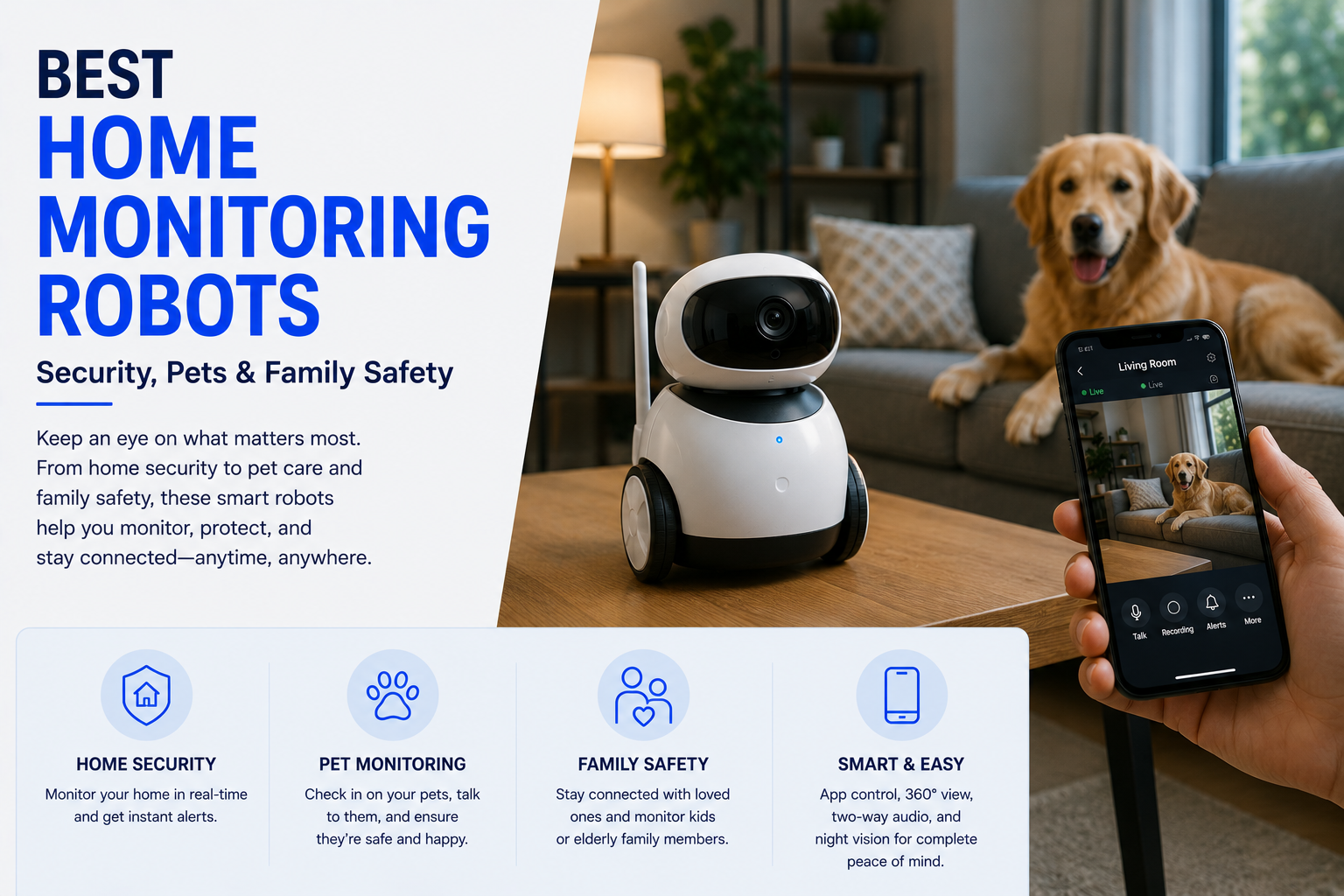
Home monitoring robots combine a mobile base, camera, microphone, speaker, app controls, sensors, and sometimes patrol or telepresence functions. Their strongest advantage is changing viewpoint without installing a camera in every room.
They remain dependent on floors, battery, Wi-Fi, software, and remote access. They should supplement—not replace—fixed security cameras, alarms, caregiving, veterinary care, medical alert systems, or emergency services.
- Move through accessible indoor areas.
- Provide live video and two-way audio.
- Send selected motion, sound, person, or pet alerts.
- Support patrols, check-ins, or telepresence.
- Return to a charging dock on supported models.
Main Types to Consider
Fixed field of view
Continuous view of selected area
Continuous or event recording
Wired or battery
Mobility and Coverage
A robot can inspect areas outside a fixed camera's field of view and move closer to a sound, pet, or open door. It is limited by floors, thresholds, clutter, battery, navigation, and where it happens to be when an event begins.
- Confirm the robot fits the intended monitoring goal.
- Test mobility, video, alerts, and docking in the actual home.
- Review privacy, recording, subscriptions, and shared access.
- Maintain human, security, and emergency backup plans.
Detection and Recording
Fixed cameras continuously watch a defined area and are better for motion zones, person detection, package events, entrances, and evidence. Robots may patrol or send alerts, but they generally provide less predictable event coverage.
- Confirm the robot fits the intended monitoring goal.
- Test mobility, video, alerts, and docking in the actual home.
- Review privacy, recording, subscriptions, and shared access.
- Maintain human, security, and emergency backup plans.
Privacy and Cybersecurity
A mobile camera can reveal more of a home's interior than a fixed camera. Both require secure accounts, firmware updates, controlled sharing, recording policies, and careful placement. Camera and microphone access should be transparent to household members.
- Confirm the robot fits the intended monitoring goal.
- Test mobility, video, alerts, and docking in the actual home.
- Review privacy, recording, subscriptions, and shared access.
- Maintain human, security, and emergency backup plans.
Best Hybrid Configuration
Place fixed cameras at exterior approaches, entrances, and key indoor areas. Use a mobile robot for pet checks, room-to-room inspection, telepresence, or investigating alerts from the fixed system.
- Confirm the robot fits the intended monitoring goal.
- Test mobility, video, alerts, and docking in the actual home.
- Review privacy, recording, subscriptions, and shared access.
- Maintain human, security, and emergency backup plans.
Monitoring Is Not Emergency Response
A consumer monitoring robot may miss an event, lose connection, become stuck, run out of power, or generate a false alert.
Use dedicated smoke and carbon-monoxide alarms, security systems, medical alert services, professional care, veterinary care, and emergency services whenever those protections are needed.
Mobility, Floors, and Docking
Evaluate thresholds, rugs, cables, dark floors, furniture clearance, narrow passages, pet toys, slopes, and stairs. Automatic charging matters only when the robot can reliably find and approach its dock.
Camera, Audio, and Smart Alerts
Compare real night vision, field of view, camera height, motion blur, microphone clarity, speaker volume, notification delay, person and pet detection, patrol scheduling, and event history.
Privacy, Recording, and Account Security
Mobile cameras can reveal more of a home's interior than fixed cameras. Use unique passwords, multifactor authentication when available, firmware updates, limited sharing, visible recording policies, and careful cloud-storage settings.
Battery, Storage, and Subscription Costs
Include battery runtime, charging time, dock reliability, local storage, cloud clips, AI subscriptions, replacement batteries, accessories, warranty, and app-support history.
How to Test a Monitoring Robot
Test every intended route and obstacle.
Verify notification speed and accuracy.
Review accounts, recording, and sharing.
Simulate low battery, Wi-Fi loss, and blocked docking.
How We Evaluated the Options
We prioritized mobility, obstacle handling, camera quality, low-light performance, audio, alerts, docking, battery, storage, privacy, app stability, subscriptions, household usability, replacement parts, and manufacturer support.
Final Verdict
Choose a monitoring robot when you need live mobile inspection across multiple rooms. Choose fixed security cameras for continuous coverage, faster event detection, stable recording, and perimeter protection. The strongest setup combines fixed cameras at critical points with a robot for flexible indoor investigation.
Home Monitoring Robot vs Security Camera FAQ
Is a monitoring robot a replacement for security cameras?
Usually no. It adds mobile inspection but does not provide the same continuous fixed coverage or event recording.
Which device detects intruders faster?
A fixed camera watching the relevant entrance is more likely to detect the event immediately.
Can a robot patrol automatically?
Selected robots support scheduled patrols, but navigation success depends on the floor plan and obstacles.
Which option records better evidence?
Fixed security cameras generally provide more dependable event history and consistent angles.
Can a robot follow a person or pet?
Some models provide tracking or remote driving, but performance varies and should not be treated as guaranteed surveillance.
Which option is more private?
A fixed camera has a predictable field of view, while a mobile robot can expose more rooms. Security depends on settings and account protection.
Which works better during a power outage?
A battery robot may operate temporarily, while wired cameras need backup power; both may lose remote access if the router fails.
Do both require subscriptions?
Cloud recording and advanced detection may require subscriptions, while local storage options vary.
Which is better for pets?
A robot is better for finding a pet around the home; fixed cameras are better for continuous views of beds, crates, doors, or feeding areas.
What is the best overall choice?
Use fixed cameras for security coverage and a robot only when mobile indoor viewing or interaction adds clear value.