
Healthcare Robot vs Human Caregiver
Compare healthcare robots and human caregivers. Understand advantages, limitations, safety features, emotional support, costs, and realistic expectations. Healthcare robots can support routines, communication, reminders, and independence, but they do not replace qualified care, diagnosis, treatment, supervision, or emergency services.
As an Amazon Associate, HomeBotGuide may earn from qualifying purchases at no extra cost to you.
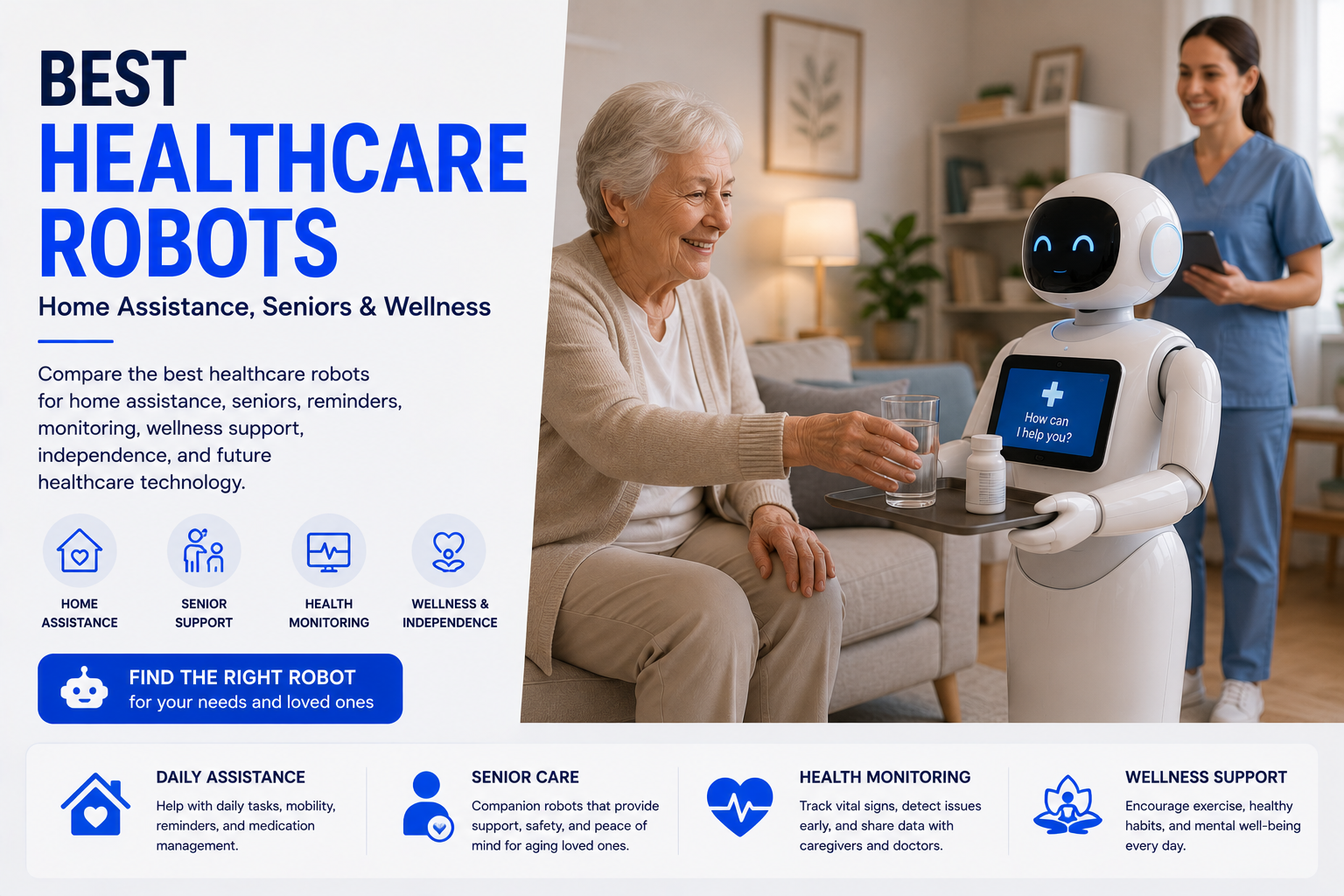
A healthcare robot is best for repeatable reminders, remote check-ins, entertainment, routine data, and always-available prompts. A human caregiver is better for judgment, emotional understanding, physical assistance, personal care, medication administration, emergencies, and changing needs. The most realistic model is a caregiver-supported robot, not a robot replacing care.
Healthcare Robot vs Human Caregiver at a Glance
Consistent reminders, scheduled activities, and routine prompts.
Adapts to symptoms, mood, risk, and changing needs.
Mobility, hygiene, meals, medication, and hands-on assistance.
Technology handles routine tasks while people provide care and judgment.
Healthcare Robot vs Human Caregiver Comparison Table
| Option | Best For | Core Features | Important Limitation |
|---|---|---|---|
| Reminders | Consistent and automatic | Personalized and context-aware | Depends on task |
| Emotional Support | Simulated conversation | Human empathy and relationship | Human caregiver |
| Physical Assistance | Very limited in home products | Hands-on mobility and care | Human caregiver |
| Monitoring | Continuous device data | Observation and interpretation | Combined approach |
| Emergency Response | May alert or call | Can assess and act directly | Human caregiver |
| Cost | Device and subscriptions | Ongoing labor cost | Depends on care level |
What Healthcare Robots Can Actually Do
Home healthcare robots may provide reminders, communication, conversation, telepresence, routine monitoring, activities, and selected smart-home control. Their value is strongest when they perform one clear support role reliably.
They cannot independently diagnose illness, provide hands-on care, guarantee emergency response, or replace qualified professionals and family caregivers.
- Deliver reminders and structured routines.
- Support family and caregiver communication.
- Provide activities, engagement, and companionship.
- Enable selected mobile or stationary check-ins.
- Share limited updates with authorized users.
Main Types to Consider
Personalized and context-aware
Human empathy and relationship
Hands-on mobility and care
Observation and interpretation
Where Robots Perform Well
Robots are strong at repeated prompts, scheduled check-ins, simple conversations, activity suggestions, remote communication, and collecting routine data. They do not tire or forget a programmed schedule.
- Confirm the exact support goal and intended user.
- Verify privacy, permissions, and remote-access controls.
- Review subscriptions, updates, and service support.
- Maintain human and emergency backup plans.
Where Human Caregivers Remain Essential
Humans interpret context, notice subtle changes, provide comfort, handle unexpected situations, assist with mobility and hygiene, prepare meals, manage medications, and respond physically in emergencies.
- Confirm the exact support goal and intended user.
- Verify privacy, permissions, and remote-access controls.
- Review subscriptions, updates, and service support.
- Maintain human and emergency backup plans.
Cost and Availability
A robot may reduce the time spent on repetitive communication or reminders, but it adds purchase, subscription, connectivity, maintenance, and support costs. It does not eliminate the need for paid or unpaid human care.
- Confirm the exact support goal and intended user.
- Verify privacy, permissions, and remote-access controls.
- Review subscriptions, updates, and service support.
- Maintain human and emergency backup plans.
The Best Hybrid Care Model
Robots can extend a caregiver's reach by delivering reminders, enabling video calls, and flagging routine changes. Caregivers remain responsible for interpreting information, deciding what matters, and taking action.
- Confirm the exact support goal and intended user.
- Verify privacy, permissions, and remote-access controls.
- Review subscriptions, updates, and service support.
- Maintain human and emergency backup plans.
Robots Support Care—They Do Not Replace It
Consumer robots can fail, misunderstand commands, miss events, lose connectivity, or create false reassurance.
Use qualified healthcare professionals, caregivers, medical alert systems, smoke and carbon-monoxide alarms, medication-management services, and emergency services whenever those protections are needed.
Reminders, Monitoring, and Alerts
Evaluate which reminders are delivered, how caregivers confirm them, whether alerts can be escalated, and what happens when the user does not respond. A notification is not the same as a completed care task.
Privacy, Consent, and Dignity
Healthcare robots may collect voice, video, routines, wellness information, medication schedules, and family communications. Use informed consent, limited accounts, secure authentication, minimal recording, and clear controls for disabling cameras and microphones.
Connectivity, Accessibility, and Support
Test voice recognition, screen readability, hearing support, language, Wi-Fi coverage, physical controls, caregiver setup, troubleshooting, and outage behavior in the actual home.
Subscriptions and Long-Term Ownership
Include hardware, service plans, family apps, cloud features, replacement parts, batteries, connectivity, technical support, and the risk that cloud-dependent features may change or end.
How to Build a Safe Care Plan
Assign the robot a narrow support role.
Limit access and recording clearly.
Plan for outages, missed alerts, and low battery.
Maintain caregivers and emergency response.
How We Evaluated the Options
We prioritized usefulness, accessibility, reminders, communication, privacy, consent, reliability, outage behavior, caregiver access, subscription cost, intended use, support, software updates, emergency limitations, and integration with human care.
Final Verdict
A healthcare robot is best for repeatable reminders, remote check-ins, entertainment, routine data, and always-available prompts. A human caregiver is better for judgment, emotional understanding, physical assistance, personal care, medication administration, emergencies, and changing needs. The most realistic model is a caregiver-supported robot, not a robot replacing care.
Healthcare Robot vs Human Caregiver FAQ
Can a healthcare robot replace a caregiver?
No. Current home robots cannot replace human judgment, physical care, emotional understanding, or emergency action.
What tasks can robots handle well?
They can handle reminders, scheduled calls, routine prompts, activities, simple monitoring, and communication support.
What tasks require a human caregiver?
Personal care, lifting, mobility assistance, wound care, medication administration, meal preparation, judgment, and emergency response require people.
Are robots available 24 hours a day?
They can provide continuous prompts or connectivity when powered and online, but they can fail, lose connection, or require maintenance.
Can robots reduce caregiver burden?
They may reduce some repetitive check-ins and routine prompting, but they also create setup, troubleshooting, and monitoring responsibilities.
Do robots provide emotional support?
They can offer conversation and engagement, but they do not provide genuine human empathy or a reciprocal relationship.
Which is less expensive?
A robot may cost less than continuous paid care, but it cannot perform the same scope of work, so direct cost comparisons can be misleading.
Can a caregiver remotely control a robot?
Telepresence systems may allow trusted users to navigate and communicate remotely, depending on permissions and connectivity.
Who is responsible if a robot misses an alert?
Responsibility depends on the product, service, caregivers, and legal agreements. Families should never rely on one consumer device for critical safety.
What is the best use of a healthcare robot?
Use it to support a human-led care plan with clearly defined tasks, privacy rules, and backup procedures.