
Best Home Inspection Robots
Compare the best home inspection robots for cameras, sensors, difficult spaces, monitoring, problem detection, smart alerts, and preventative maintenance. The strongest systems improve access, documentation, and preventative awareness while leaving diagnosis and repair to qualified people.
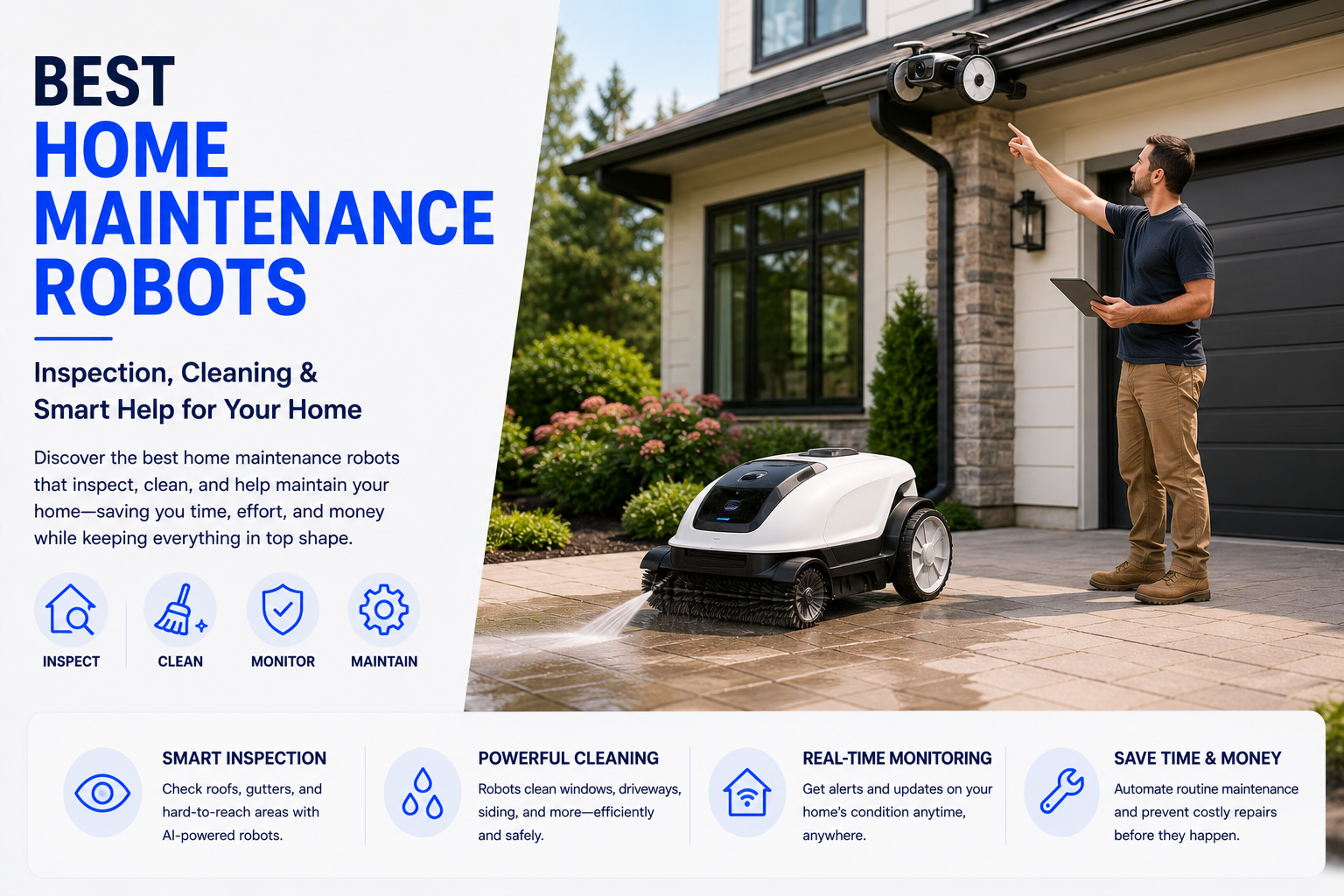
As an Amazon Associate, HomeBotGuide may earn from qualifying purchases at no extra cost to you.
For professional crawlspace and under-home inspections, a tracked wireless crawler with HD video, lighting, and optional thermal or environmental sensors is the strongest choice. For homeowners, compact camera crawlers and pipe-inspection cameras are more realistic. Robots improve access and documentation, but they do not replace a qualified inspection or confirm the cause of moisture, heat loss, pests, or structural defects.
Best Home Inspection Robots at a Glance
Low-profile drive, strong traction, live video, lighting, and recording.
Flexible camera cable for plumbing, ducts, and wall cavities.
Temperature patterns that may reveal leaks, missing insulation, or overheating.
Remote viewing beneath furniture, in basements, or around mechanical rooms.
Best Home Inspection Robots Comparison Table
| Option | Best For | Core Features | Important Limitation |
|---|---|---|---|
| Tracked Crawlspace Robot | Tight under-home areas | Live video, lighting, recording, rugged drive | Professional cost and training |
| Pipe Inspection Camera | Drains, ducts, wall cavities | Flexible cable, small camera head | Limited steering and context |
| Thermal Crawler | Moisture and heat anomalies | Thermal plus visible imaging | Patterns require expert interpretation |
| Mobile Camera Robot | Simple home monitoring | Remote drive, audio, video | Limited terrain and sensor depth |
| Drone Inspection | Roofs and large attics | Aerial imagery and difficult access | Indoor control and legal limits |
| Human Inspector | Complete evaluation | Judgment, tools, testing, standards | Physical access and time |
What Home Maintenance Robots Can Actually Do
Home maintenance robots automate narrow tasks such as cleaning, image inspection, difficult-space access, thermal scanning, environmental monitoring, or scheduled patrols.
They can reveal changes and collect evidence, but they cannot reliably diagnose every building problem or perform the varied physical repairs required in a real home.
- Inspect confined or difficult-to-reach areas.
- Capture repeatable video, images, and sensor data.
- Automate selected cleaning and outdoor tasks.
- Send smart alerts about unusual conditions.
- Support preventative maintenance documentation.
Main Types to Consider
Live video, lighting, recording, rugged drive
Flexible cable, small camera head
Thermal plus visible imaging
Remote drive, audio, video
SuperDroid-Style Crawlspace Inspection Robots
Professional crawlspace crawlers are designed to enter low, dirty, or hazardous areas while sending live video to the inspector. Tracked platforms provide better traction than small household robots and can carry lights, pan-and-tilt cameras, recording equipment, and selected sensors.
- Confirm access, terrain, lighting, and recovery requirements.
- Match the sensors to the maintenance problem.
- Verify recording, reporting, and data export.
- Use qualified professionals for diagnosis and repair.
Pipe, Duct, and Wall-Cavity Cameras
Inspection camera reels are often more practical than a mobile robot for drains, vents, narrow ducts, and openings inside walls. Cable stiffness, camera diameter, lighting, recording, locating transmitters, and waterproofing determine usefulness.
- Confirm access, terrain, lighting, and recovery requirements.
- Match the sensors to the maintenance problem.
- Verify recording, reporting, and data export.
- Use qualified professionals for diagnosis and repair.
Thermal and Moisture-Sensing Platforms
Thermal imaging can highlight temperature differences associated with air leakage, wet materials, missing insulation, overloaded electrical components, or HVAC problems. A thermal pattern is evidence for further investigation, not a diagnosis by itself.
- Confirm access, terrain, lighting, and recovery requirements.
- Match the sensors to the maintenance problem.
- Verify recording, reporting, and data export.
- Use qualified professionals for diagnosis and repair.
Limits of Robotic Home Inspection
Robots may lose connection, become stuck, miss defects outside the camera angle, fail on standing water, struggle with debris, or provide images that are difficult to interpret. Professional inspection standards and human judgment remain essential.
- Confirm access, terrain, lighting, and recovery requirements.
- Match the sensors to the maintenance problem.
- Verify recording, reporting, and data export.
- Use qualified professionals for diagnosis and repair.
Inspection Data Is Not a Diagnosis
Images, thermal patterns, moisture readings, vibration, sound, or AI alerts can identify conditions that deserve attention, but they may not reveal the cause or severity.
Use licensed or qualified professionals for structural, electrical, plumbing, HVAC, roofing, gas, mold, pest, or safety concerns.
Cameras, Sensors, and Smart Alerts
Compare visible-light clarity, low-light performance, lighting, focus distance, thermal resolution, moisture or gas sensors, timestamping, alerts, recording, and export. Sensor quality is only valuable when readings are calibrated and interpreted correctly.
Mobility, Access, and Recovery
Measure crawlspace height, pipe diameter, thresholds, debris, slopes, standing water, stairs, wireless range, and the route needed to recover the robot if it loses power or traction.
Connectivity, Storage, and Privacy
Review local control, Wi-Fi range, recording location, cloud storage, subscriptions, account security, firmware updates, export formats, and what remains available if the vendor's service ends.
Maintenance and Long-Term Cost
Include batteries, tracks, wheels, brushes, camera covers, filters, calibration, repairs, replacement sensors, cloud plans, training, and storage. The robot itself becomes another maintenance item.
How to Use Maintenance Robots Responsibly
Map access, obstacles, and recovery.
Record clear images and measurements.
Use appropriate tests and professionals.
Act on confirmed problems promptly.
How We Evaluated the Options
We prioritized task fit, access, mobility, camera quality, sensor usefulness, lighting, recording, battery, retrieval, local control, privacy, software support, replacement parts, reporting, safety, and total ownership cost.
Final Verdict
For professional crawlspace and under-home inspections, a tracked wireless crawler with HD video, lighting, and optional thermal or environmental sensors is the strongest choice. For homeowners, compact camera crawlers and pipe-inspection cameras are more realistic. Robots improve access and documentation, but they do not replace a qualified inspection or confirm the cause of moisture, heat loss, pests, or structural defects.
Best Home Inspection Robots FAQ
What is a home inspection robot?
It is a mobile or cable-based camera system used to inspect crawlspaces, pipes, ducts, roofs, attics, or other difficult areas.
Can a robot inspect a crawlspace better than a person?
It may reach spaces a person cannot safely enter and provide better documentation, but it cannot replace human judgment or a full inspection.
Do inspection robots detect moisture?
Some carry humidity, moisture, or thermal sensors, while others only provide visual evidence.
Can thermal cameras find leaks?
They can reveal temperature patterns consistent with moisture or air leakage, but confirmation requires additional testing.
Are crawlspace robots waterproof?
Water resistance varies. Standing water, mud, and deep debris may exceed the robot's limits.
Can homeowners buy inspection robots?
Yes, but professional tracked systems are expensive. Homeowners may find inspection cameras or compact crawlers more practical.
Can an inspection robot identify structural damage?
It can document cracks, movement, rot, or damaged components, but a qualified professional should determine significance.
Do inspection robots record video?
Most professional systems support video or still-image recording for reports and later review.
Can a robot inspect multiple floors?
Most cannot climb household stairs and must be moved manually between levels.
What is the biggest limitation?
A robot can show conditions but often cannot touch, probe, test, measure, or interpret them as completely as a trained inspector.