
Are Home Maintenance Robots Worth It?
Learn whether home maintenance robots are worth buying. Explore practical uses, benefits, costs, limitations, AI features, and smart home applications. The strongest systems improve access, documentation, and preventative awareness while leaving diagnosis and repair to qualified people.
As an Amazon Associate, HomeBotGuide may earn from qualifying purchases at no extra cost to you.
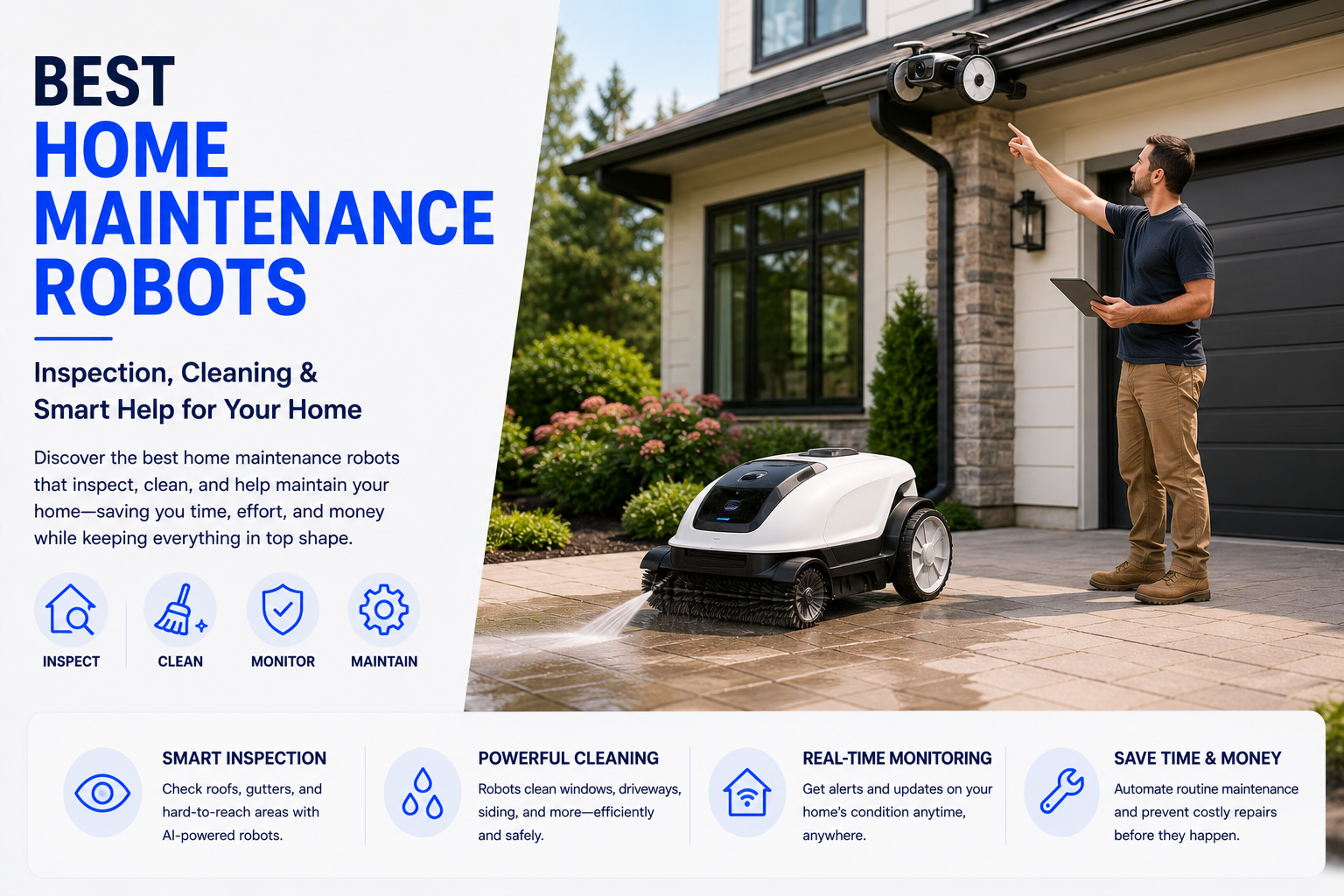
Home maintenance robots are worth it when they automate a frequent task, inspect a space that is difficult or unsafe to enter, or help detect expensive problems early. Robot vacuums, pool cleaners, lawn robots, and selected inspection crawlers have clear use cases. General-purpose repair robots are not yet practical for most homes, and smart alerts still require human verification.
Are Home Maintenance Robots Worth It? at a Glance
Best Proven ValueCleaning RobotsFrequent floor, pool, lawn, or window maintenance with measurable time savings.Best Preventative UseInspection Crawlers
Document crawlspaces, ducts, roofs, and hidden areas.Best Low-Cost PreventionSmart Sensors
Leak, temperature, humidity, smoke, vibration, and appliance alerts.Least Mature CategoryGeneral Repair Robots
Limited ability to diagnose and physically repair varied household problems.
Are Home Maintenance Robots Worth It? Comparison Table
| Option | Best For | Core Features | Important Limitation |
|---|---|---|---|
| Robot Vacuum or Mop | Strong value | Frequent maintenance cleaning | Still needs deep cleaning |
| Pool or Lawn Robot | Strong situational value | Automates large repetitive outdoor task | High purchase and maintenance |
| Inspection Robot | Professional or difficult access | Images, thermal, sensor data | Does not repair issue |
| Smart Leak Sensors | Excellent low-cost value | Early water alerts | Coverage only where installed |
| Mobile Monitoring Robot | Moderate value | Remote viewing and patrols | Limited terrain and diagnosis |
| General Repair Robot | Low current value | Future multi-task potential | Immature and expensive |
What Home Maintenance Robots Can Actually Do
Home maintenance robots automate narrow tasks such as cleaning, image inspection, difficult-space access, thermal scanning, environmental monitoring, or scheduled patrols.
They can reveal changes and collect evidence, but they cannot reliably diagnose every building problem or perform the varied physical repairs required in a real home.
- Inspect confined or difficult-to-reach areas.
- Capture repeatable video, images, and sensor data.
- Automate selected cleaning and outdoor tasks.
- Send smart alerts about unusual conditions.
- Support preventative maintenance documentation.
Main Types to Consider
Robot Vacuum or MopFrequent maintenance cleaning
Pool or Lawn RobotAutomates large repetitive outdoor task
Inspection RobotImages, thermal, sensor data
Smart Leak SensorsEarly water alerts
Where Robots Already Provide Value
Cleaning and outdoor-maintenance robots are proven because the task is repetitive, measurable, and physically constrained. They can maintain a baseline condition while people handle deep cleaning, edge cases, and repairs.
- Confirm access, terrain, lighting, and recovery requirements.
- Match the sensors to the maintenance problem.
- Verify recording, reporting, and data export.
- Use qualified professionals for diagnosis and repair.
Preventative Inspection and Monitoring
Crawlspace robots, thermal cameras, leak sensors, and mobile monitoring platforms can document changes or alert homeowners sooner. Early awareness can be valuable, but the financial benefit depends on the cost and likelihood of the problem.
- Confirm access, terrain, lighting, and recovery requirements.
- Match the sensors to the maintenance problem.
- Verify recording, reporting, and data export.
- Use qualified professionals for diagnosis and repair.
Hidden Costs and Maintenance
Robots require cleaning, charging, replacement consumables, batteries, firmware, Wi-Fi, cloud accounts, repairs, winter storage, and occasional rescue. A robot that needs constant supervision may save less time than expected.
- Confirm access, terrain, lighting, and recovery requirements.
- Match the sensors to the maintenance problem.
- Verify recording, reporting, and data export.
- Use qualified professionals for diagnosis and repair.
Who Benefits Most
The strongest buyers have a large repetitive task, difficult access, mobility limitations, a high-value property risk, or a professional inspection workflow. Small uncomplicated homes may benefit more from inexpensive sensors and scheduled human maintenance.
- Confirm access, terrain, lighting, and recovery requirements.
- Match the sensors to the maintenance problem.
- Verify recording, reporting, and data export.
- Use qualified professionals for diagnosis and repair.
Inspection Data Is Not a Diagnosis
Images, thermal patterns, moisture readings, vibration, sound, or AI alerts can identify conditions that deserve attention, but they may not reveal the cause or severity.
Use licensed or qualified professionals for structural, electrical, plumbing, HVAC, roofing, gas, mold, pest, or safety concerns.
Cameras, Sensors, and Smart Alerts
Compare visible-light clarity, low-light performance, lighting, focus distance, thermal resolution, moisture or gas sensors, timestamping, alerts, recording, and export. Sensor quality is only valuable when readings are calibrated and interpreted correctly.
Mobility, Access, and Recovery
Measure crawlspace height, pipe diameter, thresholds, debris, slopes, standing water, stairs, wireless range, and the route needed to recover the robot if it loses power or traction.
Connectivity, Storage, and Privacy
Review local control, Wi-Fi range, recording location, cloud storage, subscriptions, account security, firmware updates, export formats, and what remains available if the vendor's service ends.
Maintenance and Long-Term Cost
Include batteries, tracks, wheels, brushes, camera covers, filters, calibration, repairs, replacement sensors, cloud plans, training, and storage. The robot itself becomes another maintenance item.
How to Use Maintenance Robots Responsibly
Define the RouteMap access, obstacles, and recovery.
Collect EvidenceRecord clear images and measurements.
Confirm the FindingUse appropriate tests and professionals.
Complete the RepairAct on confirmed problems promptly.
How We Evaluated the Options
We prioritized task fit, access, mobility, camera quality, sensor usefulness, lighting, recording, battery, retrieval, local control, privacy, software support, replacement parts, reporting, safety, and total ownership cost.
Are Home Maintenance Robots Worth It? Checklist
TaskChoose inspection, monitoring, cleaning, or detection.
AccessVerify clearance, terrain, signal, and retrieval.
EvidenceMatch cameras and sensors to the issue.
OwnershipPlan parts, software, storage, and support.
- The robot solves one clearly defined maintenance task.
- Home access, clearance, terrain, and retrieval are compatible.
- The camera and sensors match the problem being investigated.
- Lighting and low-light performance are sufficient.
- Recorded evidence can be exported and reviewed.
- Battery life covers the complete inspection route.
- Local controls remain available without cloud access.
- Replacement parts, batteries, and service are available.
- Privacy and account security are configured.
- Qualified people remain responsible for diagnosis and repair.
Final Verdict
Home maintenance robots are worth it when they automate a frequent task, inspect a space that is difficult or unsafe to enter, or help detect expensive problems early. Robot vacuums, pool cleaners, lawn robots, and selected inspection crawlers have clear use cases. General-purpose repair robots are not yet practical for most homes, and smart alerts still require human verification.
Shop Home Maintenance TechnologyExplore Home Maintenance RobotsAre Home Maintenance Robots Worth It? FAQ
Which home maintenance robot is most worth it?
Robot vacuums, robotic pool cleaners, lawn robots, and leak-detection systems offer the clearest value for many homes.
Are inspection robots worth it for homeowners?
Usually only when the home has difficult crawlspaces, repeated inspection needs, or expensive access problems.
Can robots lower repair costs?
They may help detect problems earlier, but savings depend on alert accuracy and how quickly the issue is repaired.
Do maintenance robots require subscriptions?
Some use cloud storage, AI detection, cellular connectivity, or premium app features, while others do not.
How long do maintenance robots last?
Lifespan depends on motors, batteries, sealing, workload, maintenance, software support, and replacement-part availability.
Can one robot maintain the whole house?
No. Current robots are specialized for cleaning, inspection, monitoring, mowing, pools, or other narrow tasks.
Are AI alerts reliable?
They can be useful but may produce false alerts or miss events. Important findings require direct confirmation.
What is the biggest hidden cost?
Battery replacement, consumables, repairs, subscriptions, and the owner's troubleshooting time are common hidden costs.
Who should avoid buying one?
Buyers without a frequent task, compatible home layout, maintenance interest, or clear financial or convenience benefit.
What is the best low-cost alternative?
A focused network of leak, smoke, temperature, humidity, and appliance sensors often provides strong preventative value.