
Telepresence Robot Buying Guide
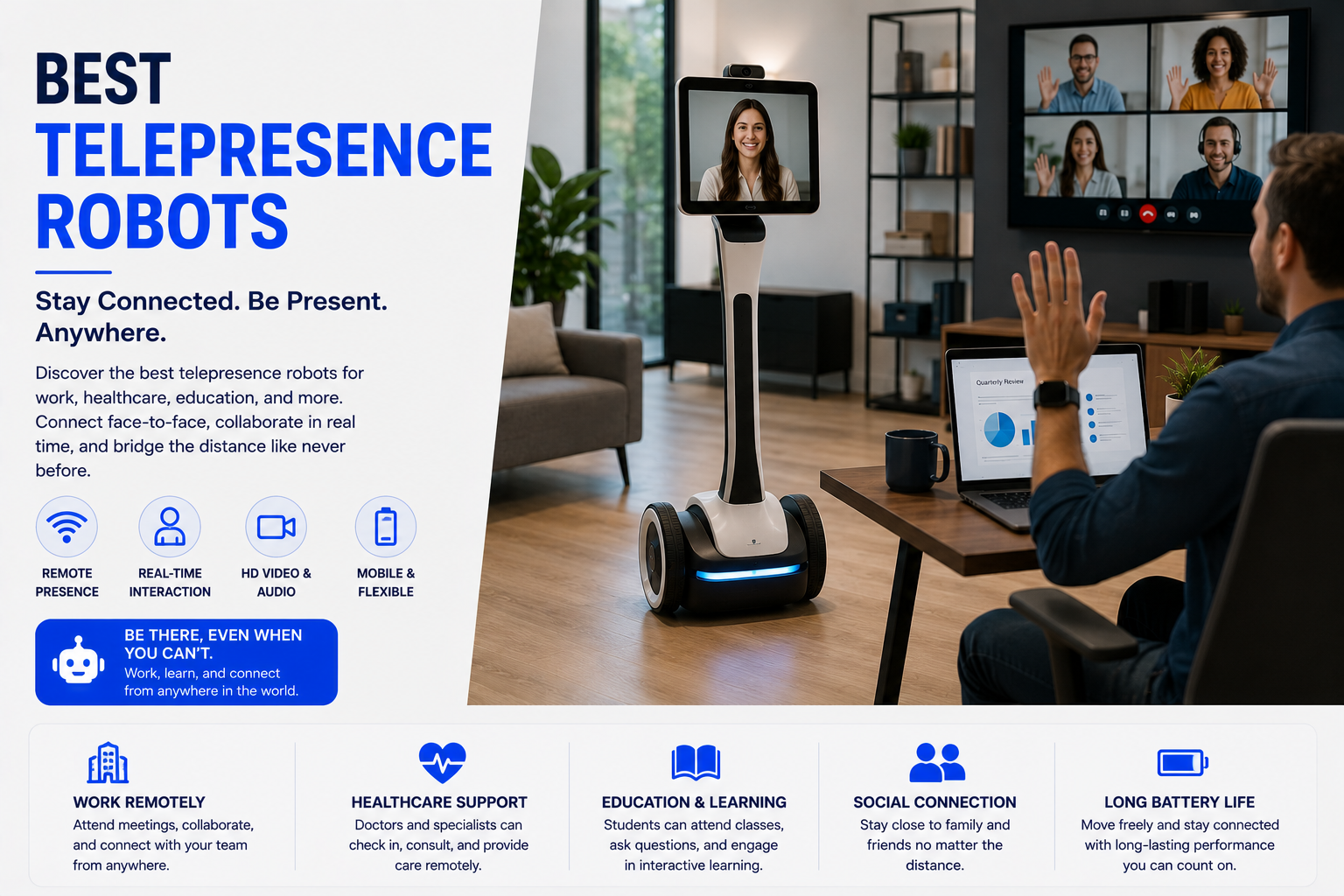
Complete telepresence robot buying guide covering cameras, screens, movement, controls, connectivity, privacy, features, and choosing the best model. The best telepresence robot should make remote communication feel more natural while remaining easy to control, secure, and reliable in the actual space.
As an Amazon Associate, HomeBotGuide may earn from qualifying purchases at no extra cost to you.
Choose a telepresence robot by defining who will drive it, where it will move, how often it will be used, and what happens if the connection fails. Prioritize stable video, clear audio, obstacle avoidance, safe speed, reliable docking, simple guest access, strong privacy controls, and long-term software support over novelty AI features.
Telepresence Robot Buying Guide at a Glance
First PriorityUse CaseFamily visits, senior support, remote work, education, healthcare, or tours.Second PriorityMobility
Floor type, thresholds, turning radius, speed, stability, and obstacle avoidance.Third PriorityCommunication
Camera, screen, microphones, speaker, latency, and guest access.Fourth PriorityOwnership
Docking, battery, updates, privacy, subscriptions, warranty, and support.
Telepresence Robot Buying Guide Comparison Table
| Option | Best For | Core Features | Important Limitation |
|---|---|---|---|
| Compact Home Robot | Families and pets | App driving, video, audio | Small display and limited navigation |
| Senior-Focused Robot | Aging at home | Large display, simple visits, remote driving | Premium price |
| Autonomous Assistant | Smart homes and business | Navigation, following, smart integrations | Complexity and higher cost |
| Enterprise Robot | Hybrid work and education | Obstacle avoidance, browser access, fleet tools | Organization-focused pricing |
| Medical Robot | Telehealth and clinical care | Secure systems and peripherals | Regulated professional use |
| Tablet Stand | Budget alternative | Familiar video apps | No mobility or autonomy |
What Telepresence Robots Can Actually Do
Telepresence robots combine live video, microphones, speakers, a display, remote driving, and sometimes autonomous navigation. They give a remote person limited control over viewpoint and movement inside another location.
They do not replace in-person care, emergency response, physical assistance, or ordinary communication backups. Their value comes from mobility and repeated access, not from performing household tasks.
- Support room-to-room mobile video calls.
- Allow remote users to choose their viewpoint.
- Join meetings, classes, tours, and family events.
- Provide remote visits for older adults or homebound users.
- Return to a charging dock on supported models.
Main Types to Consider
Compact Home RobotApp driving, video, audio
Senior-Focused RobotLarge display, simple visits, remote driving
Autonomous AssistantNavigation, following, smart integrations
Enterprise RobotObstacle avoidance, browser access, fleet tools
Step 1: Define the Remote-Presence Goal
Decide whether the robot must support family visits, senior check-ins, hallway movement, office tours, classroom participation, clinical consultation, or simple camera access. Each use requires different screen, mobility, security, and support.
- Confirm mobility and Wi-Fi in the actual space.
- Test camera, audio, remote driving, and docking.
- Review permissions, privacy, and guest access.
- Maintain a phone, tablet, or human backup.
Step 2: Test the Physical Environment
Measure doorways, thresholds, rugs, slopes, floor transitions, turning space, lighting, stairs, dock location, Wi-Fi dead zones, and the route needed to retrieve the robot if it stops.
- Confirm mobility and Wi-Fi in the actual space.
- Test camera, audio, remote driving, and docking.
- Review permissions, privacy, and guest access.
- Maintain a phone, tablet, or human backup.
Step 3: Compare Camera, Audio, and Control
Evaluate camera height, pan and tilt, zoom, field of view, low-light quality, microphone pickup, echo control, speaker volume, latency, remote driving, click-to-drive, obstacle avoidance, and browser or app compatibility.
- Confirm mobility and Wi-Fi in the actual space.
- Test camera, audio, remote driving, and docking.
- Review permissions, privacy, and guest access.
- Maintain a phone, tablet, or human backup.
Step 4: Review Privacy and Long-Term Support
Check user invitations, account permissions, call acceptance, camera indicators, recording, encryption, cloud routing, update history, subscription terms, battery replacement, warranty, repair, and vendor longevity.
- Confirm mobility and Wi-Fi in the actual space.
- Test camera, audio, remote driving, and docking.
- Review permissions, privacy, and guest access.
- Maintain a phone, tablet, or human backup.
Remote Presence Has Physical Limits
Most telepresence robots cannot climb stairs, open doors, operate elevators independently, recover from every obstacle, or provide physical help.
They can lose Wi-Fi, battery, audio, camera access, or docking ability. Keep alternative communication and human support available.
Camera, Screen, and Audio Quality
Evaluate camera height, field of view, zoom, low-light quality, stabilization, microphone pickup, echo cancellation, speaker volume, screen size, and latency. Clear audio often matters more than maximum video resolution.
Mobility, Navigation, and Docking
Test thresholds, rugs, narrow doorways, furniture, slopes, stairs, turning radius, speed, obstacle avoidance, remote steering, autonomous destinations, and return-to-dock behavior in the real environment.
Connectivity and Remote Access
Compare Wi-Fi bands, roaming between access points, browser or app access, guest links, cellular options, firewall requirements, bandwidth, updates, and what happens when the connection is interrupted.
Privacy, Consent, and Security
A mobile camera can reveal more than a stationary device. Use informed consent, restricted accounts, visible call indicators, secure passwords, multifactor authentication when available, current firmware, limited recording, and clear guest permissions.
How to Test a Telepresence Robot
Test the RouteDrive every intended room and doorway.
Test CommunicationCheck video, audio, latency, and lighting.
Test DockingReturn from multiple rooms and low battery.
Test Failure ModesSimulate Wi-Fi loss and blocked paths.
How We Evaluated the Options
We prioritized video and audio quality, mobility, obstacle avoidance, remote control, autonomous navigation, docking, battery, privacy, guest access, app and browser support, Wi-Fi reliability, accessibility, subscriptions, warranty, repair, and long-term software support.
Telepresence Robot Buying Guide Checklist
PurposeChoose family, senior, work, school, healthcare, or tour use.
MobilityVerify floors, doors, obstacles, and docking.
CommunicationTest camera, screen, microphones, and speakers.
OwnershipReview privacy, subscriptions, batteries, and support.
- The robot solves a clearly defined remote-presence need.
- Floor plan, thresholds, rugs, doorways, and stairs are compatible.
- Camera height and video quality fit the use case.
- Microphones and speakers are clear in real rooms.
- Remote driving and obstacle avoidance are easy to use.
- Automatic docking works from expected locations.
- Wi-Fi coverage and bandwidth are reliable.
- Guest access and privacy permissions are controlled.
- Subscriptions, batteries, repairs, and support are understood.
- A phone, tablet, or human backup remains available.
Final Verdict
Choose a telepresence robot by defining who will drive it, where it will move, how often it will be used, and what happens if the connection fails. Prioritize stable video, clear audio, obstacle avoidance, safe speed, reliable docking, simple guest access, strong privacy controls, and long-term software support over novelty AI features.
Shop Telepresence TechnologyExplore Telepresence RobotsTelepresence Robot Buying Guide FAQ
What camera resolution should a telepresence robot have?
1080p is a practical baseline, but lens quality, lighting, bandwidth, stabilization, and zoom matter just as much.
How important is screen height?
Eye-level communication feels more natural, and adjustable height helps with seated and standing conversations.
Does the robot need autonomous navigation?
It is valuable for home users and untrained drivers, while expert remote operators may manage with assisted driving.
What is click-to-drive?
It lets the remote user select a destination on the screen while the robot assists with steering and obstacle avoidance.
How much battery life is enough?
Choose enough for the longest expected visit plus a safety margin, and verify automatic docking.
Should guest users need an account?
Simple secure guest links make family, clients, or students easier to invite, but permissions must be time-limited and controlled.
Can telepresence robots use cellular data?
Some support cellular or optional connectivity, but most depend mainly on reliable Wi-Fi.
What privacy controls are essential?
Visible call indicators, access approval, user permissions, secure login, recording controls, updates, and easy camera or microphone disablement.
How do I test docking reliability?
Place the dock permanently, clear the approach, test from multiple rooms, and simulate low-battery returns.
What is the biggest buying mistake?
Buying for screen size or AI claims before checking floor compatibility, audio, network reliability, privacy, and software support.