
Are Robotic Pool Cleaners Worth It?
Learn whether robotic pool cleaners are worth the investment. Compare costs, cleaning performance, maintenance savings, and long-term benefits. This guide compares the main options, performance factors, limitations, maintenance needs, and long-term value.
As an Amazon Associate, HomeBotGuide may earn from qualifying purchases at no extra cost to you.
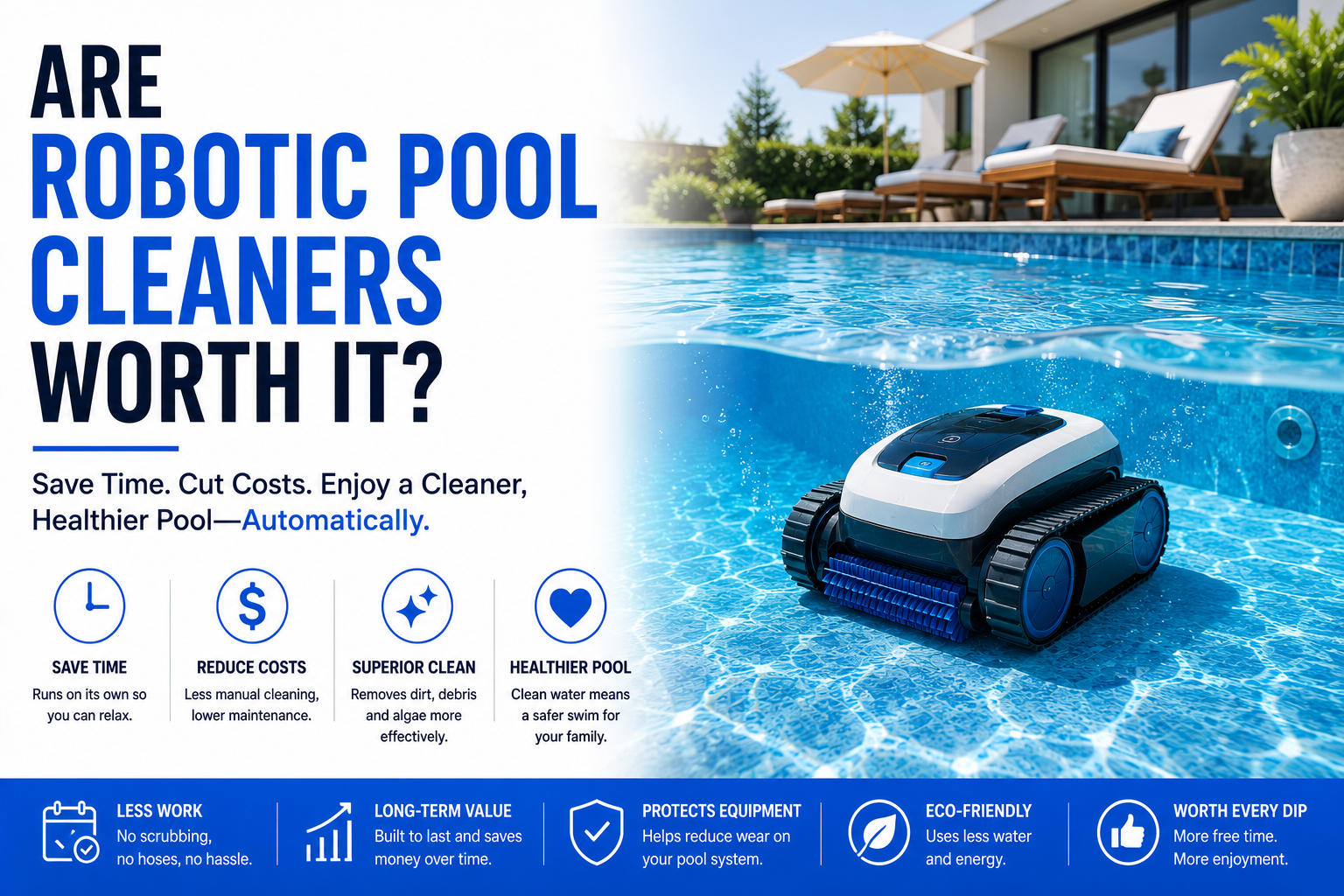
Robotic pool cleaners are worth it for owners who spend significant time brushing and vacuuming, have recurring debris, and want independent floor or wall cleaning. They are less worthwhile for very small pools, lightly used pools, or owners who expect the robot to replace chemistry, skimming, circulation, and manual detail work.
Are Robotic Pool Cleaners Worth It? at a Glance
Regular automated cleaning saves active labor.
Reduces floor and wall vacuuming effort.
High-capacity baskets simplify cleanup.
Manual cleaning may already be quick.
Are Robotic Pool Cleaners Worth It? Comparison Table
| Type | Best For | Core Features | Important Limitation |
|---|---|---|---|
| Large Inground Pool | High value | Strong labor savings and broad coverage | Higher-capacity model needed |
| Above-Ground Pool | Moderate-to-high value | Easy floor cleaning | Wall coverage may be limited |
| Leaf-Heavy Pool | High value | Frequent debris collection | Filter maintenance |
| Fine-Debris Pool | Strong value | Sand and pollen filtration | Filters clog faster |
| Small Pool | Mixed value | Convenience | Cost may be hard to justify |
| Complex Pool Shape | Conditional value | Automated routine cleaning | Steps and ledges remain manual |
What to Consider First
Start with the actual environment, workload, access, power, safety, and maintenance requirements. The best product is the one that can complete the real task consistently.
- Match the design to the real area and surface.
- Check navigation, power, and retrieval requirements.
- Review filters, brushes, blades, batteries, and storage.
- Confirm warranty and replacement-part support.
Main Options to Consider
Strong labor savings and broad coverage
Easy floor cleaning
Frequent debris collection
Sand and pollen filtration
The Main Value
A robotic cleaner reduces active vacuuming and brushing while collecting debris in its own filter.
- Confirm compatibility with the real property or pool.
- Compare maintenance, consumables, and long-term support.
- Test navigation, safety, and recovery before unattended use.
- Keep a manual maintenance backup available.
Time Savings
The greatest benefit appears in pools that need frequent cleaning.
- Confirm compatibility with the real property or pool.
- Compare maintenance, consumables, and long-term support.
- Test navigation, safety, and recovery before unattended use.
- Keep a manual maintenance backup available.
Purchase and Operating Cost
Include the robot, filters, brushes, cables or batteries, repairs, and replacement parts.
- Confirm compatibility with the real property or pool.
- Compare maintenance, consumables, and long-term support.
- Test navigation, safety, and recovery before unattended use.
- Keep a manual maintenance backup available.
Cleaning Performance
Good robots clean floors well, while wall, waterline, step, and ledge coverage varies.
- Confirm compatibility with the real property or pool.
- Compare maintenance, consumables, and long-term support.
- Test navigation, safety, and recovery before unattended use.
- Keep a manual maintenance backup available.
Energy Use
Robotic cleaners use their own pump and often consume less energy than running the main system at high speed for cleaning.
- Confirm compatibility with the real property or pool.
- Compare maintenance, consumables, and long-term support.
- Test navigation, safety, and recovery before unattended use.
- Keep a manual maintenance backup available.
Maintenance
Filter rinsing, brush inspection, impeller cleaning, cable care, and battery management remain necessary.
- Confirm compatibility with the real property or pool.
- Compare maintenance, consumables, and long-term support.
- Test navigation, safety, and recovery before unattended use.
- Keep a manual maintenance backup available.
What They Do Not Replace
They do not replace chemistry, circulation, skimming, main filtration, or manual detail cleaning.
- Confirm compatibility with the real property or pool.
- Compare maintenance, consumables, and long-term support.
- Test navigation, safety, and recovery before unattended use.
- Keep a manual maintenance backup available.
Who Should Skip One
Skip it when the pool is tiny, debris is minimal, or manual cleaning already takes little time.
- Confirm compatibility with the real property or pool.
- Compare maintenance, consumables, and long-term support.
- Test navigation, safety, and recovery before unattended use.
- Keep a manual maintenance backup available.
Automation Still Requires Oversight
Automated equipment reduces repetitive labor but still requires setup, supervision, cleaning, consumables, troubleshooting, and periodic manual maintenance.
How We Evaluated the Options
We prioritized coverage, cleaning effectiveness, navigation, power, safety, retrieval, maintenance, consumable cost, replacement parts, warranty, and total ownership value.
Final Verdict
Robotic pool cleaners are worth it for owners who spend significant time brushing and vacuuming, have recurring debris, and want independent floor or wall cleaning. They are less worthwhile for very small pools, lightly used pools, or owners who expect the robot to replace chemistry, skimming, circulation, and manual detail work.
Are Robotic Pool Cleaners Worth It? FAQ
Are robotic pool cleaners worth the money?
They are when they replace frequent manual vacuuming and brushing.
Do they save electricity?
They may use less energy than pump-driven cleaning methods, depending on the system.
Can they replace the pool filter?
No. They supplement the main circulation and filtration system.
Do they clean walls?
Wall-climbing models can, but not all robots do.
Are cordless models worth it?
They add convenience but depend on battery runtime and replacement.
How long do robotic cleaners last?
Lifespan depends on use, maintenance, parts, and water conditions.
Do they need maintenance?
Yes, especially filters, brushes, impellers, cables, and batteries.
Can they clean steps?
Some can reach broad steps, but detailed step cleaning often remains manual.
Are they good for leaves?
Large-basket models are.
What is the biggest drawback?
High upfront cost and incomplete coverage of some pool features.