
Best Robot Lawn Mowers for Small Yards
Compare the best robot lawn mowers for small yards. Find compact, efficient models that keep smaller lawns perfectly maintained. This guide compares coverage, navigation, slopes, safety, maintenance, and long-term ownership value.
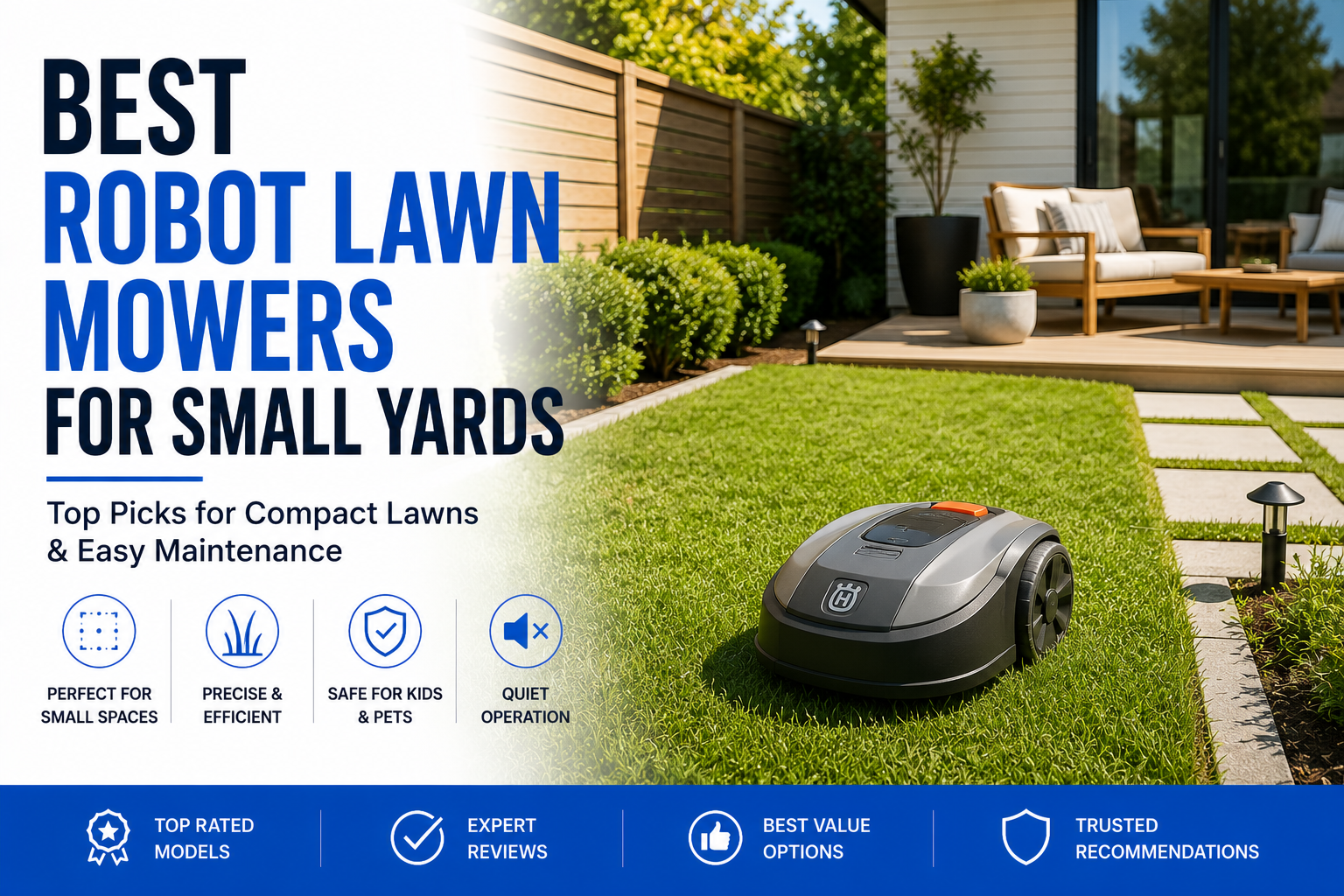
As an Amazon Associate, HomeBotGuide may earn from qualifying purchases at no extra cost to you.
The best robot lawn mower for a small yard is compact, quiet, easy to program, and precise around narrow passages, garden beds, and tight corners. Boundary-wire models often remain the most dependable value for simple lawns, while compact wire-free models are easier to reconfigure when the yard layout changes.
Best Robot Lawn Mowers for Small Yards at a Glance
Reliable perimeter control and low operating cost.
Virtual boundaries without buried wire.
Moves through tighter gates and lawn corridors.
Supports frequent mowing with minimal disturbance.
Best Robot Lawn Mowers for Small Yards Comparison Table
| Type | Best For | Core Features | Important Limitation |
|---|---|---|---|
| Compact Boundary-Wire Mower | Simple small lawns | Reliable perimeter, low cost, mature design | Wire installation |
| Small RTK Mower | Open yards | Virtual maps and easy boundary edits | Needs good satellite conditions |
| Vision Mower | Obstacle-rich lawns | Camera guidance and object detection | Lighting and edge limits |
| Narrow-Body Mower | Tight passages | Small turning radius and slim width | Reduced battery capacity |
| Budget Robotic Mower | Flat basic lawns | Simple scheduling and charging | Fewer smart features |
| Premium Smart Mower | Complex small yards | Zones, app controls, advanced navigation | Higher price |
What to Consider First
Start with the actual lawn size, slope, shape, passage width, tree cover, obstacles, boundary method, and maintenance tolerance. A mower must fit the property before its smart features matter.
- Measure the lawn instead of relying on lot size.
- Check slope, traction, and edge safety.
- Review navigation and boundary requirements.
- Plan for blades, batteries, docking, and storage.
Main Options to Consider
Reliable perimeter, low cost, mature design
Virtual maps and easy boundary edits
Camera guidance and object detection
Small turning radius and slim width
Why Small Yards Need the Right Size
A mower rated for a huge property may be unnecessary, harder to maneuver, and more expensive. Compact models are easier to place and recover.
- Measure the real lawn area, slopes, and narrow passages.
- Confirm boundary, signal, and docking requirements.
- Review blade, wheel, battery, and storage maintenance.
- Schedule operation when children, pets, and wildlife are clear.
Boundary Wire vs Wire-Free
Boundary wire is stable and affordable, while wire-free systems are easier to edit but depend on cameras, satellites, or beacons.
- Measure the real lawn area, slopes, and narrow passages.
- Confirm boundary, signal, and docking requirements.
- Review blade, wheel, battery, and storage maintenance.
- Schedule operation when children, pets, and wildlife are clear.
Narrow Passages and Obstacles
Measure gates, corridors, trees, garden borders, and turning spaces before buying.
- Measure the real lawn area, slopes, and narrow passages.
- Confirm boundary, signal, and docking requirements.
- Review blade, wheel, battery, and storage maintenance.
- Schedule operation when children, pets, and wildlife are clear.
Mowing Frequency
Robot mowers trim small amounts often, so frequent schedules are more important than maximum cutting width.
- Measure the real lawn area, slopes, and narrow passages.
- Confirm boundary, signal, and docking requirements.
- Review blade, wheel, battery, and storage maintenance.
- Schedule operation when children, pets, and wildlife are clear.
Noise and Neighbor Considerations
Small yards are close to homes and neighbors, making quiet operation especially valuable.
- Measure the real lawn area, slopes, and narrow passages.
- Confirm boundary, signal, and docking requirements.
- Review blade, wheel, battery, and storage maintenance.
- Schedule operation when children, pets, and wildlife are clear.
Dock Placement
Choose a flat, shaded, well-drained location with reliable access and nearby power.
- Measure the real lawn area, slopes, and narrow passages.
- Confirm boundary, signal, and docking requirements.
- Review blade, wheel, battery, and storage maintenance.
- Schedule operation when children, pets, and wildlife are clear.
Safety Around Children and Pets
Schedule mowing when the lawn is clear and never allow children or pets near the machine during operation.
- Measure the real lawn area, slopes, and narrow passages.
- Confirm boundary, signal, and docking requirements.
- Review blade, wheel, battery, and storage maintenance.
- Schedule operation when children, pets, and wildlife are clear.
Seasonal Maintenance
Clean the underside, replace blades, inspect wheels, and store the unit properly during the off-season.
- Measure the real lawn area, slopes, and narrow passages.
- Confirm boundary, signal, and docking requirements.
- Review blade, wheel, battery, and storage maintenance.
- Schedule operation when children, pets, and wildlife are clear.
Robot Mowers Still Need Oversight
Automated mowing reduces weekly labor but still requires boundary testing, lawn preparation, blade replacement, wheel cleaning, safe scheduling, and seasonal storage.
How We Evaluated the Options
We prioritized coverage, navigation, slope ability, traction, safety, cut quality, docking, maintenance, theft protection, replacement parts, warranty, and total ownership value.
Final Verdict
The best robot lawn mower for a small yard is compact, quiet, easy to program, and precise around narrow passages, garden beds, and tight corners. Boundary-wire models often remain the most dependable value for simple lawns, while compact wire-free models are easier to reconfigure when the yard layout changes.
Best Robot Lawn Mowers for Small Yards FAQ
Are robot lawn mowers good for small yards?
Yes, especially when the lawn is relatively open and the dock can be placed conveniently.
Do small yards need boundary wire?
Many models do, while some newer units use GPS or vision.
How small can a yard be?
It depends on the mower's minimum operating area and turning space.
Can they mow narrow passages?
Some compact models can, but width and turning radius must be checked.
Are they quiet?
Most are much quieter than gas mowers.
Do they collect clippings?
Most mulch fine clippings back into the lawn.
Can they handle slopes?
Some can, but small-yard models may have lower slope ratings.
How often should they run?
Several times per week is common.
Do they work around flower beds?
Yes with correct boundary setup or mapping.
What is the biggest limitation?
Tight layouts and irregular edges can reduce coverage.