
Robot Vacuum vs Regular Vacuum
Compare robot vacuums and traditional vacuums to understand the advantages, limitations, costs, and best use cases for each. This guide explains the major options, practical tradeoffs, maintenance needs, and buying considerations.
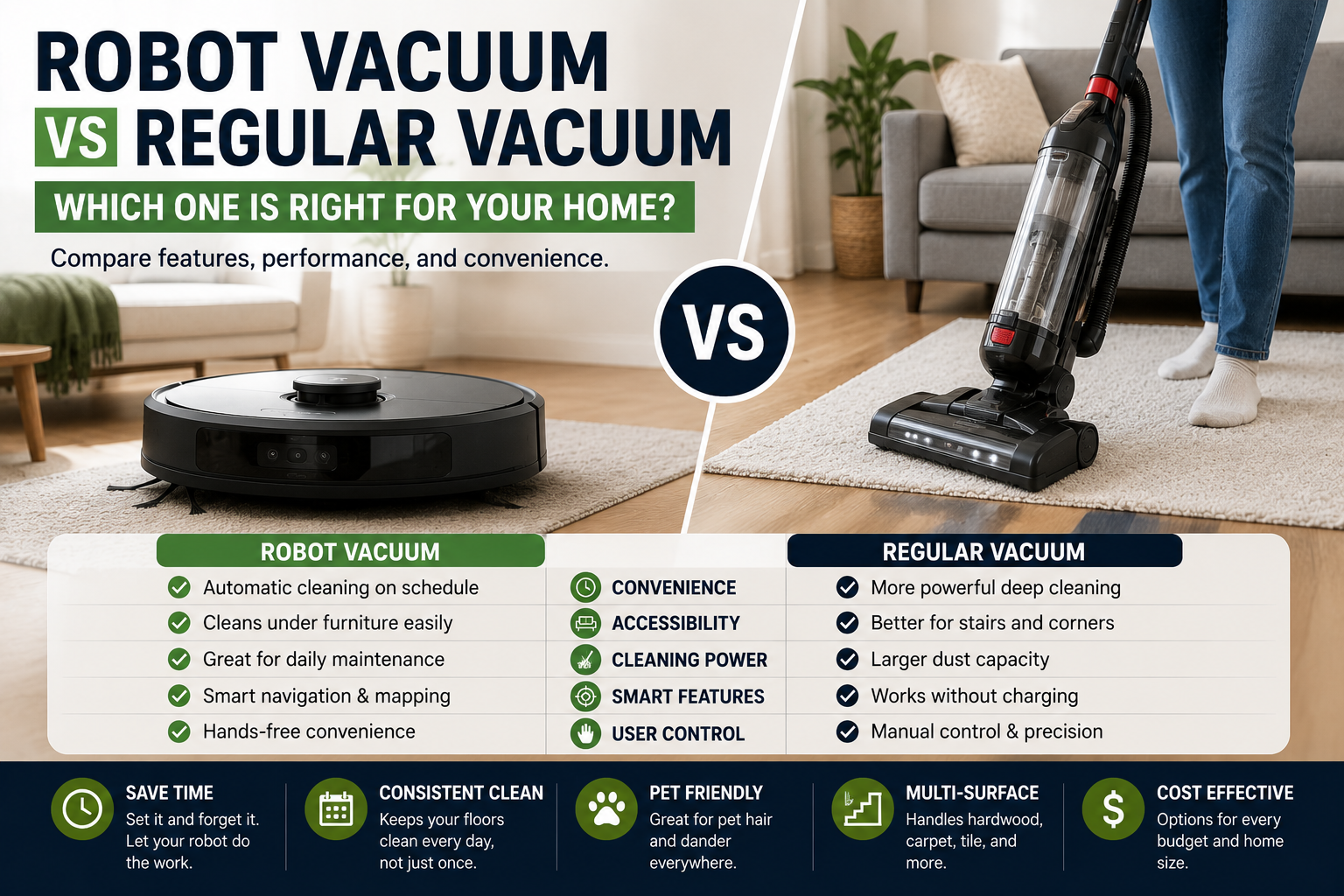
As an Amazon Associate, HomeBotGuide may earn from qualifying purchases at no extra cost to you.
A robot vacuum is better for frequent maintenance and keeping daily debris under control. A regular upright, canister, or stick vacuum is better for deep carpet cleaning, stairs, upholstery, corners, and fast targeted cleanup. Most households get the best results by using both.
Robot Vacuum vs Regular Vacuum at a Glance
Runs automatically and limits buildup between deep cleans.
Provides stronger agitation and larger debris capacity.
Reaches areas robots cannot access.
Combines automation with periodic detailed cleaning.
Robot Vacuum vs Regular Vacuum Comparison Table
| Type | Best For | Core Features | Important Limitation |
|---|---|---|---|
| Robot Vacuum | Daily floor maintenance | Scheduling, mapping, automatic cleaning | Limited deep cleaning |
| Upright Vacuum | Carpet and whole-room deep cleaning | Strong agitation and large bin | Requires active effort |
| Stick Vacuum | Quick targeted cleanup | Lightweight and flexible | Shorter runtime and smaller bin |
| Canister Vacuum | Hard floors, edges, upholstery | Flexible tools and strong suction | Bulky storage |
| Robot Mop Combo | Hard-floor maintenance | Vacuuming plus damp cleaning | Still needs manual mopping |
| Robot + Upright | Complete household coverage | Automation plus deep cleaning | Higher combined cost |
What to Consider First
Begin with the actual home layout, floor types, cleaning frequency, debris load, and maintenance tolerance. The strongest choice is the system that can complete the real routine reliably.
- Match the cleaning method to the actual surfaces.
- Check navigation, battery, and dock requirements.
- Review ongoing maintenance and consumable cost.
- Confirm replacement parts and support.
Main Options to Consider
Scheduling, mapping, automatic cleaning
Strong agitation and large bin
Lightweight and flexible
Flexible tools and strong suction
Cleaning Performance
Regular vacuums generally provide stronger airflow, deeper carpet agitation, and more tool options. Robots compensate by cleaning more frequently.
- Follow the manufacturer guidance for the specific model.
- Check compatibility with the real floor plan and surfaces.
- Review maintenance and replacement-part requirements.
- Keep a manual cleaning backup available.
Convenience
Robots save active time through scheduling, while manual vacuums offer immediate control and faster response to a specific mess.
- Follow the manufacturer guidance for the specific model.
- Check compatibility with the real floor plan and surfaces.
- Review maintenance and replacement-part requirements.
- Keep a manual cleaning backup available.
Coverage
Robots handle open floors and under-furniture areas well. Manual vacuums cover stairs, upholstery, curtains, baseboards, and corners.
- Follow the manufacturer guidance for the specific model.
- Check compatibility with the real floor plan and surfaces.
- Review maintenance and replacement-part requirements.
- Keep a manual cleaning backup available.
Cost
A good manual vacuum can cost less than a premium robot, while advanced docks and subscriptions raise ownership cost.
- Follow the manufacturer guidance for the specific model.
- Check compatibility with the real floor plan and surfaces.
- Review maintenance and replacement-part requirements.
- Keep a manual cleaning backup available.
Maintenance
Both require filters, brush cleaning, and part replacement. Robots add sensors, wheels, batteries, docks, and software.
- Follow the manufacturer guidance for the specific model.
- Check compatibility with the real floor plan and surfaces.
- Review maintenance and replacement-part requirements.
- Keep a manual cleaning backup available.
Pet Hair
Robots keep loose hair under control daily, while manual vacuums remove embedded fur from carpet and furniture.
- Follow the manufacturer guidance for the specific model.
- Check compatibility with the real floor plan and surfaces.
- Review maintenance and replacement-part requirements.
- Keep a manual cleaning backup available.
Allergies and Dust
Sealed manual vacuums may offer stronger filtration, while frequent robot use reduces the amount of dust that accumulates.
- Follow the manufacturer guidance for the specific model.
- Check compatibility with the real floor plan and surfaces.
- Review maintenance and replacement-part requirements.
- Keep a manual cleaning backup available.
Best Combined Routine
Run the robot several times per week and use a manual vacuum for weekly or biweekly deep cleaning.
- Follow the manufacturer guidance for the specific model.
- Check compatibility with the real floor plan and surfaces.
- Review maintenance and replacement-part requirements.
- Keep a manual cleaning backup available.
Automation Still Requires Maintenance
Robot vacuums reduce repetitive floor cleaning but still require preparation, brush care, filter replacement, dock maintenance, and periodic manual deep cleaning.
How We Evaluated the Options
We prioritized real-world cleaning, navigation, battery, serviceability, bin and dock design, obstacle handling, replacement parts, warranty, software support, and total ownership value.
Final Verdict
A robot vacuum is better for frequent maintenance and keeping daily debris under control. A regular upright, canister, or stick vacuum is better for deep carpet cleaning, stairs, upholstery, corners, and fast targeted cleanup. Most households get the best results by using both.
Robot Vacuum vs Regular Vacuum FAQ
Which cleans better, a robot or regular vacuum?
A regular vacuum usually cleans more deeply, while a robot cleans more frequently.
Can a robot vacuum replace an upright?
Not completely, especially for stairs, upholstery, and deep carpet.
Which saves more time?
A robot saves active cleaning time through automation.
Which is better for pet hair?
Use a robot for daily pickup and a manual vacuum for embedded fur.
Are robot vacuums cheaper to own?
Not always, because batteries, docks, bags, and repairs can add cost.
Which is better for allergies?
A sealed manual vacuum often offers stronger filtration, but frequent robot cleaning reduces buildup.
Can a robot clean corners?
It can reach edges with side brushes but usually not as thoroughly as a manual tool.
Which is better for apartments?
A robot is convenient, while a compact stick vacuum is useful for stairs and spot cleaning.
Do robot vacuums use less electricity?
They often use less power per run, though frequent operation and docks add usage.
What is the best choice for most homes?
Use both: a robot for maintenance and a regular vacuum for deep cleaning.