
Best AI Home Robots
Discover the best AI home robots available today. Compare smart assistants, autonomous home robots, and AI-powered household technology. This guide compares the most useful types, realistic benefits, limitations, maintenance needs, and buying considerations.
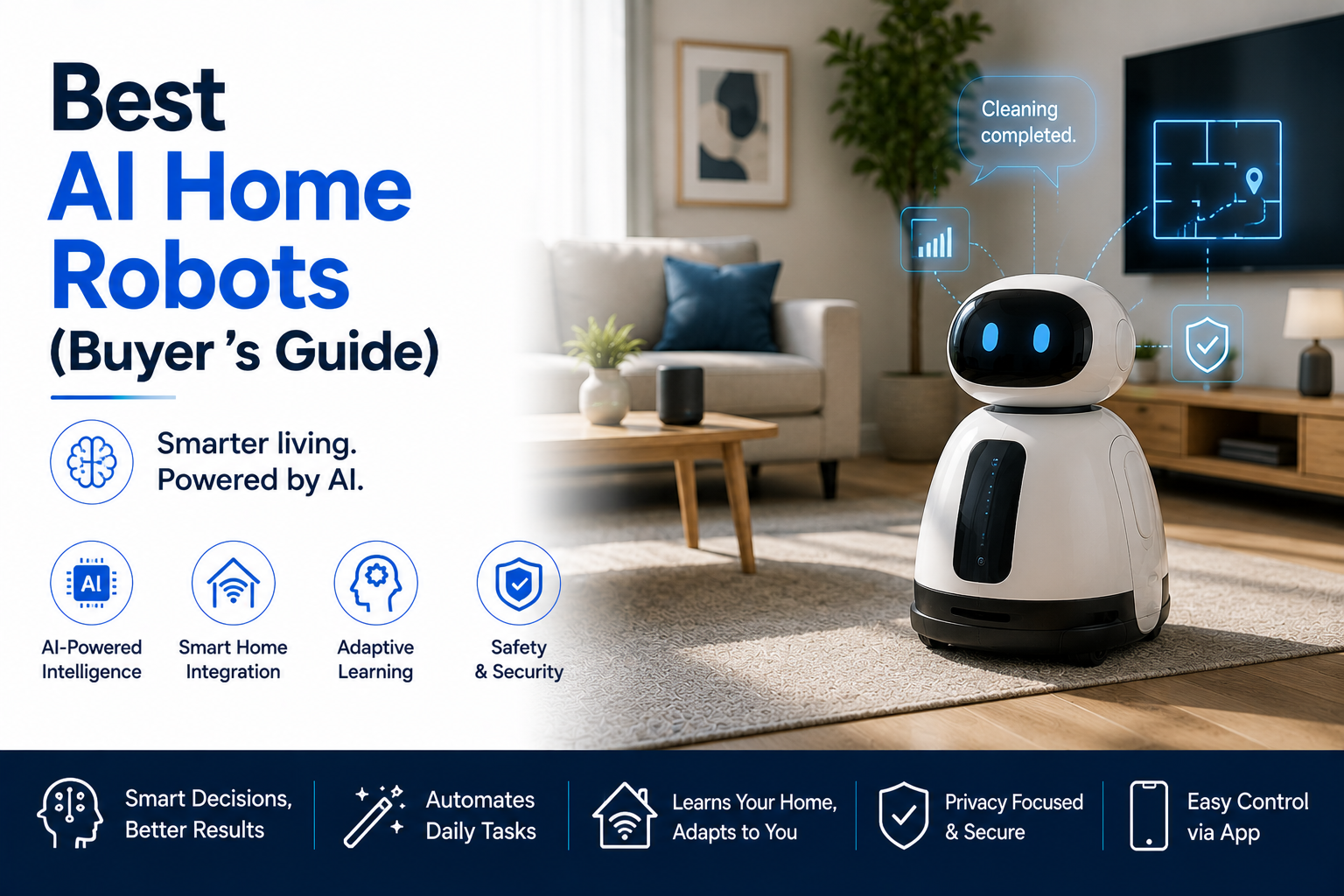
As an Amazon Associate, HomeBotGuide may earn from qualifying purchases at no extra cost to you.
The best AI home robots today are specialized rather than universal. Robot vacuums excel at floor care, telepresence robots add remote mobility, companion robots provide interaction, and monitoring robots extend home awareness. General-purpose humanoid assistants remain experimental and expensive.
Best AI Home Robots at a Glance
Uses mapping, object recognition, and adaptive cleaning.
Adds mobile video, navigation, and room-to-room access.
Provides conversation, entertainment, and routines.
Combines cameras, alerts, and remote patrols.
Best AI Home Robots Comparison Table
| Type | Best For | Core Features | Important Limitation |
|---|---|---|---|
| AI Robot Vacuum | Floor care | Mapping, object avoidance, room intelligence | Specialized cleaning task |
| Telepresence Robot | Remote visits | Video, navigation, remote control | High cost and no physical help |
| Companion Robot | Conversation and engagement | Voice interaction, routines, personality | Limited practical assistance |
| Monitoring Robot | Home awareness | Camera, alerts, mobile patrols | Privacy and coverage limits |
| Kitchen Robot | Guided or automated cooking | Recipes, sensors, appliance control | Narrow food tasks |
| Humanoid Prototype | Future general assistance | Mobility and manipulation research | Immature and expensive |
What to Look for Before Buying
Start with the actual household need and environment. The strongest choice is the product that performs one useful task reliably, fits the space, and remains practical to maintain.
- Match the robot to the real task and environment.
- Check navigation, power, connectivity, and safety.
- Review maintenance and replacement-part access.
- Confirm privacy and software-support expectations.
Main Types to Consider
Mapping, object avoidance, room intelligence
Video, navigation, remote control
Voice interaction, routines, personality
Camera, alerts, mobile patrols
What Makes a Home Robot 'AI'
AI can support mapping, object recognition, language interaction, adaptive routines, anomaly detection, and decision-making within a limited task.
- Confirm the feature solves a real household need.
- Check compatibility with the actual environment.
- Review maintenance, subscriptions, and replacement parts.
- Keep a manual or human backup available.
Specialized Robots Deliver the Most Value
Current robots perform best when the environment and task are constrained, such as vacuuming floors, monitoring rooms, or conducting video calls.
- Confirm the feature solves a real household need.
- Check compatibility with the actual environment.
- Review maintenance, subscriptions, and replacement parts.
- Keep a manual or human backup available.
Voice and Conversational AI
Companion and assistant robots can answer questions and manage routines, but accuracy, privacy, and cloud dependence vary.
- Confirm the feature solves a real household need.
- Check compatibility with the actual environment.
- Review maintenance, subscriptions, and replacement parts.
- Keep a manual or human backup available.
Computer Vision and Object Recognition
Vision helps robots avoid obstacles, identify people or pets, and understand rooms, though performance changes with lighting and clutter.
- Confirm the feature solves a real household need.
- Check compatibility with the actual environment.
- Review maintenance, subscriptions, and replacement parts.
- Keep a manual or human backup available.
Navigation and Mapping
Better robots combine cameras, lidar, structured light, ultrasonic sensors, or wheel odometry to build maps and move safely.
- Confirm the feature solves a real household need.
- Check compatibility with the actual environment.
- Review maintenance, subscriptions, and replacement parts.
- Keep a manual or human backup available.
Privacy and Cloud Dependence
Always-on microphones and cameras require careful account security, permissions, recording settings, and data-policy review.
- Confirm the feature solves a real household need.
- Check compatibility with the actual environment.
- Review maintenance, subscriptions, and replacement parts.
- Keep a manual or human backup available.
Software Support and Vendor Risk
AI robots depend heavily on updates and cloud services. A discontinued platform can lose major functionality.
- Confirm the feature solves a real household need.
- Check compatibility with the actual environment.
- Review maintenance, subscriptions, and replacement parts.
- Keep a manual or human backup available.
Realistic Expectations
Today's home robots automate narrow routines. They do not understand homes or manipulate objects with human-level flexibility.
- Confirm the feature solves a real household need.
- Check compatibility with the actual environment.
- Review maintenance, subscriptions, and replacement parts.
- Keep a manual or human backup available.
Automation Still Requires Oversight
Connected robots reduce repetitive work but still require setup, supervision, maintenance, updates, and human judgment. Important safety, medical, and security decisions should never depend on one device alone.
How We Evaluated the Options
We prioritized practical usefulness, reliability, navigation, communication quality, safety, privacy, maintenance, software support, replacement parts, warranty, and total ownership value.
Final Verdict
The best AI home robots today are specialized rather than universal. Robot vacuums excel at floor care, telepresence robots add remote mobility, companion robots provide interaction, and monitoring robots extend home awareness. General-purpose humanoid assistants remain experimental and expensive.
Best AI Home Robots FAQ
What is an AI home robot?
It is a household robot that uses software models and sensors to navigate, recognize conditions, interact, or automate a task.
Which AI home robot is most useful?
For most households, a smart robot vacuum offers the clearest practical value.
Can AI robots do household chores?
They can perform narrow chores such as vacuuming, mopping, monitoring, and selected cooking tasks.
Are humanoid home robots available?
A few prototypes and limited products exist, but they are not practical for most consumers.
Do AI robots require internet access?
Many use cloud services, though some navigation and core functions work locally.
Are AI robots private?
Privacy depends on sensors, recording, cloud processing, account security, and vendor policies.
Can AI robots learn routines?
Some adapt schedules, room preferences, or user behavior within limited parameters.
Do they work with smart homes?
Some integrate with voice assistants, sensors, and automation platforms.
How long do AI robots last?
Hardware may last years, but software support and battery replacement determine useful life.
What is the biggest risk?
Overpaying for novelty or losing functionality when a cloud platform changes.