
Kitchen Robot vs Traditional Cooking
Kitchen robots promise easier meals, faster prep, guided recipes, and more consistent results. Traditional cooking gives you more control, flexibility, creativity, and often lower upfront cost. The better option depends on how often you cook, what meals you make, how much time you want to save, and whether automation actually fits your kitchen routine.
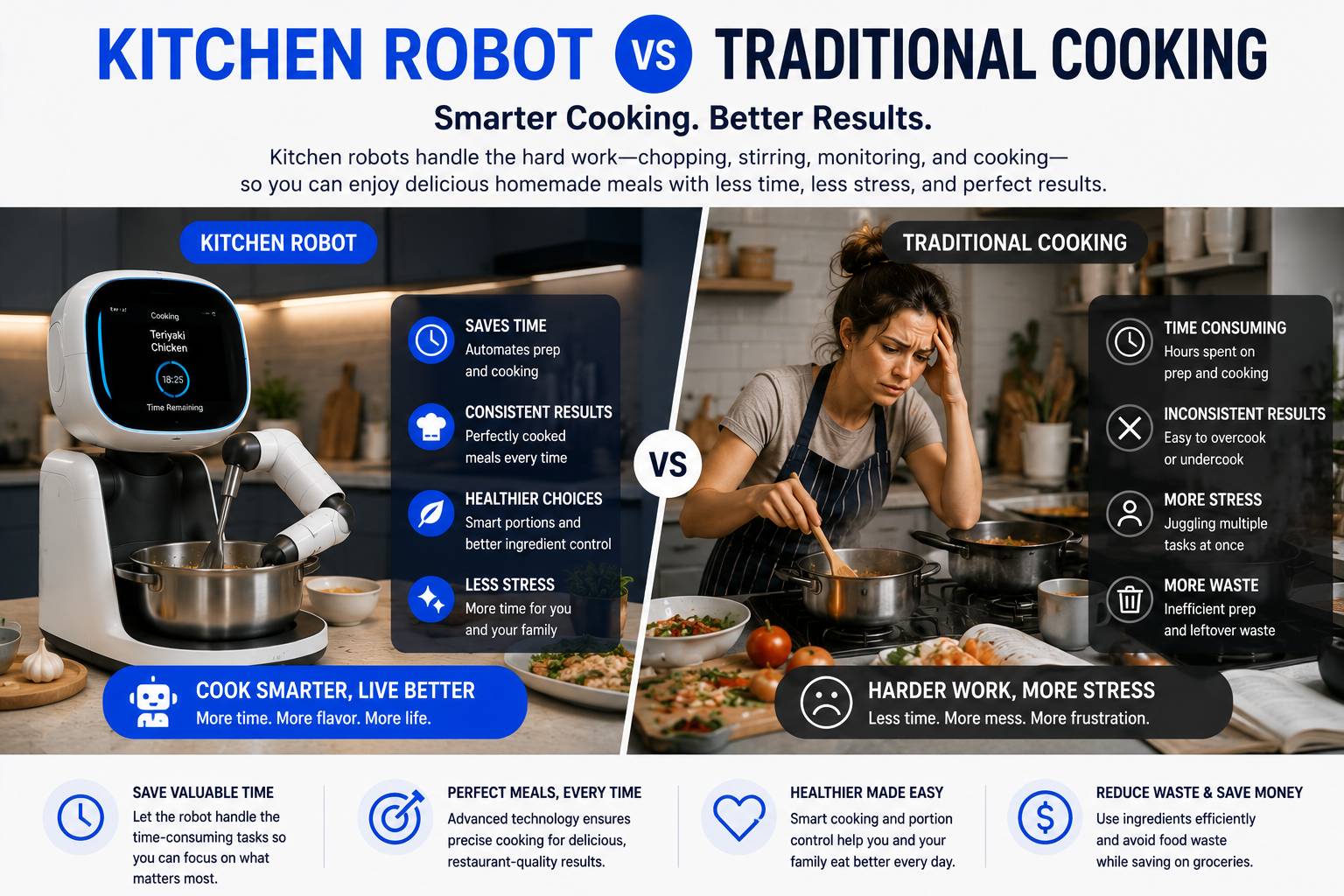
Kitchen robots are better for convenience, guided recipes, repetitive prep work, consistent results, and busy households that cook similar meals often. Traditional cooking is better for flexibility, creativity, lower upfront cost, larger meal variety, and people who enjoy hands-on cooking. For most homes, the best setup is not one or the other — it is using kitchen robots for repetitive tasks while keeping traditional cooking for meals that need judgment and creativity.
Kitchen Robot vs Traditional Cooking at a Glance
Kitchen Robot vs Traditional Cooking Comparison Table
| Factor | Kitchen Robot | Traditional Cooking |
|---|---|---|
| Convenience | Better for guided recipes, timers, automatic stirring, and repeatable meals. | Requires more manual effort, attention, and cooking knowledge. |
| Cost | Higher upfront cost, especially for advanced cooking robots. | Lower upfront cost if you already own basic cookware. |
| Meal quality | Consistent for recipes the machine handles well. | Can be better when skill, tasting, adjusting, and creativity matter. |
| Time savings | Can save time on prep, stirring, timing, and repeated recipes. | Can be faster for simple meals if you already cook confidently. |
| Cleanup | Can be easy or annoying depending on parts, blades, bowls, and dishwasher support. | Depends on cookware used, but may be simpler for basic meals. |
| Learning curve | Easier for beginners if recipes are guided well. | Requires more cooking skill and experience over time. |
| Flexibility | Limited by programs, capacity, attachments, and recipe support. | More flexible for taste, portions, ingredients, and cooking style. |
| Best for | Busy families, beginners, meal prep, repeated recipes, and convenience-focused cooks. | Experienced cooks, creative meals, budget buyers, and people who enjoy cooking. |
What Is a Kitchen Robot?
A kitchen robot is a smart cooking or meal prep device that helps automate parts of the cooking process. Some kitchen robots chop, mix, knead, stir, heat, steam, or guide recipes step by step. Others are smart appliances that focus on one cooking task, such as pressure cooking, air frying, blending, or automated stirring.
A kitchen robot does not usually replace cooking completely. It helps reduce repetitive work and make certain meals easier to prepare.
- Can reduce prep and stirring time.
- Can guide recipes step by step.
- Can help beginners cook with less guesswork.
- Can improve consistency for repeated meals.
- Can save time when used often.
- Still requires ingredients, cleaning, and supervision.
What Is Traditional Cooking?
Traditional cooking means preparing meals manually using cookware, appliances, tools, timing, taste, and cooking skill. It gives you more control over heat, seasoning, texture, ingredients, and adjustments during the cooking process.
Traditional cooking can be more flexible and creative, but it usually requires more attention and experience than using a guided kitchen robot.
- Gives more control over taste and texture.
- Works for almost any recipe or cuisine.
- Usually costs less upfront.
- Can be faster for experienced cooks.
- Allows more creativity and adjustments.
- Requires more time, attention, and skill.
Key Differences Explained
Kitchen robots automate parts of cooking. Traditional cooking depends more on your own timing and technique.
Traditional cooking gives more control. Kitchen robots give more consistency within supported recipes.
Kitchen robots cost more upfront. Traditional cooking can use basic tools you may already own.
A kitchen robot is worth more when it helps with meals you already make often.
Which Is More Convenient?
Kitchen robots are usually more convenient for guided recipes, repeated meals, prep work, automatic stirring, and temperature-controlled cooking. They can help reduce decision fatigue because the machine handles parts of the process for you.
Traditional cooking can still be more convenient for very simple meals. If you already know what you are doing, grabbing a pan may be faster than setting up a machine, choosing a program, and cleaning extra parts.
- Kitchen robots win for repeated recipes.
- Kitchen robots help with guided cooking.
- Traditional cooking can be faster for simple meals.
- Traditional cooking requires fewer device steps.
- Kitchen robots help when you dislike prep work.
- Convenience depends heavily on cleanup.
Which Costs Less?
Traditional cooking usually costs less upfront because most homes already have pots, pans, knives, cutting boards, and basic appliances. A kitchen robot can be more expensive, especially if it has cooking programs, multiple attachments, app features, or premium hardware.
However, cost is not only about purchase price. If a kitchen robot helps you cook more at home and order less takeout, it may provide value over time.
- Traditional cooking usually has lower upfront cost.
- Kitchen robots cost more initially.
- Premium robots may require accessories or replacement parts.
- Some smart features may involve subscriptions or apps.
- A robot may save money if it reduces takeout.
- Value depends on how often you use it.
Kitchen Robot vs Traditional Cooking by Need
| Your Need | Better Choice | Why |
|---|---|---|
| Weeknight convenience | Kitchen robot | Helps with repeated meals, timers, prep, and guided cooking. |
| Lowest cost | Traditional cooking | Uses basic tools and has less upfront expense. |
| Creative cooking | Traditional cooking | More freedom to adjust ingredients, heat, texture, and seasoning. |
| Beginner confidence | Kitchen robot | Guided recipes can reduce mistakes and uncertainty. |
| Meal prep | Kitchen robot | Can help with chopping, slicing, mixing, kneading, and batch cooking. |
| Special recipes | Traditional cooking | Better for meals that need judgment, technique, and flexible timing. |
Which Gives Better Results?
Traditional cooking can deliver better results when the cook has skill, experience, and the ability to adjust seasoning, texture, heat, and timing. It gives more flexibility and control.
Kitchen robots can deliver more consistent results for recipes they handle well. They are especially helpful for meals that rely on timing, stirring, controlled heat, or step-by-step instructions.
- Traditional cooking is better for creativity.
- Traditional cooking gives more control over taste.
- Kitchen robots are better for repeatable consistency.
- Kitchen robots help reduce beginner mistakes.
- Traditional cooking can be better for advanced techniques.
- Results depend on recipe type and user skill.
Which Saves More Time?
Kitchen robots can save time on chopping, mixing, kneading, stirring, timing, and guided steps. But they do not always save time on every meal. Setup and cleanup matter.
Traditional cooking can be faster for simple meals like eggs, sandwiches, salads, quick pasta, or reheating leftovers. A robot is more valuable when the recipe has repetitive steps or requires attention over time.
- Kitchen robots save time on prep-heavy meals.
- Kitchen robots help with stirring and timing.
- Traditional cooking can be faster for simple meals.
- Robot setup can reduce time savings.
- Robot cleanup can affect convenience.
- Best time savings come from repeated use.
Which Is Better for Families?
Kitchen robots can be very useful for families if they help with weeknight dinners, batch cooking, guided meals, and repeatable recipes. Families often benefit from consistency and convenience more than fancy features.
Traditional cooking may still be better when family meals require flexibility, larger portions, multiple pans, or personal cooking preferences.
- Kitchen robots help with repeated family meals.
- Kitchen robots can reduce weeknight stress.
- Traditional cooking is better for large flexible meals.
- Traditional cooking allows more customization.
- Kitchen robots need enough capacity for the family.
- Cleanup should be easy enough for daily use.
Related guide: Best Cooking Robots for Home Use.
Which Is Better for Beginners?
Kitchen robots are often better for beginners because guided recipes reduce uncertainty. Timers, temperature control, screens, and step-by-step instructions can help new cooks learn without feeling overwhelmed.
Traditional cooking is better for building long-term skill, but beginners may find it more stressful at first if they are unsure about timing, heat, seasoning, or technique.
- Kitchen robots help beginners follow steps.
- Kitchen robots reduce timing mistakes.
- Traditional cooking builds stronger cooking instincts.
- Traditional cooking offers more flexibility over time.
- Beginners may benefit from using both.
Kitchen Robot vs Traditional Cooking by Household Type
| Household Type | Better Option | Buying Tip |
|---|---|---|
| Busy families | Kitchen robot | Choose enough capacity and easy cleanup for repeated meals. |
| Experienced cooks | Traditional cooking | Manual cooking offers more control and creativity. |
| Beginners | Kitchen robot | Guided recipes can help build confidence. |
| Small apartments | Depends | Choose compact tools and avoid machines that waste counter space. |
| Budget buyers | Traditional cooking | Basic cookware is usually cheaper than a full kitchen robot. |
| Meal preppers | Kitchen robot | Prep functions can save time on chopping, mixing, and batch cooking. |
Are Kitchen Robots Worth It Compared With Traditional Cooking?
Kitchen robots are worth it compared with traditional cooking if they solve a real cooking problem. If prep work, recipe confidence, repeated meals, or weeknight time pressure keeps you from cooking at home, a kitchen robot may be valuable.
They are not worth it if you already enjoy cooking, have strong kitchen skills, cook simple meals quickly, or dislike cleaning extra parts.
- Worth it if you cook often.
- Worth it if prep work is the barrier.
- Worth it if guided recipes help you cook more.
- Worth it for repeated weeknight meals.
- Not worth it if you rarely cook.
- Not worth it if traditional cooking already works well for you.
Related guide: Are Kitchen Robots Worth It?.
Common Mistakes When Comparing Both
A robot that saves cooking time but takes too long to clean may not be worth it.
Do not buy for impressive recipes you will never make at home.
Most kitchen robots still need ingredients, setup, supervision, and cleaning.
Traditional cooking can produce better results when the cook knows how to adjust and improvise.
Final Verdict: Kitchen Robot or Traditional Cooking?
Kitchen robots win for convenience, consistency, guided recipes, and repetitive prep work. Traditional cooking wins for creativity, flexibility, lower upfront cost, and full control over results.
For most homes, the best answer is both. Use a kitchen robot when it saves real time on repeated meals, prep, or guided cooking. Use traditional cooking when you want control, creativity, and flexibility.
Related Kitchen Robot Guides
Kitchen Robot vs Traditional Cooking FAQ
Are kitchen robots better than traditional cooking?
Kitchen robots are better for convenience, guided recipes, consistency, and repetitive prep work. Traditional cooking is better for flexibility, creativity, and full control.
Do kitchen robots save time?
Kitchen robots can save time on prep-heavy meals, stirring, timing, and repeated recipes, but setup and cleanup affect the real time savings.
Is traditional cooking cheaper?
Traditional cooking is usually cheaper upfront because most homes already have basic cookware and tools.
Do kitchen robots make better food?
Kitchen robots can make consistent food, but traditional cooking can produce better results when skill, tasting, adjusting, and creativity matter.
Are kitchen robots good for beginners?
Yes, kitchen robots can help beginners by providing guided recipes, timers, temperature control, and step-by-step instructions.
Are kitchen robots good for families?
They can be good for families if they have enough capacity, simple controls, easy cleanup, and recipes that fit weeknight meals.
Can kitchen robots replace traditional cooking?
Not completely. Kitchen robots can help with many tasks, but traditional cooking is still better for flexible, creative, and skill-based meals.
What is the biggest downside of kitchen robots?
The biggest downside is that they can be expensive and may not be worth it if cleaning is difficult or the machine is not used often.
Who should choose traditional cooking?
Traditional cooking is best for experienced cooks, budget buyers, creative cooks, and people who enjoy hands-on control.
Who should choose a kitchen robot?
A kitchen robot is best for busy families, beginners, meal preppers, and people who want convenience, consistency, and less repetitive kitchen work.
We may earn a commission from qualifying purchases at no extra cost to you.